Advanced & Zygomatic
Failed Bone Graft? Implant Options That Come Next for San Antonio-Area Patients
A failed bone graft does not always end the road to implants. Here is how to spot a failure, why grafts fail, and the options that may come next for San Antonio-area patients.
You had a bone graft so your implants would have something solid to hold onto. You ate soft food, kept the follow-ups and waited. Then came the news: the graft did not take, or it took far less than planned. Maybe the site got infected and the material had to come out. Maybe a sinus lift left you with weeks of congestion. Now the question is whether implants are still possible at all. This guide is for people in San Antonio, New Braunfels, Schertz, Boerne and the surrounding area who are living with a failed bone graft and want to understand the implant options that come next: what failure looks like, why it happens, when grafting again makes sense, and when a plan built on the bone you already have may be the better path.
Regional Implant Centers has no office in San Antonio. Our two offices are in Hutto, in the Austin metro, and in Katy, on the west side of Houston. If you are weighing the upper-jaw choices in depth, our comparison of a sinus lift vs. zygomatic and pterygoid implants walks through each path. This article stays with the moment after a graft has not worked, and with the decisions that follow it.
The short answer
A failed bone graft does not automatically close the door on implants. Once infection has cleared and the site has healed, the next step is a fresh 3D scan and a clear explanation of why the graft failed. From there the usual paths are grafting again with something changed, placing implants where bone already exists, anchoring implants beyond the upper jaw, or choosing a removable implant overdenture.
Which one fits depends on how much bone is left and where, what went wrong the first time, your health and how many more surgeries you are willing to go through. Some mouths are not good candidates for fixed teeth after repeated failures, and an honest team will tell you that too.
What a failed graft can look like
Some failures are obvious: pain, swelling or drainage that gets worse instead of better. Others are quiet and only show up on a scan months later, when there is less new bone than the plan needed.
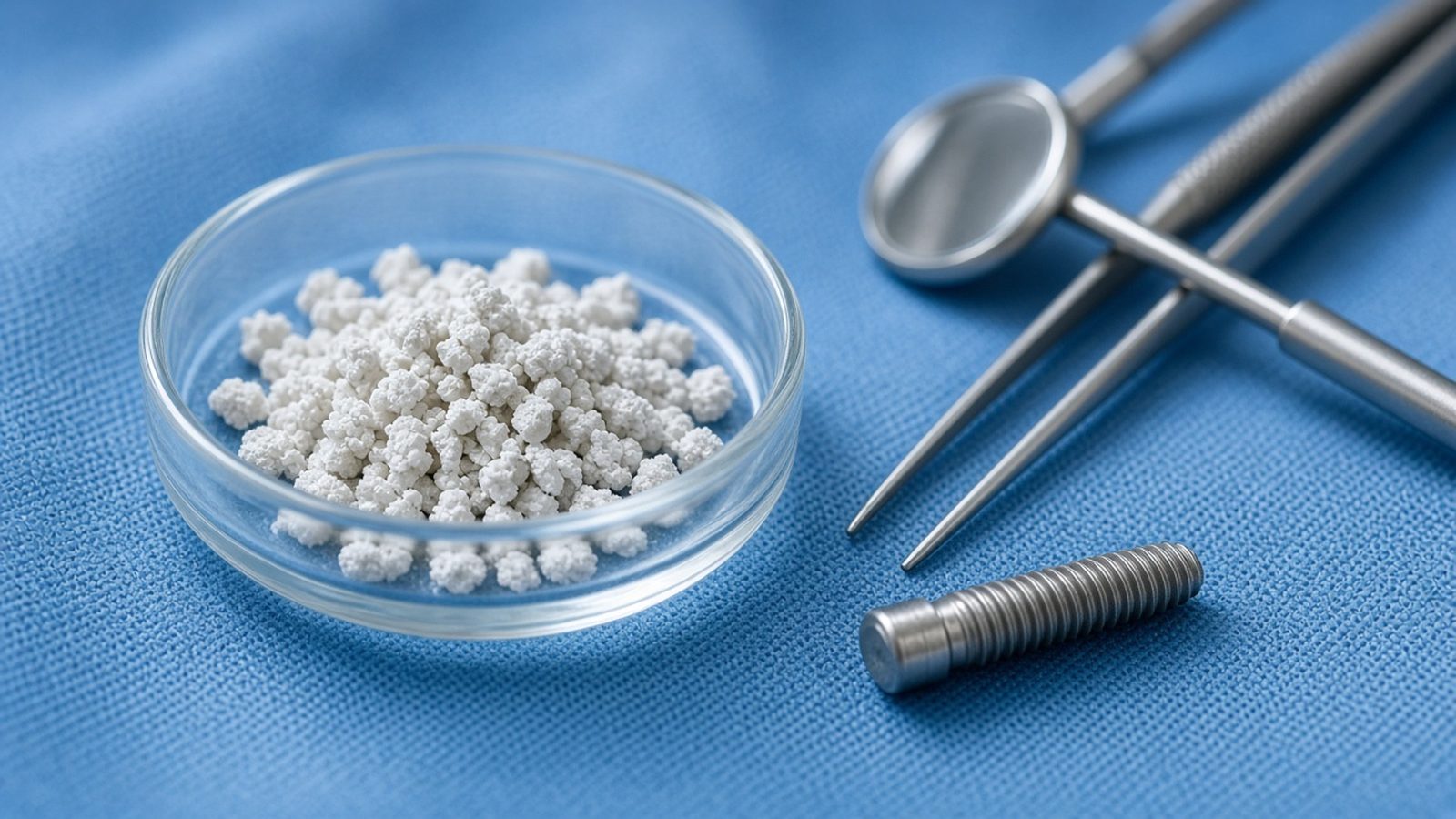
Cleveland Clinic lists the signs of a failing dental bone graft as pain or swelling that worsens after the first week, pus or drainage from the site, gum recession, and no improvement in jawbone volume. It also notes that in the first few days, small particles that look like grains of sand or salt can come out of the site. That is usually normal. Losing a large amount is not, and your surgeon should hear about it.
Another pattern is exposure: the gum opens and the protective membrane or graft material shows through. A 2022 review in Periodontology 2000 found this is the most common complication of bone grafting in the mouth. Depending on how much is exposed and whether infection is present, care ranges from antiseptics to removing the membrane or graft.
In the upper back jaw, a sinus graft can fail in its own way. An expert consensus on infections after sinus lift surgery put their incidence at roughly 2 to 5.6 percent. Symptoms that last beyond about three weeks, such as nasal obstruction, pain, discharge from the nose or throat, or the gum reopening, point to an infection that may need more than medication, sometimes including partial or complete removal of the graft.
"Failed" also comes in degrees. A graft can be lost entirely, heal with enough bone for some implants but not where they were planned, or look fine at first and then shrink. Each one leads to a different conversation.
When to call right away. Cleveland Clinic advises calling your provider for a fever of 101 degrees Fahrenheit or higher, increasing swelling, pus around the graft site or severe pain. In the San Antonio area, call the surgeon who placed the graft or a local dental office first rather than waiting for a visit in Hutto or Katy. Trouble breathing or swallowing, or swelling that spreads quickly, means calling 911 or going to the nearest emergency room.
Why bone grafts fail
Most graft failures trace back to a few causes: the wound opening over the graft, infection, health factors such as smoking or uncontrolled diabetes, pressure on the healing site, or a defect that was hard to rebuild in the first place. Naming the cause shapes every decision after it.
This is not about blame. Some grafts fail even when everything is done well. But a second attempt that repeats the same conditions tends to meet the same result.
- The wound opened. The 2022 review points to surgical factors such as careful flap handling and closing the gum over the graft without tension. When the tissue cannot cover the graft, bacteria reach it.
- Smoking and health. The same review found fewer reported complications in compliant patients, such as nonsmokers. The U.S. Food and Drug Administration (FDA) makes a similar point about implants: smoking may affect healing, and infection may be more likely with uncontrolled diabetes. The American Association of Oral and Maxillofacial Surgeons (AAOMS) adds that graft healing varies with where the bone came from, where it was placed and your overall health.
- Pressure on the site. A denture or temporary bridge pressing on a healing graft can disturb it, which is why surgeons often adjust or limit what you wear while it heals.
- The size and shape of the defect. Rebuilding lost height is demanding. In randomized trials in the back of the lower jaw, vertical grafting carried more complications than short implants placed without a graft, as covered below.
- The sinus itself. The sinus consensus lists a healthy maxillary sinus as part of proper patient selection. Chronic sinus problems before a lift can affect how it heals.
Before anything else: heal, then re-scan
Give the area time to heal completely, clear any infection, and then get a new 3D scan. A plan built on a scan from before the failed graft, or on tissue that is still inflamed, rests on the wrong picture.
How long to wait is a clinical call. After a sinus graft infection that needed surgery, the consensus panel said a new sinus procedure is possible once a CT scan, and preferably an ear, nose and throat (ENT) evaluation, confirms complete healing, which takes six to nine months on average. Smaller sites may be ready sooner. Going back in too early risks a second failure in the same spot.
Meanwhile, collect your history. Ask the office that did the graft for the operative notes (which graft material and membrane were used, and whether implants went in at the same time), any 3D scans from before and after, and a record of what happened afterward. Our guide to getting a second opinion before full-arch surgery explains how to request scans and records under Texas rules, so we will not repeat it here.
Bring your health into the picture as well. If smoking, blood sugar control or a medication may have played a part, your physician's input matters before another surgery. Our dental clearance service already shares records and summaries with physicians when requested and authorized.
The new cone beam CT (CBCT) scan does the heavy lifting. It shows how much bone is left and where, the condition of the sinuses and the path of nerves in the lower jaw, and that map decides which options are even on the table.
Option 1: Graft again, with something changed
A second graft can make sense when the cause of the first failure is understood and fixable, and when the bone you need cannot be reached another way. The most useful question to ask is what will be different this time.
Surgeons have more than one way to rebuild bone. AAOMS describes graft material taken from your own body, from a human or animal donor, or made synthetically, along with membranes that can dissolve on their own or need removal, and titanium mesh for more complicated defects. A changed plan might use a different material or membrane, rebuild in smaller stages, treat the gum tissue first, or wait until smoking or blood sugar is under control.
The cost is time and surgery. Cleveland Clinic notes that a graft needs at least three months to heal and that a large one can take nine to 12 months, before implants and their own healing begin. From San Antonio, every stage means more trips. The 2022 review also offers a sensible rule of thumb: whenever possible, it appears prudent to choose less invasive interventions.
Our Hutto office performs bone grafting and sinus procedures. Our bone and tissue reconstruction page lists previous implant complications among the reasons a patient may need it, describes staged reconstruction when needed, and says plainly that reconstruction is not required for every patient. For the basics of why grafting comes up at all, see why bone grafting may be needed before dental implants.
Option 2: Use the bone you already have
Many full-arch plans can be built around existing bone by changing where implants go, how they are angled or how long they are, rather than rebuilding the jaw first.
This is the thinking behind All-on-X. Implants do not have to sit where your old teeth were. Angling the back implants lets them reach firmer bone in front of the sinus in the upper jaw, or in front of the nerve in the lower jaw, while the bridge still spreads support across the arch, and the number of implants is chosen for your anatomy rather than fixed at four.
In the back of the lower jaw, a nerve runs through the bone, and a shrunken ridge may leave too little height above it for a standard implant. A 2021 meta-analysis in the International Journal of Oral and Maxillofacial Surgery pooled eight randomized trials comparing short implants, 7 mm or less, with vertical grafting followed by regular implants in that area. Survival was comparable through the first five years, and complications were less likely with short implants. The short implants also had far less length anchored in bone, which is one reason longer follow-up still matters. The authors concluded that patients who are fit for surgery should be told the risks and benefits of both options.
The limit of this approach is simple: the implants still need solid bone somewhere. If the front of the jaw is thin as well, tilting has nothing to anchor into, and the bridge may carry fewer back teeth or extend past the last implant. Your prosthodontist weighs that against your bite.
Option 3: Anchor beyond the upper jaw
In the upper jaw, when grafting has failed and little bone remains, zygomatic implants anchored in the cheekbone or pterygoid implants anchored behind the last molar can support a fixed bridge without another graft. They are advanced procedures with their own risks.
The International Team for Implantology (ITI) recognizes zygomatic implants as an alternative when upper-jaw bone is partly or completely missing because earlier implants or bone grafts failed. Be aware that this particular statement rests on a small body of evidence, six articles covering 34 patients plus expert opinion, so it is a recognized rescue path, not a guaranteed one. The ITI also says success depends heavily on the clinician's skill and experience, that both surgical and restorative expertise are needed, and that planning should include a CT or CBCT of the midface and a check for existing sinus disease. After a failed sinus graft, that sinus check carries extra weight.
Our sinus lift vs. zygomatic implants guide covers how each works, the published survival figures and the risks, including sinus problems and temporary numbness, so read it before your consultation.
Regional Implant Centers offers both zygomatic and pterygoid implants. They are performed by Dr. Dan Holtzclaw, a board-certified Diplomate of the American Board of Periodontology who earned his dental degree at the University of Texas Health Science Center San Antonio, and Dr. Enrique Tabarini, an oral and maxillofacial surgeon, and only when imaging and evaluation show they are a sound fit.
Option 4: A removable implant overdenture
A snap-on overdenture needs fewer implants, can use the spots where bone is strongest, and comes out for cleaning. After repeated failures, it can be the steadier choice.
A fixed bridge is not the only good outcome. For many people an overdenture that clips onto a few implants is much steadier than a conventional denture, asks less of the jaw and can often be adapted if an implant later has trouble. Both of our offices offer traditional dentures, snap-on implant overdentures and fixed full-arch teeth, so the recommendation can follow your anatomy rather than a single product. Our comparison of All-on-X, implant dentures and traditional dentures lays out the trade-offs.
The four paths side by side
Each option trades time, surgery and long-term upkeep differently. Use this as a starting point for your consultation, not a substitute for one.
| Path | Tends to fit when | What it asks of you |
|---|---|---|
| Graft again, changed | The cause is known and fixable, and implants need bone in that exact spot | More surgery and months of healing before implants |
| Use existing bone | Solid bone remains in part of the jaw | Implants in new positions or lengths; sometimes a shorter bridge |
| Zygomatic or pterygoid (upper jaw only) | Little upper-jaw bone is left and the sinuses are healthy | Complex surgery, an experienced team and more maintenance |
| Implant overdenture | Bone or health cannot support a fixed bridge, or you want fewer implants | A removable appliance you take out to clean |
After more than one failed procedure
When a site has failed twice, repeating the same plan a third time deserves a hard look. The better question is whether the cause was found, and whether a different strategy avoids the problem altogether.
Repeated surgery takes a toll on bone, gum tissue and patience. Before another attempt, ask these questions wherever you are being treated:
- What do you think caused each failure, specifically?
- What will be different in this plan?
- Can implants be placed without grafting this area?
- If this attempt fails, what is plan B?
- How many surgeries and how many months does each option involve?
- Who designs the final teeth, and has that person reviewed the plan?
If the problem is an implant that failed after it was placed, rather than the graft before it, our guide to All-on-4 implant failure covers when an implant can be saved and how a full-arch revision is staged. If you have been told implants are off the table entirely, start with our article for patients told they are not candidates for dental implants.
Planning from San Antonio
Start with a phone consultation and your records. If an exam makes sense, most of the San Antonio area is closer to our Hutto office, and the number of trips depends heavily on whether your plan includes another graft.
From San Antonio, New Braunfels and Schertz, the drive to Hutto runs up the I-35 corridor through San Marcos, and some drivers use the SH 130 toll road to stay east of central Austin. Our Katy office sits off I-10, a straight run east from Boerne or San Antonio. Our guide to traveling from San Antonio for full-mouth implants covers surgery-day logistics, including why you need a responsible adult to drive you home after sedation.
The plan you choose changes the travel. A staged regraft adds a surgery and a healing period before implants even begin, each with its own checkups. A plan built on existing bone, or on zygomatic or pterygoid implants, may involve fewer surgical stages, though not always fewer visits. Every full arch also needs maintenance for years: after your final teeth are delivered, a Maintenance Package is required, and those visits take place at Regional Implant Centers unless your written agreement says otherwise. Weigh those years of driving, not just the surgery.
Keep your San Antonio dentist in the loop, because if something urgent happens between visits, local care comes first.
How our team approaches a failed graft
We start with the teeth you need and a fresh scan, then weigh every path together, including the ones that skip another graft and the ones that come out at night.
Under our RISE Protocol, a prosthodontist maps out your bite, facial support, speech and future teeth before surgery begins, and the surgical team then decides how to support them. Our CBCT imaging shows bone volume, nerve pathways and sinus position, and the SegMark Workflow combines that scan with intraoral scans, bite records and facial references into one plan the specialists review together. Our full-mouth implants page describes a model built for patients who have been told they are not candidates, and our team frequently evaluates patients who need failed treatment from elsewhere corrected. We cannot promise a different answer, only a careful one.
Our Hutto office has CBCT imaging, performs bone grafting and sinus procedures, and has an on-site anesthesia provider who is a dentist anesthesiologist. Depending on your plan, anesthesia options may include IV sedation or general anesthesia, with monitoring throughout. Our Katy office is home to our in-house lab, where technicians work beside the surgical and restorative team on your final teeth.
When fixed teeth are planned and the implants are stable, many qualifying patients leave surgery with a fixed temporary bridge the same day; final teeth follow once healing is verified, and grafted cases usually take longer. We do not offer a traditional implant warranty that promises lifetime success, because outcomes depend on biology, healing, hygiene and follow-up care. Our implant warranty page explains what protects you instead.
Before treatment begins, you receive a written plan with the recommended care, estimated insurance benefits, financing options and your expected out-of-pocket cost. Our Insurance Advantage team reviews dental and medical benefits, though coverage is never guaranteed, and our financing page lists independent lenders that set their own terms. Not every case can be treated with fixed teeth, and if yours cannot, we will say so.
Frequently asked questions
How do I know if my bone graft failed? Warning signs include pain or swelling that gets worse after the first week, pus or drainage, gum pulling back from the site, graft material showing through the gum, or a scan that shows little new bone. A few sand-like particles in the first days are usually normal. Only an exam and imaging can confirm a failure.
Can a failed bone graft be redone? Often, yes, once any infection has cleared and the site has fully healed. A second attempt makes the most sense when the cause of the first failure is understood and something will be done differently, such as a different technique, staging or better control of smoking or blood sugar.
Can I get dental implants without another bone graft? Sometimes. Tilted implants can use existing bone, short implants may avoid vertical grafting in the back of the lower jaw, and in the upper jaw zygomatic or pterygoid implants can anchor beyond the thin bone. A removable implant overdenture is another option. A new 3D scan decides which, if any, fit.
Can zygomatic implants be used after a failed sinus lift? They can be an option. The International Team for Implantology recognizes zygomatic implants as an alternative when upper-jaw bone is missing because earlier grafts or implants failed. Your sinus needs to be healthy first, so expect a new scan and possibly an ENT evaluation before surgery.
Do you have an office in San Antonio? No. Our offices are in Hutto and Katy, and Hutto is the shorter drive for most of the San Antonio area. You can start with a phone consultation from home, and an in-person exam with 3D imaging happens at either office.
Talk with our team about what comes next
If you are in San Antonio, New Braunfels, Schertz, Boerne or nearby and a bone graft has not gone the way you hoped, the first step does not require a drive. Schedule a consultation by phone or in person, choosing Hutto or Katy, or call (832) 632-7037. Have your operative notes, scans and medication list ready. Qualified patients receive a complimentary consultation, advanced CBCT scan and insurance benefits evaluation, and by the end of the appointment you will have a clear understanding of your next steps.
Sources & Resources
- Cleveland Clinic: Dental Bone Graft
- American Association of Oral and Maxillofacial Surgeons: Bone Grafting and Membranes
- U.S. Food and Drug Administration: Dental Implants: What You Should Know
- Sanz-Sanchez I, Sanz-Martin I, Ortiz-Vigon A, Molina A, Sanz M. Complications in bone-grafting procedures: Classification and management. Periodontology 2000, 2022;88(1):86-102.
- Testori T, Drago L, Wallace SS, et al. Prevention and treatment of postoperative infections after sinus elevation surgery: clinical consensus and recommendations. International Journal of Dentistry, 2012;2012:365809.
- Terheyden H, Meijer GJ, Raghoebar GM. Vertical bone augmentation and regular implants versus short implants in the vertically deficient posterior mandible: a systematic review and meta-analysis of randomized studies. International Journal of Oral and Maxillofacial Surgery, 2021;50(9):1249-1258.
- International Team for Implantology: Indications for Zygomatic Implants, Consensus Statements
This article is general education, not a diagnosis or treatment recommendation. Whether a graft can be redone, which implant plan fits, and the timeline and cost depend on an individual clinical evaluation. Same-day teeth are temporary and offered only to qualifying patients. Insurance coverage is never guaranteed, and financing is provided by independent third-party companies. Regional Implant Centers has offices in Katy and Hutto, Texas only, and no office in San Antonio.
Ready to Learn What Is Possible?
Schedule a consultation with Regional Implant Centers.
Schedule ConsultationFrequently Asked Questions
How do I know if my bone graft failed?
Warning signs include pain or swelling that gets worse after the first week, pus or drainage, gum pulling back from the site, graft material showing through the gum, or a scan that shows little new bone. A few sand-like particles in the first days are usually normal. Only an exam and imaging can confirm a failure.
Can a failed bone graft be redone?
Often, yes, once any infection has cleared and the site has fully healed. A second attempt makes the most sense when the cause of the first failure is understood and something will be done differently, such as a different technique, staging or better control of smoking or blood sugar.
Can I get dental implants without another bone graft?
Sometimes. Tilted implants can use existing bone, short implants may avoid vertical grafting in the back of the lower jaw, and in the upper jaw zygomatic or pterygoid implants can anchor beyond the thin bone. A removable implant overdenture is another option. A new 3D scan decides which, if any, fit.
Can zygomatic implants be used after a failed sinus lift?
They can be an option. The International Team for Implantology recognizes zygomatic implants as an alternative when upper-jaw bone is missing because earlier grafts or implants failed. Your sinus needs to be healthy first, so expect a new scan and possibly an ENT evaluation before surgery.
Do you have an office in San Antonio?
No. Our offices are in Hutto and Katy, and Hutto is the shorter drive for most of the San Antonio area. You can start with a phone consultation from home, and an in-person exam with 3D imaging happens at either office.
This content is educational and not a substitute for a consultation.