Full-Mouth Rehabilitation
Failing Crowns and Bridges: When Replacing Them One at a Time Stops Making Sense. A Guide for Austin-Area Patients
When old crowns and bridges keep failing, the next repair is not always the right one. How Austin-area patients can tell when to fix a tooth or plan the arch.
If you have a mouth full of older dental work, you probably know the rhythm. A crown comes loose, a bridge starts to rock or smell, a tooth that already had a root canal flares up again, and each time the answer is one more appointment for one more tooth. Failing crowns and bridges are usually repaired one at a time, and often that is the right call. But there comes a point where the next repair is no longer the best use of your time, your money or the teeth you have left. This guide explains why crowns and bridges fail, when fixing them tooth by tooth still makes sense, and which signs suggest it is time for Austin-area patients to look at the whole arch.
A quick note on terms. In this article, "bridge" always means a dental bridge: a row of artificial teeth held in place by crowns on neighboring teeth or, in the implant version, by dental implants. A full-arch bridge, also called a full-arch prosthesis, replaces every tooth in the upper or lower jaw.
The short answer
Repairing failing crowns and bridges one at a time makes sense when the problem is isolated, its cause is under control and the surrounding teeth have a good long-term outlook. It stops making sense when several anchor teeth in the same arch are failing, when each new repair would depend on teeth that are themselves in doubt, or when the cause of the failures cannot be controlled.
Most people with old dental work do not need full-arch implants. The American Academy of Periodontology (AAP) says that treating and maintaining a natural tooth is preferable whenever possible, and that patients should hear the full range of options, with their risks and benefits, before considering extraction. What changes the decision is the pattern of failures, not just the latest one. When that pattern points to an arch that will not hold together much longer, the question shifts from "how do I fix this tooth?" to "what is the most predictable plan for this jaw?" Finding the pattern is what a careful evaluation is for.
Why crowns and bridges fail
Most crowns and bridges fail because of what happens to the tooth underneath, not because the porcelain or metal wore out. New decay at the edge of a crown, a lost nerve or failed root canal, a cracked root and cement that washes out are the usual causes.
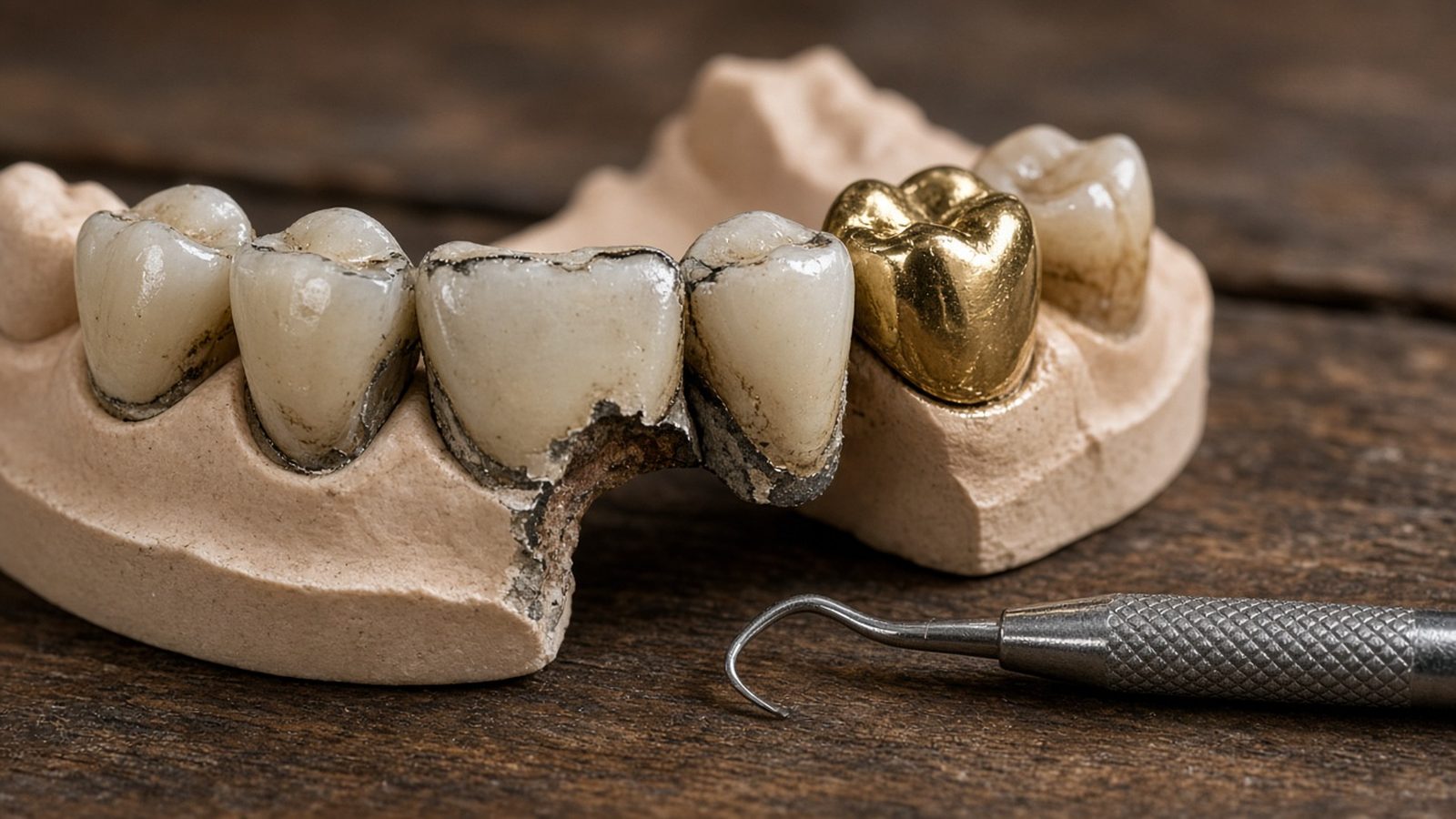
A crown covers a tooth. It does not make that tooth immune to problems. The weak spot is the margin, the seam where the crown meets the natural tooth near the gumline. Plaque that sits along that seam can start new decay that spreads under the crown, where neither you nor a quick glance can see it. By the time a crown feels loose or a dark line shows at the gum, the tooth underneath may have lost a lot of structure.
The other common problems:
- A lost nerve or a failed root canal. Teeth that have been drilled for crowns, sometimes more than once, can lose their nerve years later. A root canal can often save the tooth, but some root-canal-treated teeth become infected again.
- Cracks and root fractures. Heavily restored teeth have less natural structure left. A crack that runs down the root usually means the tooth cannot be kept.
- Loss of retention. The cement seal fails and the crown or bridge comes loose. Sometimes it can simply be recemented. Often the reason it came loose, such as decay, a short tooth or heavy biting forces, is still there.
- Gum and bone loss. When the gums and bone around anchor teeth recede, those teeth can loosen even if the crowns look fine.
- Material fractures. Porcelain can chip and frameworks can break, especially in people who clench or grind.
The research lines up with this. A systematic review by Tan and colleagues in Clinical Oral Implants Research pooled 19 studies of tooth-supported bridges followed for at least five years. The estimated 10-year survival was 89.1 percent, but only 71.1 percent were free of complications over the same period. The 10-year risk of losing a bridge to decay was 2.6 percent, and the risks of the bridge coming loose, an anchor tooth fracturing and the material fracturing were 6.4, 2.1 and 3.2 percent. Put plainly: most bridges last a decade, a fair number need attention along the way, and the trouble tends to start in the teeth holding them up.
Why one failing anchor tooth can take a whole bridge with it
A traditional bridge is one connected piece, so it is only as reliable as its weakest anchor tooth. When one anchor fails, the bridge usually has to come off, and the replacement often needs more teeth or a different approach.
Picture a three-tooth bridge: crowns on two anchor teeth with a false tooth, called a pontic, between them. If decay gets under one anchor crown, the dentist usually cannot treat it without cutting the bridge off. If that tooth can be rebuilt, a new bridge can be made. If it cannot, there is now a two-tooth gap where there used to be one missing tooth, and a new tooth-supported bridge would have to reach farther and lean on teeth that may not be up to the job.
This is how many mouths drift from a couple of bridges to a much bigger problem. Each replacement asks a little more of the teeth that remain, and longer spans put more load on fewer anchors. Over the years, a person can end up with crowns on nearly every remaining tooth, root canals in several of them and bridges linked together in ways that make any single repair complicated.
Implants change one part of this chain. An implant-supported bridge does not rely on natural teeth for support, so a failing neighbor does not take it down. That does not make implants trouble-free, as we cover below.
Find the cause before you choose the fix
Before deciding between another crown, an implant or a full arch, ask why the earlier work failed. If the cause is still active, the next restoration, implant or not, will face the same conditions.
Failed dental work usually has a reason, and the reason is often not the dentist who did it. Common ones:
- Dry mouth. Saliva helps protect teeth from decay. The National Institute of Dental and Craniofacial Research notes that hundreds of medicines can reduce saliva, including some for high blood pressure, depression and bladder control, and that persistent dry mouth raises the risk of tooth decay. If you started new medicines in the last few years and now have decay under several crowns, mention it.
- Diet and cleaning access. Frequent sugary drinks or snacks feed decay at crown margins, and bridges are harder to clean underneath than single teeth. Floss threaders, water flossers and small brushes matter more once a mouth has a lot of bridgework.
- Heavy biting forces. Clenching and grinding crack teeth, chip porcelain and break down cement. If you have a history of broken crowns, ask whether a night guard has ever been discussed.
- Gum disease. Bone loss around anchor teeth undermines even well-made bridges.
- The original design. Sometimes a bridge was asked to do too much, such as spanning a long gap or holding a false tooth supported on one side only (a cantilever).
The cause matters in both directions. If it can be controlled, keeping and restoring teeth becomes more realistic. If it cannot, implants are not an automatic way out. The AAP points out that implants do not get tooth decay but can still lose gum and bone support, and that they require diligent home care and regular dental visits. Implants take decay off the table. They do not take maintenance off the table.
When fixing one tooth at a time still makes sense
One-at-a-time repair is usually reasonable when most teeth in the arch have a good long-term outlook, the failing crown or bridge is an isolated problem and the cause has been found and addressed.
Situations where a targeted fix is often the sensible choice:
- A crown came loose and the tooth underneath is sound. Recementing it or making a new crown may be all you need.
- One anchor tooth of a bridge has failed, but the rest of the arch is healthy. A single implant, or an implant-supported bridge for that short span, can replace the missing teeth without asking more of the neighbors.
- A root-canal-treated tooth has a problem that can be retreated, and the tooth has enough structure left to be worth restoring.
- The porcelain chipped on an otherwise stable bridge. Small chips can sometimes be smoothed or repaired.
Our general dentistry page puts the principle simply: "Our goal isn't simply to replace teeth. Whenever possible, it's to help you keep your natural teeth healthy for life." That is the right starting point. Removing a tooth that could have served you for years is a trade you cannot take back.
Signs that one-at-a-time repair has stopped making sense
The tipping point is a pattern, not a single failure: several anchor teeth in one arch failing at once, repairs that depend on questionable teeth, failures that keep coming back for the same reason, or a bite that is breaking down.
Patterns that suggest it is time to step back and look at the whole arch:
- Several anchor teeth are failing at the same time. Decay under multiple crowns, more than one cracked root or repeated root canal problems in the same jaw.
- The next fix depends on teeth that are themselves in doubt. If a new bridge would have to anchor on a tooth with a questionable root canal or very little structure left, the new work may inherit the old problem.
- The same failure keeps coming back. Crowns that keep coming loose, or decay that returns under new crowns within a few years, point to a cause that tooth-by-tooth work is not fixing.
- Your bite is changing. Teeth drifting into gaps, front teeth flaring or spreading apart, or a sense that your teeth no longer meet the way they used to can mean the back teeth no longer support your bite.
- You cannot chew comfortably on either side. When you are steering food around several sore or loose teeth, the problem is no longer one tooth.
- Every plan you are offered is a long list of separate procedures on nearly every tooth, such as posts, crowns, root canals and new bridges, and the dentist is honest that several of those teeth are questionable.
None of these signs on its own means teeth must come out. They mean the question has changed to "what will be most predictable for this arch over the next ten years?" Being worn out by dental visits is understandable, but on its own it is not a reason to remove teeth that could last.
The options between one tooth and a full arch
There is a lot of ground between repairing one tooth and replacing every tooth in a jaw. A good plan should at least consider implant-supported bridges for one section, keeping strategic healthy teeth, partial dentures, snap-on overdentures and staged treatment.
- An implant-supported bridge for one section. If the failing teeth are grouped in one area, a few implants can carry a bridge across that section while healthy teeth elsewhere stay.
- Keeping strategic teeth. Healthy teeth in key positions can sometimes be kept and protected while failing teeth around them are replaced. Bridges that connect a natural tooth to an implant have generally done less well than bridges carried only by implants: a review by Lang and colleagues found lower survival for combined tooth-and-implant bridges, so planners usually keep natural teeth and implants separate.
- A removable partial denture. Less involved than implant treatment, though many people find the clasps and the daily removal inconvenient.
- A snap-on implant overdenture. A removable denture that clips onto a small number of implants, for more stability than a denture resting on the gums.
- Fixed full-arch teeth (All-on-X). A fixed full-arch bridge carried by several implants that replaces every tooth in the jaw.
- Staged treatment. Stabilizing the most urgent problems first and making bigger decisions later, once infection is cleared and the cause of the failures is under control.
Which of these fits depends on how many teeth have a good outlook and where they sit, your bone, your bite, your health, how well you can clean and what you want. Our article on why full-mouth rehabilitation requires more than implants explains why the bite and the final teeth should drive that choice.
What full-arch replacement changes, and what it does not
Replacing a failing arch with implant-supported teeth ends the cycle of decay under crowns, but it starts a different kind of upkeep. Implants and full-arch bridges can still develop gum and bone problems, loose screws and chipped or broken teeth, and they need maintenance for life.
Research on implant bridges gives an honest picture. In a systematic review by Pjetursson and colleagues, an estimated 86.7 percent of implant-supported bridges were still in place after 10 years, but only 61.3 percent of patients had been free of any complication after five years. Screw loosening or fracture affected 7.3 percent of bridges and veneer or framework fractures 14 percent within five years. That review looked at partial implant bridges rather than full arches, but the lesson carries over: implant work is not something you place and forget.
Other things to weigh before choosing a full arch:
- It is permanent. Extractions cannot be reversed, and full-arch surgery often includes reshaping bone.
- It needs care. The FDA advises carefully following your hygiene instructions, keeping regular visits and telling your dental provider right away if an implant feels loose or painful.
- Your health matters. The FDA notes that overall health affects candidacy and healing, and that smoking may affect healing and decrease long-term success.
- Temporary teeth come first. Many patients are able to leave surgery with fixed temporary teeth the same day, when the treatment plan allows it, and the final teeth are made after healing.
At Regional Implant Centers, we do not offer a traditional implant warranty. Long-term care comes through a required Maintenance Package, with enrollment beginning within 30 days of final prosthesis delivery, and as our implant warranty page explains, there is no guarantee that implants or prosthetics will never need adjustment, repair or replacement. Our article on how to avoid failed implant dentistry and costly mistakes covers more of what to look for in a plan.
Make a timeline of your dental work before your consultation
A simple list of each crown, bridge and root canal, with roughly when it was done and what has gone wrong since, is one of the most useful things you can bring. It shows a pattern that a single X-ray cannot.
Set aside 20 minutes and go area by area: upper right, upper front, upper left, then the same for the lower jaw. For each area, write down:
- What was done: crown, bridge, root canal, post, implant or extraction.
- Roughly when it was done.
- What has happened since: came loose, broke, new decay, infection, retreatment or pain.
- Anything that changed in your health around the same time, especially new medicines.
Add any X-rays or scans you can get from your current dentist. A timeline like this helps the team see whether failures cluster in one area or one stretch of years, and whether the cause is still present.
Questions to ask before your next crown or bridge
Good questions look at the next ten years, not just the next repair. Ask what failed and why, what is likely to fail next and how each option would handle it.
- Why did this crown or bridge fail, and is that cause still present?
- Which teeth would hold the next bridge, and what is the long-term outlook for each one?
- If I repair this now, which tooth in this arch is most likely to need work next?
- If one part of the new plan fails later, what happens to the rest? Can it be repaired, or would it all need to be redone?
- What would a staged plan look like, starting with the most urgent problems?
- If a full arch is recommended, why can my healthier teeth not be kept, and what would maintenance look like?
If the answers point to keeping your teeth, that is good news. If they point to an implant plan, you will understand why.
How our Hutto team evaluates failing dental work
At Regional Implant Centers, an evaluation of failing crowns and bridges starts with your dental history, a 3D scan and a plan for the final teeth that is made before any surgery is planned. Our Hutto office offers CBCT imaging, bone grafting and sinus procedures, and has a dentist anesthesiologist on site.
We care for adults with failing teeth, missing teeth, advanced periodontal disease, failing dental work and complex dental conditions, and we frequently evaluate patients who need correction of treatment done elsewhere. Under our RISE Protocol, the evaluation covers overall oral health, bone structure, bite relationship, facial anatomy, medical history, airway considerations and long-term goals. Your prosthodontist then "maps out bite, facial support, speech, and the long-term plan for your new teeth before surgery begins." Our article on how prosthodontists design implant-supported teeth explains that role, and why final teeth should guide oral surgery planning explains why the plan is built in that order. If keeping and restoring your teeth is the more predictable path, your plan should say so.
Our CBCT imaging lets the team study bone volume, nerve pathways, sinus position and jaw anatomy, which matters when judging whether a failing root is worth keeping and where an implant could go. Our implant treatment ranges from single tooth implants and implant-supported bridges to full arch care, as our dental implant surgery page describes, and both of our offices offer traditional dentures, snap-on implant overdentures and fixed full-arch teeth. When bone needs rebuilding, the Hutto office does grafting and sinus work; our article on why bone grafting may be needed before dental implants explains when. For severe upper-jaw bone loss, Dr. Dan Holtzclaw and Dr. Enrique Tabarini perform zygomatic and pterygoid implants in selected cases; they are not right for everyone. Our in-house lab is at our Katy office.
On surgery day, the oral surgeon focuses on the surgery while a dedicated anesthesia provider focuses on your safety, comfort and monitoring, as our anesthesia and patient comfort page describes.
Before any treatment begins, you receive a detailed written plan outlining the recommended care, estimated insurance benefits, financing options and your expected out-of-pocket investment. Our Insurance Advantage team reviews your dental and medical benefits. When medical insurance applies, it is billed only for surgical professional services such as extractions and bone grafting; implants, temporary teeth and the final prosthesis are billed to you. Coverage is never guaranteed, so please verify your own benefits. Financing is offered through independent third-party companies.
Visiting our Hutto office
Our Hutto office is at 201 E Wilco Hwy, Suite 203, and serves patients from Hutto, Round Rock, Pflugerville, Georgetown and across the Austin area. We do not have offices in those other cities.
Office hours are Monday through Thursday, 8 AM to 5 PM, with Fridays reserved for surgery, and our Hutto location page has directions. If you would like to talk through your dental history before making the drive, you can start with a phone consultation.
Bring your dental work timeline, any recent X-rays or scans, a list of your medicines and doctors, and your dental and medical insurance cards.
Frequently asked questions
Can a failing dental bridge be replaced with implants? Often, yes. If an anchor tooth has failed, the bridge can sometimes be replaced with a single implant or an implant-supported bridge that does not rely on neighboring teeth, as long as your bone, bite and health allow it. If the other teeth are healthy and the failure was mechanical, a new tooth-supported bridge may also be reasonable. A clinical exam and 3D imaging decide which fits.
How long do crowns and bridges usually last? It depends on the tooth underneath, your cleaning, your bite and your health. In a systematic review of tooth-supported bridges followed for at least five years, about 89 percent were estimated to still be in place at 10 years, though fewer were free of all complications. Many problems start in the anchor teeth rather than in the bridge itself.
Should I get full-arch implants if several of my crowns are failing? Not automatically. Full-arch treatment becomes worth considering when several anchor teeth in the same arch are failing, the remaining teeth cannot reliably support new work, or the cause of the failures cannot be controlled. If most of your teeth have a good long-term outlook, keeping and restoring them is usually preferable.
Why does decay keep coming back under my crowns? Decay usually starts at the edge of the crown, where it meets the natural tooth. Dry mouth from medicines or health conditions, frequent sugary snacks or drinks, hard-to-clean bridgework and gum recession all raise the risk. Finding and addressing the cause matters as much as replacing the crown.
Can I keep some of my teeth and replace only the failing ones? Often, yes. If your healthier teeth are in useful positions and the cause of the failures is under control, failing teeth can sometimes be replaced with single implants or an implant-supported bridge while the healthy teeth stay. Bridges that join natural teeth to implants have generally done less well in research than implant-only bridges, so the two are usually kept separate.
Talk with our Hutto team about failing crowns and bridges
If you live in Hutto, Round Rock, Pflugerville, Georgetown or anywhere in the Austin area and your crowns and bridges keep needing attention, start with an evaluation that looks at the whole arch, not just the tooth that hurts today. Schedule an Austin-area consultation, in person at our Hutto office or by phone, use our scheduling page to choose a location, or call (832) 632-7037. Qualified patients receive a complimentary consultation, advanced CBCT scan and insurance benefits evaluation, and by the end of the appointment you will have a clear understanding of your next steps.
Sources & Resources
- American Academy of Periodontology: Statement on the Importance of Preserving Natural Teeth (November 4, 2024)
- National Institute of Dental and Craniofacial Research (NIH): Dry Mouth
- U.S. Food and Drug Administration: Dental Implants: What You Should Know
- Tan K, Pjetursson BE, Lang NP, Chan ES. A systematic review of the survival and complication rates of fixed partial dentures (FPDs) after an observation period of at least 5 years. Clinical Oral Implants Research. 2004;15(6):654-666.
- Pjetursson BE, Tan K, Lang NP, Bragger U, Egger M, Zwahlen M. A systematic review of the survival and complication rates of fixed partial dentures (FPDs) after an observation period of at least 5 years (implant-supported FPDs). Clinical Oral Implants Research. 2004;15(6):625-642.
- Lang NP, Pjetursson BE, Tan K, Bragger U, Egger M, Zwahlen M. Combined tooth-implant-supported FPDs. Clinical Oral Implants Research. 2004;15(6):643-653.
This article is general education, not medical or dental advice, and it cannot tell you whether a specific tooth, crown or bridge can be saved. Treatment options, timelines and costs depend on an individual clinical evaluation and imaging, outcomes vary, and fixed implant teeth are not appropriate for every patient. Insurance coverage is never guaranteed; at Regional Implant Centers, medical insurance is billed only for surgical professional services, and implants, temporary teeth and final prostheses are billed to the patient. Financing is provided by independent third-party companies. Regional Implant Centers has offices in Katy and Hutto, Texas only.
Ready to Learn What Is Possible?
Schedule a consultation with Regional Implant Centers.
Schedule ConsultationFrequently Asked Questions
Can a failing dental bridge be replaced with implants?
Often, yes. If an anchor tooth has failed, the bridge can sometimes be replaced with a single implant or an implant-supported bridge that does not rely on neighboring teeth, as long as your bone, bite and health allow it. If the other teeth are healthy and the failure was mechanical, a new tooth-supported bridge may also be reasonable. A clinical exam and 3D imaging decide which fits.
How long do crowns and bridges usually last?
It depends on the tooth underneath, your cleaning, your bite and your health. In a systematic review of tooth-supported bridges followed for at least five years, about 89 percent were estimated to still be in place at 10 years, though fewer were free of all complications. Many problems start in the anchor teeth rather than in the bridge itself.
Should I get full-arch implants if several of my crowns are failing?
Not automatically. Full-arch treatment becomes worth considering when several anchor teeth in the same arch are failing, the remaining teeth cannot reliably support new work, or the cause of the failures cannot be controlled. If most of your teeth have a good long-term outlook, keeping and restoring them is usually preferable.
Why does decay keep coming back under my crowns?
Decay usually starts at the edge of the crown, where it meets the natural tooth. Dry mouth from medicines or health conditions, frequent sugary snacks or drinks, hard-to-clean bridgework and gum recession all raise the risk. Finding and addressing the cause matters as much as replacing the crown.
Can I keep some of my teeth and replace only the failing ones?
Often, yes. If your healthier teeth are in useful positions and the cause of the failures is under control, failing teeth can sometimes be replaced with single implants or an implant-supported bridge while the healthy teeth stay. Bridges that join natural teeth to implants have generally done less well in research than implant-only bridges, so the two are usually kept separate.
This content is educational and not a substitute for a consultation.