Full-Mouth Dental Implants
How Long Do Dental Implants Last? Success Rates and Full-Arch Longevity for Houston Patients
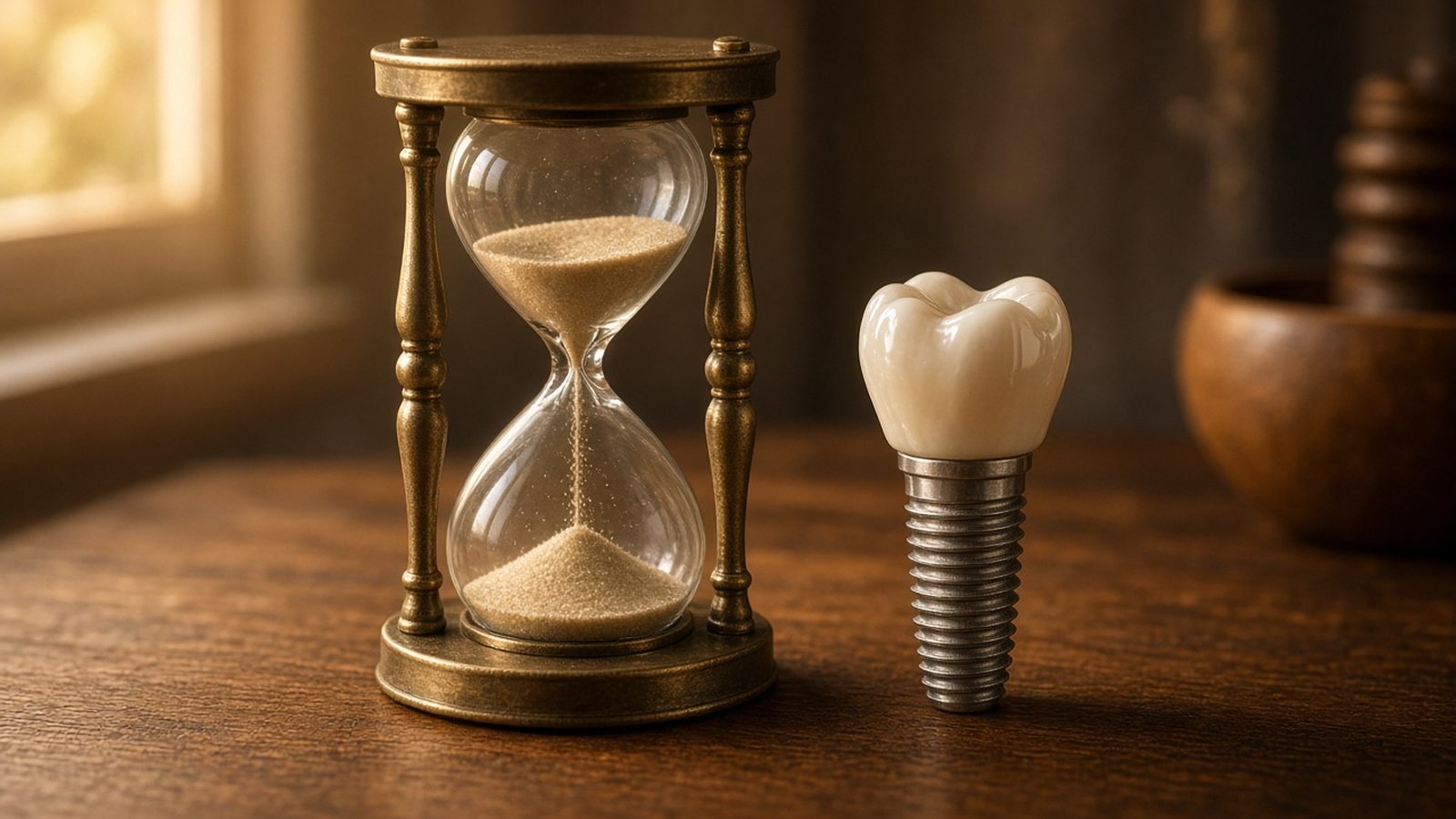
How long dental implants and full-arch teeth really last, what success rates measure, and what shortens or extends their life, for Houston-area patients.
Before anyone signs up for full-arch implants, they tend to ask some version of the same question: how long do dental implants last, and is this the last time I will have to deal with my teeth? You have probably seen ads around Katy and West Houston promising teeth that last a lifetime and quoting a 95 or 98 percent success rate. Those numbers are not made up, but they answer a narrower question than most people think. This guide explains what implant success rates actually measure, what long-term research reports for single implants and full arches, why the implants and the teeth on top of them age at different speeds, and which factors shorten or extend the life of your treatment. It is written for patients in Katy, Cypress, Sugar Land, Fulshear, Richmond, Memorial and the rest of the Houston area.
The short answer
In long-term studies, roughly 95 of every 100 implants are still in place after 10 years or more. The teeth attached to them usually need repairs, adjustments and eventually replacement sooner than the implants do. How long your own implants last depends on your health, your habits, how the case was planned and whether you keep up with maintenance.
That is a strong track record, and it is also not a promise. A survival figure describes large groups of patients, not you. Someone who smokes, has a history of severe gum disease and skips checkups starts from different odds than a non-smoker who is seen on schedule. And for full-arch patients, "my implants are fine" and "my teeth are fine" are two separate questions.
What a "95 percent success rate" actually measures
Most headline numbers are survival rates: the share of implants still in the mouth at a given point. Survival does not tell you whether the bone and gum around each implant are healthy, or whether the teeth on top have needed repairs.
Researchers use two words that sound alike. Survival means the implant has not been lost. Success is stricter and usually adds conditions, such as limited bone loss, no infection and no pain. In a systematic review published online in October 2026 in Periodontology 2000, Moraschini and colleagues pooled 34 studies that followed more than 20,000 implants for at least 10 years. Survival came out at about 95 percent across every type of study. Success, measured in the 14 studies that reported it, averaged about 85 percent, and the authors noted that definitions of success varied widely. Peri-implantitis, the infection that destroys bone around implants, was found at about 11 percent of implants on average, with a very wide range between studies. Their conclusion is worth repeating: an implant that is still there is not automatically a healthy implant.
The second thing to check is who is being counted. Most studies report results per implant. Patients, of course, experience results per mouth. In a cohort study of 4,247 patients treated by one periodontist over more than 20 years, French and colleagues found that 96.8 percent of implants were still in place at 10 years, but only 92.5 percent of patients had kept every implant they received. Patients with several implants were more likely to lose at least one than patients with a single implant. If you are getting four, five or six implants in one arch, the per-patient figure is the one that describes your experience more closely.
What the long-term research reports
For modern implants, 10-year survival in the research generally falls between about 93 and 97 percent, depending on how the study handled patients who stopped coming back.
A 2019 systematic review by Howe, Keys and Richards in the Journal of Dentistry looked at 18 prospective studies of contemporary implants and estimated 10-year survival at 96.4 percent. The authors then reran the analysis with an adjustment for patients lost to follow-up, on the reasonable assumption that people who stop attending are not always the ones doing well. The estimate dropped to 93.2 percent, and in that adjusted analysis patients aged 65 and older had a lower survival estimate, 91.5 percent. Older age on its own does not rule anyone out, and many older adults do well with implants. It does mean health, healing and the ability to keep implants clean belong in the conversation.
What the research cannot tell you is how long any individual implant will last. Few studies follow patients past 20 years, and the people in long studies were often treated with older implant designs. The fair summary is that implants have a long and well-documented record, not that they come with a known expiration date or none at all.
Full-arch implants: the implants and the teeth age differently
With All-on-4 or All-on-X treatment, the implants in the bone often outlast the prosthesis, the full arch of teeth screwed onto them. Expect the teeth to need maintenance, repairs and possibly a remake over the years, even when the implants stay healthy.
The longest full-arch follow-up published so far comes from the clinic group that developed the All-on-4 concept. In a 2026 study in the Journal of Clinical Medicine, de Araujo Nobre and colleagues reported on 740 patients who received four implants and a fixed upper arch, followed for 15 to 20 years. Implant survival was 94.1 percent at 15 years and 90.7 percent at 20 years. Only about 2 percent of patients lost their prosthesis entirely. But mechanical complications, such as loose screws and chipped or fractured teeth, affected 78.5 percent of patients at some point, and biological complications around the implants affected about 35 percent. Smoking and earlier biological complications were the main risk indicators for losing an implant. Two caveats apply: nearly 39 percent of patients were lost to follow-up over two decades, and the results come from one experienced clinic group.
An older systematic review points the same way. Papaspyridakos and colleagues, writing in the International Journal of Oral and Maxillofacial Implants in 2012, analyzed fixed full-arch prostheses followed for at least five years. Only about 29 percent were free of any complication at five years, and fewer than 9 percent at 10 years. Chipping or fracture of the tooth material was the most common technical problem. Many of those prostheses were made with older materials and designs, and complications such as a chipped tooth are usually repairable. The authors' point still holds: complications build up over time from normal wear and stress, and they translate into maintenance visits, time and cost.
So when you read that "All-on-4 lasts a lifetime," separate the parts. The implants may serve you for decades. The teeth on top are closer to a well-made appliance that is checked, tightened, repaired and eventually replaced. Material choice affects how often that happens, and so does the design of the teeth. Our post on how prosthodontists design implant-supported teeth explains the choices involved.
What tends to shorten an implant's life
The factors with the clearest evidence are smoking, poorly controlled diabetes, gum disease around the implants, heavy grinding, a prosthesis that is hard to clean and missed maintenance. Several of these are within your control.
Smoking has the most data behind it. A 2015 meta-analysis by Chrcanovic, Albrektsson and Wennerberg pooled 107 studies and found that about 6.4 percent of implants placed in smokers failed, compared with about 3.2 percent in non-smokers, roughly double, though the authors cautioned that the studies could not rule out other differences between the groups. The U.S. Food and Drug Administration (FDA) says the same thing in plainer terms: smoking may affect healing and decrease the long-term success of an implant.
Health matters in other ways too. The FDA lists infection around the implant, delayed healing and uncontrolled diabetes among the risks that can lead to implant failure, and says your overall health affects how long an implant may stay in place. A history of gum disease does not rule out implants, but it raises the importance of maintenance afterward, because the same bacteria that destroyed bone around teeth can do the same around implants.
Then there is force. People who clench or grind put repeated heavy loads on screws, implants and the tooth material, which shows up as loosened screws and chipped teeth. A protective nightguard and a carefully designed bite are the usual answers. Finally, design and access: a full arch that traps food against the gum, with no way to clean underneath, invites inflammation no matter how careful you are at home.
What you control once your teeth are in
Daily cleaning around and under your implant teeth, regular professional visits, wearing a nightguard if you grind, not smoking and calling early when something changes do more for longevity than anything else after treatment.
The FDA's advice to implant patients is short: follow your oral hygiene instructions carefully, schedule regular visits, and tell your dental provider right away if an implant feels loose or painful. For full-arch teeth, that usually means brushing the teeth and the gumline, a water flosser or threaded floss under the prosthesis, and professional visits where the prosthesis can be checked and, when needed, removed for cleaning. Your team should show you a routine built for your specific teeth, including which tools reach the strip of gum under the prosthesis.
Early warning signs are easy to dismiss. Bleeding around an implant, a bad taste that keeps coming back, a clicking sound when you bite or a tooth that feels rough or sharp are all worth a call before the next scheduled visit. A loose screw caught early is a small appointment. A loose screw ignored for months can damage the parts it holds together.
What gets decided before surgery
Many long-term problems trace back to planning decisions made before the first implant goes in: where the implants sit in the bone, how the bite is designed and whether the final teeth can be cleaned.
This is the part patients cannot see and rarely ask about. The number and angle of implants, whether there is enough bone or grafting is needed, how forces will spread across the arch and how the underside of the prosthesis is shaped all affect how the case holds up over years. Our article on why the final teeth should guide oral surgery planning explains why the teeth are planned first and the implant positions follow, and why dental implant surgery requires complete rehabilitation planning covers the rest of that plan.
At Regional Implant Centers, that planning runs through our RISE Protocol. A prosthodontist maps out the bite, facial support and long-term plan for the new teeth before surgery begins, and 3D CBCT imaging lets the team study bone volume, nerve pathways and sinus position ahead of time. After implants are placed, photogrammetry captures their exact three-dimensional positions so a full-arch restoration can be designed for a passive fit. None of this guarantees an outcome. It does put the decisions that affect longevity in front of the people responsible for them. As the RISE Protocol page itself puts it, long-term success still depends on individualized treatment, healing, maintenance and follow-up care.
What upkeep usually looks like over the years
Think of full-arch implants as a long-term relationship with a maintenance schedule, not a one-time purchase. Visits, small repairs and eventual replacement of the teeth are normal parts of the plan.
The first year is when the temporary teeth give way to the final prosthesis and the team watches how your bite, gums and bone settle. After that, most patients are seen at regular intervals that depend on their risk. A typical visit checks the gums and bone around each implant, the bite and the condition of the screws and tooth material. At some visits the prosthesis comes off so the implants and the underside of the teeth can be cleaned and inspected. Screws may need to be retightened or replaced. A nightguard wears out and gets remade. Over a longer stretch, the tooth material wears, chips or stains, and at some point a new prosthesis may be made on the same implants. How soon depends on the material, your bite, your habits and how well problems are caught early, which is why nobody can honestly give you a fixed number of years.
If an implant does run into trouble, it is not always lost. An implant that is failing but still solid in the bone can sometimes be treated and kept, while one that moves on its own usually cannot. Our article on how to avoid failed implant dentistry and costly mistakes covers the questions to ask before treatment starts, and why full-mouth rehabilitation requires more than implants explains why the implants are only one part of a result that lasts.
How Regional Implant Centers approaches long-term results
We do not sell a lifetime warranty. Instead, every patient with a final prosthesis enrolls in a required Maintenance Package, because long-term results depend on what happens after the teeth go in.
Our implant warranty page says it directly: Regional Implant Centers does not offer a traditional implant warranty that guarantees lifetime success after surgery, because implant and prosthetic outcomes depend on biology, healing, hygiene, habits, follow-up care and long-term maintenance. There is no guarantee that implants or prosthetics will never need adjustment, repair or replacement. Ongoing protection comes through a Maintenance Package, and enrollment must begin within 30 days of final prosthesis delivery. Depending on the tier, the package includes services such as implant cleanings, periodic exams with CBCT imaging, prosthesis removal, screw retorque or replacement, a protective nightguard and repairs. The warranty page also lists what is not covered, including trauma, poor oral hygiene, smoking, uncontrolled medical conditions and grinding without protection.
We would rather tell you that up front than promise a lifetime. Plans are reviewed by a specialist team: Dr. Polyxeni Konti is a prosthodontist who focuses on the teeth the implants support, Dr. Dan Holtzclaw is a Board-Certified Diplomate of the American Board of Periodontology and the International Congress of Oral Implantologists, and Dr. Enrique Tabarini is an oral and maxillofacial surgeon. Our Katy office, on S Fry Rd, has surgical suites and imaging and is home to our in-house dental lab, where technicians work beside the surgical and restorative team. Both our Katy and Hutto offices offer traditional dentures, snap-on implant overdentures and fixed full-arch teeth, so the conversation can include the option that fits your health and goals rather than only one type of treatment. Our full-mouth implants page explains how fixed full-arch treatment is planned.
If you already have implants from another office and are wondering how long they have left, an evaluation can look at the bone, the gums and the condition of the prosthesis. Regional Implant Centers frequently evaluates patients who need correction of failed treatment performed elsewhere, and outside X-rays and records help.
Insurance and financing
Medical insurance may help with some surgical parts of treatment, but it does not cover implants or implant teeth through our office, and coverage is never guaranteed.
Our team bills medical insurance only for surgical professional services, such as extractions, bone grafting and alveoloplasty. Implants, temporaries and the final prosthesis are billed to the patient separately. Maintenance Packages are a separate program and are not dental insurance. Some PPO medical plans with oral surgery coverage may be worth checking, but please verify your benefits with us before treatment. We cannot bill Federal Employee Program (FEP) Blue Cross Blue Shield plans. Our insurance team can review your plan, and financing is available through independent third-party companies for qualified patients. When you compare options, ask what upkeep each one needs over the years, not only what it costs to start.
Questions to ask about longevity before you commit
Bring these to any consultation, with us or another office.
- When you quote a success rate, is that survival or success, and per implant or per patient?
- Is there anything in my health or habits that lowers my odds, and what can I do about it?
- How many implants are you planning, where, and why that number?
- What will the final teeth be made of, and what repairs does that material usually need?
- Will the prosthesis be removable by the office for cleaning, and how often should that happen?
- Do you recommend a nightguard for me?
- What does maintenance include, how often will I come in, and what is not covered?
- If an implant or the teeth have a problem in five or ten years, what happens then?
Frequently asked questions
Do dental implants last forever?
No one can promise that. Long-term studies show about 95 percent of implants still in place after 10 years or more, but implants can still be lost to infection, bone loss or overload, and the teeth attached to them usually need repairs and eventual replacement.
How long does an All-on-4 last?
In the longest published follow-up, a large study from one clinic group, about 91 percent of implants supporting four-implant upper arches were still in place at 20 years. The full arch of teeth on top typically needs maintenance and repairs along the way and may need to be remade, depending on the material, your bite and your care.
What is the most common reason implants fail years later?
Infection and bone loss around the implant, called peri-implantitis, is one of the main long-term causes. Smoking, poorly controlled diabetes, a history of gum disease, heavy grinding and missed maintenance all raise the risk.
Does Regional Implant Centers offer a lifetime warranty?
No. We do not offer a traditional implant warranty that guarantees lifetime success. Patients enroll in a required Maintenance Package within 30 days of receiving their final prosthesis, which covers defined services each year depending on the tier.
Can old implants from another office be evaluated?
Yes. Our team can examine the implants, bone and prosthesis and review any X-rays and records you bring. Whether existing implants can be kept, repaired or need a new plan depends on that evaluation.
Plan for the long run with a specialist team
If you are weighing full-arch implants, or wondering how much life your current teeth or implants have left, a consultation is the place to get specific answers about your mouth instead of averages. You will have a clinical evaluation, 3D imaging when indicated, a frank look at the factors that affect your long-term odds, and for qualified patients, a complimentary consultation, CBCT scan and Insurance Advantage benefit review. Schedule a consultation by phone or in person at our Katy office, serving Katy, Cypress, Sugar Land, Fulshear, Richmond and the rest of the Houston area, or call (832) 632-7037. Patients in the Austin area can book with our Hutto office.
Sources & Resources
- Moraschini V, Mikulas K, Shibli JA, et al. Ten years and beyond: long-term dental implant survival, success, and biological health. A systematic review and meta-analysis. Periodontology 2000, 2026 (online ahead of print).
- Howe MS, Keys W, Richards D. Long-term (10-year) dental implant survival: a systematic review and sensitivity meta-analysis. Journal of Dentistry, 2019;84:9-21.
- French D, Ofec R, Levin L. Long term clinical performance of 10 871 dental implants with up to 22 years of follow-up: a cohort study in 4247 patients. Clinical Implant Dentistry and Related Research, 2021;23(3):289-297.
- de Araujo Nobre M, Lopes A, Ferro A, et al. Immediate full-arch maxillary rehabilitation supported by four implants: a retrospective study with 15 to 20 years of follow-up. Journal of Clinical Medicine, 2026;15(2):446.
- Papaspyridakos P, Chen CJ, Chuang SK, Weber HP, Gallucci GO. A systematic review of biologic and technical complications with fixed implant rehabilitations for edentulous patients. International Journal of Oral and Maxillofacial Implants, 2012;27(1):102-110.
- Chrcanovic BR, Albrektsson T, Wennerberg A. Smoking and dental implants: a systematic review and meta-analysis. Journal of Dentistry, 2015;43(5):487-498.
- U.S. Food and Drug Administration. Dental Implants: What You Should Know
This article is general patient education and is not a diagnosis or treatment plan. How long implants and implant teeth last depends on an individual clinical evaluation, your health and habits, and ongoing maintenance. Regional Implant Centers has offices in Katy and Hutto, Texas. Outcomes vary, and fixed implant teeth are not appropriate for every patient.
Ready to Learn What Is Possible?
Schedule a consultation with Regional Implant Centers.
Schedule ConsultationFrequently Asked Questions
Do dental implants last forever?
No one can promise that. Long-term studies show about 95 percent of implants still in place after 10 years or more, but implants can still be lost to infection, bone loss or overload, and the teeth attached to them usually need repairs and eventual replacement.
How long does an All-on-4 last?
In the longest published follow-up, a large study from one clinic group, about 91 percent of implants supporting four-implant upper arches were still in place at 20 years. The full arch of teeth on top typically needs maintenance and repairs along the way and may need to be remade, depending on the material, your bite and your care.
What is the most common reason implants fail years later?
Infection and bone loss around the implant, called peri-implantitis, is one of the main long-term causes. Smoking, poorly controlled diabetes, a history of gum disease, heavy grinding and missed maintenance all raise the risk.
Does Regional Implant Centers offer a lifetime warranty?
No. We do not offer a traditional implant warranty that guarantees lifetime success. Patients enroll in a required Maintenance Package within 30 days of receiving their final prosthesis, which covers defined services each year depending on the tier.
Can old implants from another office be evaluated?
Yes. Our team can examine the implants, bone and prosthesis and review any X-rays and records you bring. Whether existing implants can be kept, repaired or need a new plan depends on that evaluation.
This content is educational and not a substitute for a consultation.