Implant Procedure Education
IV Sedation or General Anesthesia for Full-Arch Implants: What Austin-Area Patients Should Know
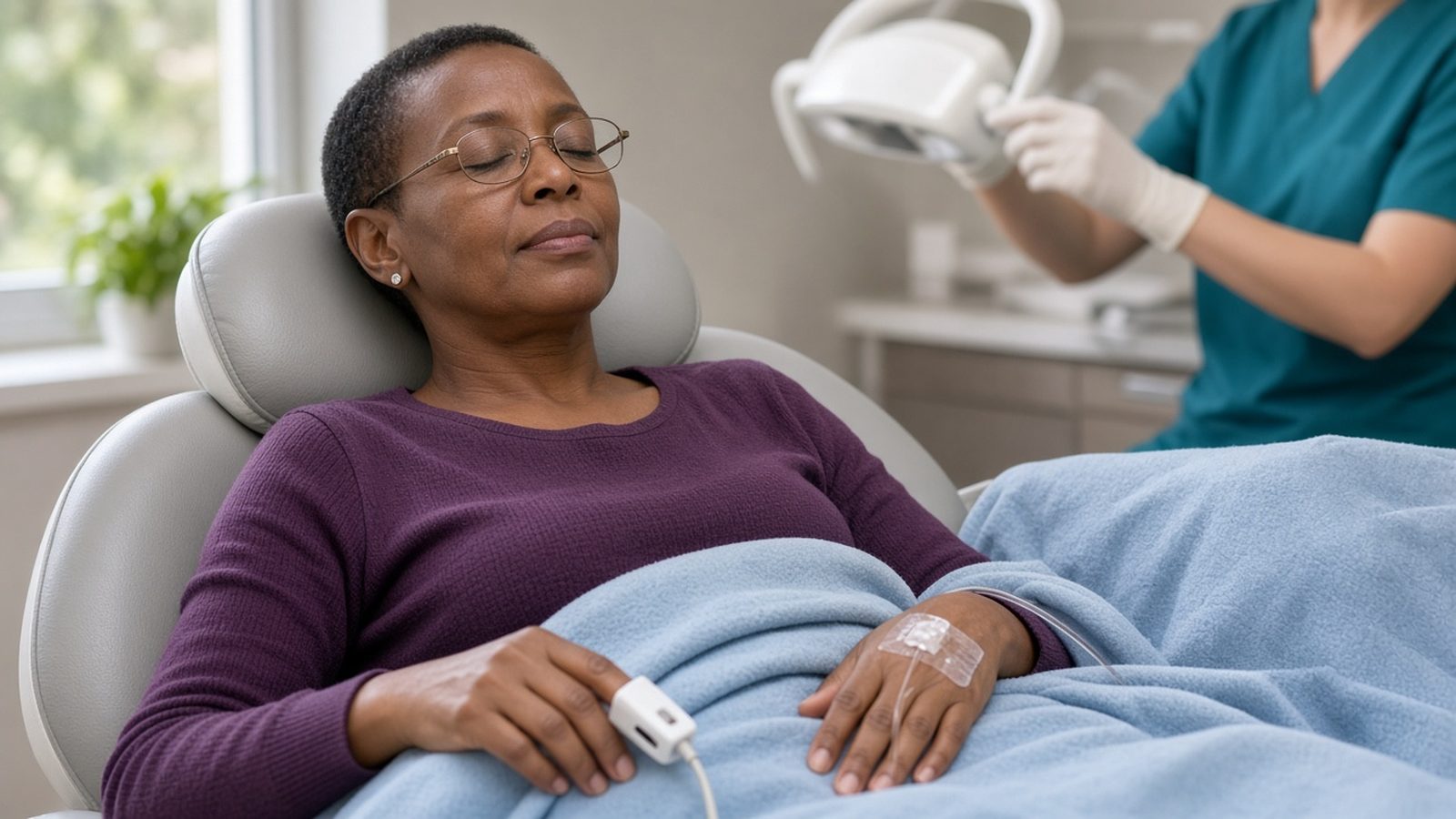
How moderate IV sedation and general anesthesia differ for full-arch implants, who may provide each in Texas, and what Austin-area patients should ask.
Sedation for dental implants is often the first thing people ask about, sometimes before they ask about the teeth. If you live in Austin, Hutto, Round Rock, Pflugerville, Georgetown or Cedar Park and you are facing extractions and full-arch implants, you may have heard several offices use "IV sedation," "sleep dentistry" and "general anesthesia" as if they meant the same thing. They do not. This article explains the difference in plain terms, who is allowed to provide each level in Texas, what decides which one is recommended for you, and what to ask before you agree to a plan. It is general education, not a diagnosis, and the right choice for you depends on a personal evaluation.
The short answer
IV sedation and general anesthesia are different points on one scale. With moderate IV sedation you are drowsy but still breathing on your own and able to respond. With general anesthesia you are fully unconscious and usually need help with your breathing. Which one fits depends on your health, your airway, the length of the surgery and how anxious you are, not on which sounds more comfortable.
The more useful questions are who gives the anesthesia, what that person is permitted and trained to do, and whether their only job during surgery is watching you. Those answers say more about safety than the name of the sedation level.
Sedation is a scale, not a switch
The American Society of Anesthesiologists (ASA) describes four levels: minimal sedation, moderate sedation, deep sedation and general anesthesia. Each level changes how well you respond, whether you keep your own airway open and how much your breathing and circulation are affected.
In the ASA's definitions:
- Minimal sedation. You are relaxed but respond normally when spoken to. Breathing and heart function are unaffected. This is usually reached with a single pill before the procedure.
- Moderate sedation, often called "conscious sedation." You respond purposefully to your name or a light touch, you breathe adequately on your own, and no help is needed to keep your airway open. This is the level most people mean by "IV sedation," and it is usually reached by giving medicine through an IV a little at a time.
- Deep sedation. You cannot be easily woken and respond only to repeated or painful stimulation. You may need help keeping your airway open, and your breathing may not be adequate on its own.
- General anesthesia. You cannot be woken, even by painful stimulation. Your breathing often needs support, sometimes with a breathing tube and a ventilator, and your blood pressure may need managing.
The ASA makes one more point that matters for patients: because sedation is a continuum, no one can predict exactly how a given person will respond. A patient meant to be moderately sedated can drift deeper. That is why the ASA says anyone giving moderate sedation must be able to rescue a patient who slips into deep sedation, and anyone giving deep sedation must be able to rescue a patient who slips into general anesthesia. "Rescue" means having the airway skills, drugs and equipment to correct the problem and bring the patient back to the intended level.
What each one feels like from the chair
With moderate IV sedation, most people feel relaxed and drowsy and remember little afterward, but some notice pressure, sounds or the numbing injections. With general anesthesia, you are not aware of anything until you wake up in recovery.
Local anesthetic, the numbing medicine placed in the gums, is used in both cases. Sedation and anesthesia affect awareness and anxiety. Local anesthetic blocks pain where the surgery is done, and it also helps with comfort after you wake up.
Under moderate sedation, you may hear the team talking, feel vibration or pressure as teeth are removed, and be asked to turn your head or open wider. Many people doze through most of it and have only patchy memories. People who expect total unawareness sometimes find that surprising, so it is worth asking in advance what you are likely to notice.
Under general anesthesia, you go to sleep and wake up when the surgery is over. Afterward you may feel groggy, have a sore throat if a breathing tube was used, or feel queasy for a while. With either approach, you will need a responsible adult to drive you home and stay with you, and you should not drive, sign important papers or make big decisions for the rest of the day. Our article on what happens on full-arch surgery day covers fasting, medicines and the trip home in more detail.
Why full-arch surgery changes the conversation
A single implant is often placed with local anesthetic alone or with light sedation. Full-arch treatment is different: it can mean removing many teeth, smoothing or grafting bone, placing several implants and fitting temporary teeth, often in one long visit.
Length matters because the longer the surgery, the longer someone has to keep you comfortable, still and safe. The location matters too. In mouth surgery, the surgeon and the anesthesia provider share the same small space around your airway, water and debris are present, and your mouth has to stay open. Some patients have a strong gag reflex, jaw joint problems or a history of being hard to numb. Others have avoided the dentist for years because of fear, and a plan that keeps them comfortable is what makes treatment possible at all.
None of this means everyone having full-arch surgery needs general anesthesia. Many full-arch cases are done under IV sedation. The point is that the choice should be made deliberately, with your health and the surgical plan in front of the person responsible for your anesthesia. Our article on dental implants for seniors near Austin explains why overall health, not age alone, shapes these decisions.
Who decides, and what they look at
The anesthesia plan should come from a review of your health history, medicines, airway and the planned surgery. Your preferences count, but they are one input, not the deciding vote.
The ASA encourages patients to tell the person giving their anesthesia about anything that could affect it, even details that seem unrelated:
- Every medicine and supplement. Some medicines interact with sedatives or pain relief. Some supplements, such as ginkgo and ginseng, can increase bleeding.
- Smoking and marijuana use. Smoking affects the heart and lungs and slows healing. Marijuana has sedative effects and can interact with anesthesia. Our article on smoking and dental implants covers the healing side.
- Alcohol. The ASA notes that more than two drinks a day can increase the risk of side effects and change how much anesthesia you need.
- Snoring or sleep apnea. Sleep apnea makes sedation riskier because these medicines slow breathing, and it can make waking up harder. The provider may adjust medicines, keep you in recovery longer or plan pain relief that avoids opioids.
- A past reaction to anesthesia, and any personal or family history the provider asks about, including stroke or heat stroke.
- Chronic conditions such as diabetes, heart disease, asthma, high blood pressure, kidney or liver disease, obesity and seizure disorders. Our article on dental implants with diabetes explains how blood sugar control fits into surgical planning.
Be completely honest here. No one is judging you. A sedation plan built on missing information is the one most likely to go wrong. Sometimes the review leads to a request for records or a letter from your physician before a date is set.
Who can give sedation in Texas
In Texas, a dentist needs a separate permit from the Texas State Board of Dental Examiners (TSBDE) for each level of sedation they provide. The highest permit, Level 4, covers deep sedation and general anesthesia.
Under the TSBDE's rules, the permits are:
- Nitrous oxide (laughing gas)
- Level 1: minimal sedation
- Level 2: moderate sedation by mouth (pills or liquid)
- Level 3: moderate sedation by IV or other injected routes
- Level 4: deep sedation or general anesthesia
Each level requires specific training, and permit holders must keep up continuing education in sedation and emergency care. The TSBDE's public license search lets anyone look up a Texas dentist's license status, anesthesia permit levels and any public disciplinary actions. Physician anesthesiologists and certified registered nurse anesthetists are licensed through their own boards.
A related term worth knowing is dentist anesthesiologist. In 2019, the American Dental Association's National Commission on Recognition of Dental Specialties and Certifying Boards recognized dental anesthesiology as a dental specialty. Its definition covers managing pain, anxiety and overall patient health during dental and oral surgical procedures, before, during and after treatment, with a focus on patient safety. A dentist anesthesiologist is a dentist who has completed advanced training specifically in anesthesia.
What safe monitoring looks like
Whatever level you receive, someone trained should be watching your oxygen, breathing, heart and blood pressure continuously, with rescue equipment within reach, from the start of sedation until you are ready to go home.
The American Dental Association's Guidelines for the Use of Sedation and General Anesthesia by Dentists, updated in October 2025, set out what that means in practice. For moderate sedation, the qualified dentist giving the sedation must stay in the room and monitor the patient continuously until recovery. Monitoring includes pulse oximetry for oxygen levels, watching chest movement, measuring exhaled carbon dioxide (capnography) unless the patient or procedure makes that impossible, and checking blood pressure and heart rate, with ECG unless it is precluded.
For deep sedation or general anesthesia, the guidelines call for at least three people in the room: the qualified dentist providing the anesthesia and two others certified in Basic Life Support. When the same dentist is both giving the anesthesia and doing the dental procedure, one of the other team members must be assigned to patient monitoring. Advanced airway equipment, emergency drugs and a defibrillator must be immediately available, and the patient's heart rhythm, oxygen, exhaled carbon dioxide and blood pressure are tracked and recorded throughout.
That last detail is why many patients ask whether the surgeon will also be running the sedation. In some offices one provider does both, supported by a monitoring assistant. In others, a separate anesthesia provider has no job except the patient. Both setups are used. It is reasonable to ask which one you would have and who would be watching you while the surgeon works.
How anesthesia works at our Hutto office
Our Hutto office has an anesthesia provider on site, a dentist anesthesiologist, along with CBCT imaging and the ability to do bone grafting and sinus work. Your anesthesia plan is made as part of your overall treatment plan, not added at the end.
Under our RISE Protocol, the work is split by role. A prosthodontist designs the outcome, the oral surgeon focuses on implant placement, bone reconstruction and surgical execution, and a dedicated anesthesia provider focuses on your safety, comfort and monitoring. Our seed article on why dedicated anesthesia professionals matter explains the reasoning behind that split.
Our anesthesia and patient comfort page describes the options your doctor may discuss: local anesthesia to numb specific areas, sedation for anxious patients and longer visits, and general anesthesia, which may be recommended for certain complex procedures. The page notes that monitoring covers oxygen levels, breathing, heart rate, blood pressure and overall patient status, and that general anesthesia with nasal intubation may be recommended in some cases to protect the airway while keeping the mouth fully accessible. Our article on why nasal intubation may be used during complex dental treatment explains that approach, and our article on advanced anesthesia monitoring covers the equipment side.
Which option is right for you is decided after your health history, imaging and surgical plan are reviewed. Sedation does not remove all risk, and no website can decide it for you. If your plan involves very limited upper bone, our surgeons Dr. Dan Holtzclaw and Dr. Enrique Tabarini also perform zygomatic and pterygoid implants, which are longer, more specialized procedures. Our article on sinus lift versus zygomatic implants explains when they come up.
Questions to ask before you agree to a sedation plan
Clear, specific answers are a good sign. Be cautious if the answer to every question is that you will "just be asleep" and nothing else is explained.
Whether you are talking with our team or another office, these questions are worth asking:
- What level of sedation or anesthesia are you recommending for me, and why that level?
- Who will give it, what is their training, and what Texas permit or license do they hold?
- During surgery, is that person doing anything other than watching me?
- How will my oxygen, breathing, heart and blood pressure be monitored?
- What happens if I become more deeply sedated than planned, or if I am not comfortable enough?
- How long is the surgery expected to take, and how long will I be in recovery?
- What should I do about my medicines, eating and drinking beforehand?
- Who should I call that night if something does not feel right?
If you have already been given a plan elsewhere and want to compare, our article on how to avoid failed implant dentistry and costly mistakes lists other questions to bring.
Getting to our Hutto office from around Austin
Our Austin-area office is in Hutto, on E Wilco Hwy (US-79). Surgery is usually scheduled on a Friday, so plan your driver and the rest of that day around it.
Our Hutto office is at 201 E Wilco Hwy, Suite 203, Hutto, TX 78634. Its posted hours are Monday through Thursday 8 to 5, with Fridays for surgeries only. Patients come from Hutto, Round Rock, Pflugerville, Georgetown, Cedar Park and across the Austin area. Our article on full-mouth dental implants near Austin walks through the visits from consultation to final teeth. Both our Hutto and Katy offices offer traditional dentures, snap-on implant overdentures and fixed full-arch teeth, so a fixed bridge is not the only path. Our in-house dental lab is at our Katy office.
Plan for the whole surgery day, not just the appointment. Your companion should be available to drive you home and stay with you afterward, and our article on what to eat after All-on-4 surgery can help you stock the kitchen in advance.
How insurance and financing fit in
Medical insurance may help with some surgical parts of a plan, but at our office it does not pay for implants, temporary teeth or final teeth, and coverage is never guaranteed.
At Regional Implant Centers, we bill medical insurance only for surgical professional services, such as extractions, bone grafting and alveoloplasty (smoothing and reshaping the bone). Implants, temporary teeth and the final prosthesis are billed to the patient separately. How anesthesia is handled depends on your plan and your benefits, so ask for it to be shown clearly in your written estimate. Only PPO plans work for out-of-network oral surgery benefits. If you have a PPO medical plan with oral surgery coverage, it is worth checking, but please verify your benefits with our team before treatment. We cannot bill Federal Employee Program (FEP) Blue Cross Blue Shield plans. Our Insurance Advantage team reviews dental and medical benefits, and our insurance disclaimer explains that a benefit estimate or preauthorization is not a guarantee of payment.
Financing is available through independent third-party companies listed on our financing page, including Cherry, Proceed, CareCredit and Sunbit. Approval, rates and terms are set by each lender, not by Regional Implant Centers. Our article on dental implant financing in Austin explains how those options compare.
After treatment, Regional Implant Centers does not offer a traditional implant warranty. Our implant warranty page explains which events are not covered, including neglect, poor oral hygiene and smoking. Our Maintenance Package must begin within 30 days of final prosthesis delivery, and its terms explain what can void coverage. Read both before treatment.
Frequently asked questions
Is IV sedation the same as being put to sleep?
Not quite. Moderate IV sedation leaves you drowsy but able to respond and breathe on your own, and many people remember little afterward. General anesthesia makes you fully unconscious, and your breathing usually needs support. Some offices use "sleep dentistry" for both, so ask which level is actually planned.
Will I feel anything during full-arch implant surgery?
Numbing medicine is used either way, so the surgery itself should not be painful. Under IV sedation some people notice pressure, vibration or sounds. Under general anesthesia you are not aware of anything until you wake up. Tell the team if you have been hard to numb in the past.
Is general anesthesia safer than IV sedation for dental implants?
Neither is automatically safer. Each carries its own risks, and the right level depends on your health, your airway, the length of surgery and the training of the person providing it. What matters most is a careful pre-surgery review, continuous monitoring and a provider who can manage the airway if sedation goes deeper than planned.
Can I have sedation if I have sleep apnea?
Often, yes, but it needs planning. Sedation medicines slow breathing, so sleep apnea raises the risk. Tell the team early, bring your CPAP details, and expect your anesthesia provider to adjust medicines, monitoring or recovery time, or to ask your sleep physician for information.
How do I check a Texas dentist's sedation permit?
The Texas State Board of Dental Examiners has a free public license search on its website. A dentist's record shows license status, anesthesia permit levels and any public disciplinary actions. Level 3 covers moderate IV sedation, and Level 4 covers deep sedation and general anesthesia.
Talk with our Hutto team about your comfort plan
If you live in Austin, Hutto, Round Rock, Pflugerville, Georgetown or Cedar Park and fear of the dental chair has kept you from treatment, start with a conversation. Tell us what has happened before, what worries you and what medicines you take, and ask us the questions above. If you come in, you will have a clinical exam, 3D imaging when indicated, and a written plan with estimated insurance benefits, financing options and your expected out-of-pocket investment before anything begins. Qualified patients receive a complimentary consultation, CBCT scan and insurance benefits evaluation. Schedule a consultation by phone or in person at our Hutto office, or call (832) 632-7037. Houston-area patients can book with our Katy office.
Sources & Resources
- American Society of Anesthesiologists. Statement on Continuum of Depth of Sedation: Definition of General Anesthesia and Levels of Sedation/Analgesia. Last amended 2024.
- American Dental Association. Guidelines for the Use of Sedation and General Anesthesia by Dentists. Adopted October 2025.
- American Society of Anesthesiologists. Eight Things to Tell Your Physician Anesthesiologist Before Surgery. 2019.
- National Commission on Recognition of Dental Specialties and Certifying Boards. Recognized Dental Specialties (dental anesthesiology definition, adopted March 2019).
- Texas State Board of Dental Examiners. Anesthesia Privileges and Applications and Public License Search.
- Texas Administrative Code. 22 Tex. Admin. Code 110.2, Sedation/Anesthesia Permit.
This article is general patient education and is not a diagnosis or treatment plan. The type of sedation or anesthesia that is appropriate depends on an individual medical review, the planned procedure and the judgment of the treating team, and no level of sedation is free of risk. Insurance coverage is never guaranteed, and financing is provided by independent third-party companies. Regional Implant Centers has offices in Katy and Hutto, Texas. Outcomes vary, and implant treatment is not appropriate for every patient.
Ready to Learn What Is Possible?
Schedule a consultation with Regional Implant Centers.
Schedule ConsultationFrequently Asked Questions
Is IV sedation the same as being put to sleep?
Not quite. Moderate IV sedation leaves you drowsy but able to respond and breathe on your own, and many people remember little afterward. General anesthesia makes you fully unconscious, and your breathing usually needs support. Some offices use "sleep dentistry" for both, so ask which level is actually planned.
Will I feel anything during full-arch implant surgery?
Numbing medicine is used either way, so the surgery itself should not be painful. Under IV sedation some people notice pressure, vibration or sounds. Under general anesthesia you are not aware of anything until you wake up. Tell the team if you have been hard to numb in the past.
Is general anesthesia safer than IV sedation for dental implants?
Neither is automatically safer. Each carries its own risks, and the right level depends on your health, your airway, the length of surgery and the training of the person providing it. What matters most is a careful pre-surgery review, continuous monitoring and a provider who can manage the airway if sedation goes deeper than planned.
Can I have sedation if I have sleep apnea?
Often, yes, but it needs planning. Sedation medicines slow breathing, so sleep apnea raises the risk. Tell the team early, bring your CPAP details, and expect your anesthesia provider to adjust medicines, monitoring or recovery time, or to ask your sleep physician for information.
How do I check a Texas dentist's sedation permit?
The Texas State Board of Dental Examiners has a free public license search on its website. A dentist's record shows license status, anesthesia permit levels and any public disciplinary actions. Level 3 covers moderate IV sedation, and Level 4 covers deep sedation and general anesthesia.
This content is educational and not a substitute for a consultation.