Medical Insurance For Dental Treatment
Medical Insurance for the Oral Surgery Part of Full-Arch Treatment: How Claims Work for Houston Patients
Medical insurance may help with the oral surgery part of full-arch care, never the implants. Here is how the claim, the records and your share work.
If you are planning full-arch implant treatment in the Houston area, you may hear that medical insurance could help with part of it. That is sometimes true, but only for part of the work, and only when your plan's rules and your documented diagnosis line up. This article explains how medical insurance for oral surgery actually works on the claim side: which surgical services a medical plan may review, what documentation goes with the claim, which plan is billed first, what your share can look like and how to read the paperwork that comes back. It is written for patients in Katy, Cypress, Sugar Land, Fulshear, Richmond and across Greater Houston who are comparing plans before a consultation at our Katy office or anywhere else.
We have separate articles on whether a Blue Cross Blue Shield PPO may help with full-arch surgery, which covers plan types, networks and appeals, and on how dental insurance clauses affect All-on-4 treatment. This one stays with the medical claim itself.
The short answer
At Regional Implant Centers, a medical plan is reviewed only for surgical professional services, such as extractions, bone grafting and alveoloplasty. The implants, temporary teeth and final prosthesis are billed to you separately. Whether a medical plan pays for any of the surgical work depends on your plan's own medical policy, a documented diagnosis and the insurer's decision, so treat it as worth checking, never as something to count on, and please verify your benefits before you decide.
Medical and dental insurance run on two different systems
Medical and dental plans use different codes, different claim forms and different cost-sharing rules. That is why a surgical claim to a medical plan looks nothing like the dental estimates most patients have seen before.
| Dental plan | Medical plan | |
|---|---|---|
| Procedure codes | CDT codes (dental procedure codes) | CPT or HCPCS codes, paired with ICD-10 diagnosis codes |
| Claim form | Dental claim form | Professional medical claim (CMS-1500 or its electronic version) |
| What the claim has to show | That a covered dental service was done | That a covered service was medically necessary for a documented diagnosis |
| Typical limit on your benefits | An annual maximum the plan will pay | A deductible, coinsurance and an out-of-pocket limit |
| Prior review | Optional predetermination on many plans | Preauthorization required for some services on some plans |
The diagnosis code is the part many patients do not expect. A medical claim does not just say what was done. It says why, using the same diagnosis code system physicians use, and the plan checks that reason against its medical policy. Federal rules on cost estimates describe the same split: diagnosis codes come from the ICD code set, and service codes from code sets such as CPT and HCPCS. Insurers also set their own filing rules. One Blue Cross plan's provider manual, for example, tells offices not to file both a dental claim form and a medical claim form for the same service, and requires medical (CPT) procedure codes to be billed on the CMS-1500 form.
Which parts of a full-arch plan a medical plan may look at
Full-arch treatment combines surgery to prepare the mouth with the teeth you will chew with. A medical plan is considered only for the first part.
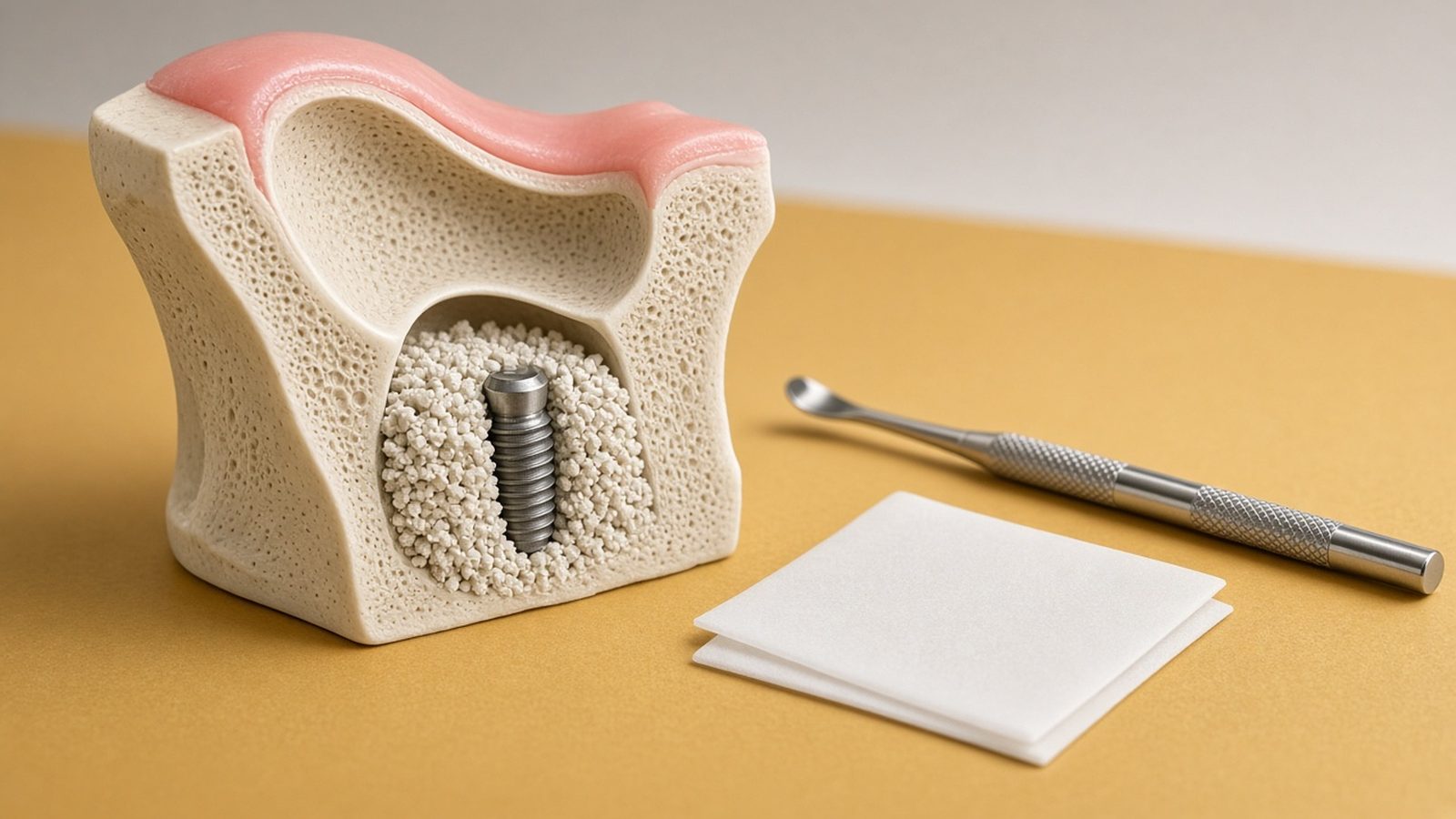
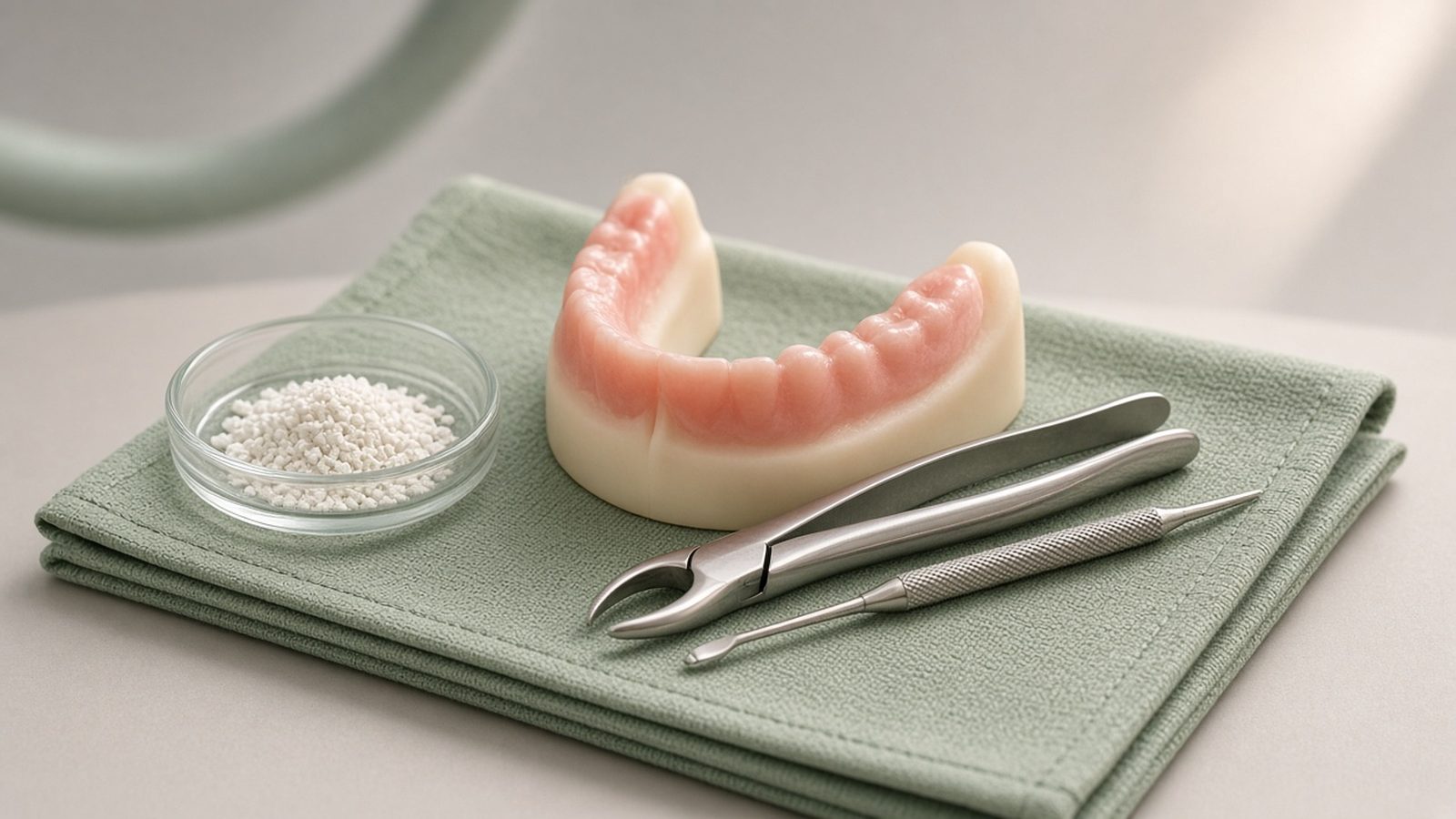
At our offices, medical insurance may help only with surgical professional services. Our oral surgery page describes those services: tooth extractions, bone grafting (socket preservation, ridge augmentation and guided bone regeneration when appropriate) and alveoloplasty, which is the surgical smoothing and shaping of the bony ridge. The implants, the temporary teeth you wear while you heal and the final prosthesis are non-surgical components, and they are billed to you separately, whatever a medical plan says about oral surgery.
Even on the surgical side, nothing is automatic. Insurers publish their own medical policies, and they differ:
- Aetna's clinical policy on dental and oral surgery services under medical plans (last reviewed March 2026) states that routine dental care and the structures directly supporting the teeth are generally excluded from its medical plans, with limited exceptions. It also states that most medical plans do not cover routine replacement of teeth with implants, that grafts done to support implants are not covered either, and that bone grafts placed into extraction sites are generally not considered medically necessary.
- The same policy lists situations where dental or oral surgery services are tied to a covered medical problem, such as removing teeth before head and neck radiation, reducing facial bone fractures, and removing cysts or tumors of the jaws.
- Plan type changes the answer even within one insurer. Aetna's standard traditional plans cover surgical removal of erupted and impacted teeth, while its standard HMO-based plans cover only the removal of teeth impacted in bone. Other insurers write their own rules.
That variety is the reason we use words like "possible" and "worth checking" instead of promises. Two people with the same insurance company can have different employer plans, different exclusions and different results. The American Association of Oral and Maxillofacial Surgeons puts it plainly: benefits depend solely on the individual policy, so do not base your budget on anyone else's experience.
What makes oral surgery "medical" in the eyes of a plan
A medical plan pays for a service only when it agrees the service is medically necessary under its rules. That decision rests on the diagnosis and the records behind it, not on the name of the procedure.
HealthCare.gov defines medically necessary care as services or supplies needed to diagnose or treat an illness, injury, condition, disease or its symptoms that meet accepted standards of medicine. For oral surgery, the conditions that tend to start that conversation involve more than missing teeth. Our Insurance Advantage page lists severe dental disease, bone loss, infection, trauma, functional impairment and nutritional concerns as the kinds of situations that may open a medical necessity discussion.
Timing with other medical care can matter too. Medicare.gov, for example, describes narrow situations in which Original Medicare may pay for dental services linked to the success of a covered medical treatment, such as an exam and dental treatment before a heart valve replacement or an organ transplant, or an extraction to treat a mouth infection before chemotherapy. Private plans set their own rules, but the logic is similar: the stronger the documented link between the oral condition and your health, the more there is for a plan to review. Our articles on chronic tooth infection and on dental clearance before medical procedures cover that link from the clinical side.
The documentation behind a surgical claim
A medical review is only as strong as its records. Most of the file comes from your surgical team, but several pieces can only come from you or your physicians.
| Document | Who usually provides it | Why it matters |
|---|---|---|
| Diagnosis and clinical findings | Your surgeon | States the condition being treated and what the exam showed |
| 3D imaging and x-rays | Your surgical team, or a past dentist | Shows infection, bone loss or damage the claim describes |
| Clinical photographs | Your surgical team | Documents the condition at the time of the exam |
| Gum and bone measurements | Your surgical team or past dentist | Supports a diagnosis of advanced gum disease or bone loss |
| Prior dental records | Past dentists | Shows what has already been tried and when teeth were lost |
| Physician notes or letters | Your physicians | Connects the oral condition to diabetes, heart care, cancer treatment, nutrition or other health concerns |
| Medical history and medicine list | You, your physicians | Gives context the plan may ask about |
| A written narrative of medical necessity | Your surgeon | Ties the diagnosis, the findings and the planned surgery together in plain terms |
| Your plan documents | You, your employer or the insurer | Shows what the plan actually covers and excludes |
Our Insurance Advantage team lists the documentation that may support a medical review as diagnostic imaging, clinical findings, photographs, treatment records, medical history, functional concerns and provider notes. You can make that file stronger before your first visit:
- Request records from past dentists. Under HIPAA, you generally have the right to a copy of your medical and billing records from health care providers covered by the Privacy Rule. A provider cannot refuse because you owe a balance, though it may charge a reasonable copying fee.
- Ask your physicians for a note if they have raised concerns. If your doctor has talked with you about infection, weight loss, trouble eating or clearing your mouth before a procedure, a short note in your chart helps. Our article on how dental and physician communication works explains what that exchange usually looks like.
- Write down your history. When teeth were lost, what treatment you have already had, any injuries to your mouth or jaw, and how your teeth affect eating or speaking.
- Find your plan's Summary of Benefits and Coverage. HealthCare.gov describes it as an easy-to-read summary that lets you compare costs and coverage between health plans. The full plan document, sometimes called the certificate of coverage or plan description, holds the oral surgery exclusions.
If your teeth or jaw were injured in an accident, say so early. Some medical policies treat injuries to the mouth and jaw differently from disease, and the date and cause of the injury become part of the record.
Which plan is billed first
When you have both medical and dental coverage, the order is set by the plans themselves. The usual starting point is that the medical plan is primary, but some plans reverse that for oral surgery.
The American Dental Association's guidance on coordination of benefits states that when a patient has coverage under both a medical and a dental plan, the medical plan is primary. In practice, plans add their own rules. Some dental plans will not consider a surgical extraction until the medical plan has reviewed or denied it, and they ask for the medical plan's explanation of benefits as proof. Other insurers go the other way: the Blue Cross plan manual mentioned above requires oral surgery claims to be processed under the member's dental coverage first.
This is one reason a benefit review should happen before surgery is scheduled, not after. The same surgery can be routed differently depending on your plans, and sending a claim to the wrong plan first can mean delays or a second round of paperwork. If you have two medical plans, or a medical plan plus a separate dental plan through a spouse, bring the cards for all of them.
Preauthorization and timing
Preauthorization is a plan's decision that a service is medically necessary. It is useful, but it is not a promise of payment.
HealthCare.gov defines preauthorization as a decision by your health plan that a service or treatment plan is medically necessary, sometimes called prior authorization or precertification, and adds that it "isn't a promise your health insurance or plan will cover the cost." Deductibles, coinsurance and plan limits still apply after an approval, and the final payment decision is made when the claim is processed.
A few timing questions are worth asking your plan or our team:
- Does the plan require preauthorization for the specific surgical services in your plan, and how long does an approval stay valid?
- If surgery is staged, for example extractions and grafting first and implant surgery later, does each stage need its own review?
- When does your plan year reset? Medical deductibles and out-of-pocket limits usually run on a plan year, so surgery near the end of one year and the start of the next can mean meeting a deductible twice.
Our BCBS PPO article covers decision timelines and what to do if a plan denies or underpays a surgical claim, including your appeal rights.
Your share on the surgical side
Even when a medical plan pays part of a surgical claim, you usually still owe a deductible, coinsurance or both, and out-of-network care can cost you more.
HealthCare.gov defines the terms you will see on your plan summary:
- Deductible: the amount you pay for covered services before the plan starts to pay.
- Coinsurance: the percentage of a covered service's cost you pay after the deductible.
- Out-of-network coinsurance: the percentage you pay to providers that do not contract with your plan, which usually costs you more than in-network coinsurance.
- Out-of-pocket limit: the most you pay for covered services in a plan year. HealthCare.gov notes that this limit does not include services your plan does not cover, out-of-network care, or charges above the plan's allowed amount.
- Balance billing: when a provider bills you for the difference between its charge and the plan's allowed amount. A preferred (in-network) provider may not balance bill you for covered services.
Network status matters here. Only PPO plans work for our out-of-network oral surgery benefits. Most BCBS PPO plans with oral surgery coverage can work with our offices in or out of network, so if your PPO covers oral surgery, there is a strong chance it can help with the surgical services; please verify with your plan and our team. Out of network often means a separate deductible and a larger share of the cost. We cannot bill Federal Employee Program (FEP) Blue Cross Blue Shield plans.
Reading the paperwork after surgery
After a medical claim is processed, you receive an explanation of benefits from the plan. It is not a bill, but it is the plan's written record of what it decided and why.
An explanation of benefits usually shows the date of service, each service billed, the plan's allowed amount, what the plan paid, what it applied to your deductible or coinsurance, and short reason codes for anything it did not pay. When yours arrives:
- Compare it with your written plan. Each surgical line on your treatment plan should match a line on the explanation of benefits.
- Read the reason codes. A request for more information is very different from an exclusion. Many delays come from a missing record that can still be sent.
- Check what was applied to your deductible. That number affects every other claim you file that plan year.
- Keep everything in one folder. Save the written plan, any preauthorization letter, each explanation of benefits, payment receipts and notes from calls with the plan, including the date and the name of the person you spoke with.
If a claim is denied, the denial notice has to give a reason. Our BCBS PPO article walks through how employer-plan appeals work.
The part you pay for directly
Because the implants, temporary teeth and final prosthesis are billed to you, plan for them as their own budget line from the start.
Your written plan lists those components separately from the surgical services. For any item you are paying for without insurance, federal No Surprises Act rules treat you as a self-pay patient for that item, and providers generally must give self-pay patients a written good faith estimate when care is scheduled at least three business days ahead or when you ask. Our article on comparing full-arch quotes explains what a good faith estimate includes. Our Houston cost-factors article covers what drives the patient-billed portion, and our budgeting article covers payment timing and health savings accounts. Financing may be available for qualified patients through third-party financing partners, which set their own approval requirements and terms.
How our Katy team reviews medical benefits
At Regional Implant Centers, the insurance review runs alongside the clinical plan. Our Insurance Advantage team looks at both your dental and medical benefits and explains your estimated out-of-pocket costs before treatment begins.
Through Insurance Advantage, our team reviews your dental benefits (annual maximums, exclusions and waiting periods), evaluates whether your condition may involve medical necessity, reviews medical benefits, gathers supporting documentation and, when appropriate, helps coordinate claims, preauthorization requests or supporting documentation for carrier review. Coverage is never guaranteed. As our insurance disclaimer explains, benefits depend on your diagnosis, documentation, policy, plan limits, medical necessity requirements and the final decision of your insurance carrier, and a predetermination or preauthorization is not a guarantee of payment.
Before treatment, you receive a written plan outlining the recommended care, estimated insurance benefits, financing options and your expected out-of-pocket investment. That is where the medical and patient-billed portions appear side by side.
The clinical exam feeds the paperwork. When the clinical team decides 3D imaging is appropriate, CBCT imaging lets it study bone volume, nerve pathways, sinus position and jaw anatomy, and those images become part of the record a medical review relies on. Our Houston-area office is at 707 S Fry Rd, Suite 150, in Katy, and serves patients from Katy, Cypress, Sugar Land, Fulshear, Richmond and the rest of Greater Houston. Both of our offices offer traditional dentures, snap-on implant overdentures and fixed full-arch teeth, and zygomatic and pterygoid implants are performed by Dr. Dan Holtzclaw and Dr. Enrique Tabarini for selected patients with severe upper bone loss. The benefit review is part of choosing among those options, not a reason to steer you toward one. Our full-mouth dental implants in Katy page describes the visit, and our Katy location page has directions.
What to bring and what to ask
Bring the front and back of every medical and dental insurance card, your plan summary or plan document, recent x-rays or scans, records from past dentists, any physician notes, a list of your medicines and notes from calls with your plan. Then ask any Houston-area office:
- Which services in my plan would be submitted to my medical plan, and which would be billed to me?
- Which of my plans would be billed first, and why?
- Does my plan require preauthorization for these services, and who requests it?
- What diagnosis and records will support the surgical claim?
- Is your office in network or out of network for my plan, and what does that mean for my deductible and coinsurance?
- If the medical plan pays less than expected, what happens to my balance?
- Will I get a written plan that lists the surgical and patient-billed portions separately?
Frequently asked questions
Does medical insurance cover tooth extractions?
Sometimes, depending on the plan's medical policy and the documented reason for the extraction. Many medical plans treat routine extractions as dental care, while extractions tied to infection, injury or certain medical treatments are more likely to be reviewed. At our offices, a PPO plan with oral surgery coverage is worth checking for extractions, bone grafting and alveoloplasty; please verify your benefits.
Will my medical insurance pay for dental implants?
At Regional Implant Centers, implants are not billed to medical insurance. The implants, temporary teeth and final prosthesis are billed to you separately. A medical plan is reviewed only for surgical professional services such as extractions, bone grafting and alveoloplasty, and coverage is never guaranteed.
What documents does a medical plan need for oral surgery?
Usually the diagnosis and clinical findings, imaging, photographs, prior dental records and a written narrative explaining why the surgery is medically necessary. Notes from your physicians can help when your oral condition affects other health problems. Plans can ask for more, so the file is built case by case.
If I have medical and dental insurance, which one pays first?
Under the ADA's coordination of benefits guidance, the medical plan is usually primary when both apply. Some plans set a different order for oral surgery, such as requiring the dental plan to process the claim first, so the order should be confirmed before surgery.
Does preauthorization mean my surgery is covered?
No. Preauthorization is the plan's decision that a service is medically necessary, and HealthCare.gov notes it is not a promise the plan will pay. Your deductible, coinsurance and plan limits still apply, and the final decision is made when the claim is processed.
Get a clear picture of your benefits before surgery
If you are planning full-arch treatment in the Houston area and want to know whether your medical plan may help with the surgical part, bring your insurance cards and records to a consultation. Our team will review your dental and medical benefits alongside your exam and give you a written plan that shows what may be submitted to insurance and what you would pay directly. Schedule a consultation, book directly with our Katy office, or call (832) 632-7037.
Sources & Resources
- Aetna. Dental Services and Oral and Maxillofacial Surgery: Coverage Under Medical Plans (Clinical Policy Bulletin 0082). Last reviewed March 2026.
- American Association of Oral and Maxillofacial Surgeons. Does Insurance Cover Dental Implants?
- American Dental Association. ADA Guidance on Coordination of Benefits.
- Blue Cross and Blue Shield of Louisiana. Professional Provider Office Manual, Section 5: Dental Billing. 2024.
- Medicare.gov. Dental services.
- HealthCare.gov glossary: Medically necessary, Preauthorization, Deductible, Coinsurance, Out-of-network coinsurance, Out-of-pocket maximum/limit, Balance billing, Summary of Benefits and Coverage.
- U.S. Department of Health and Human Services. Your Medical Records.
- Centers for Medicare & Medicaid Services. What is a good faith health insurance estimate?
- Electronic Code of Federal Regulations. 45 CFR 149.610, Good faith estimates for uninsured (or self-pay) individuals.
This article is general patient education and is not medical, dental, legal or insurance advice, a diagnosis or a treatment plan. Insurer policies quoted here are examples and may not reflect your plan. Insurance coverage is never guaranteed; benefits depend on your diagnosis, documentation, policy, plan limitations, medical necessity requirements and the final decision of your insurance carrier, and you remain financially responsible for treatment. At Regional Implant Centers, medical insurance is reviewed only for surgical professional services, and implants, temporary teeth and the final prosthesis are billed to the patient. Only PPO plans work for our out-of-network oral surgery benefits, and we cannot bill Federal Employee Program (FEP) Blue Cross Blue Shield plans. Financing is provided by independent third-party companies. Implant treatment is not appropriate for every patient, outcomes vary, and no surgery or anesthesia is free of risk. Regional Implant Centers has offices in Katy and Hutto, Texas.
Ready to Learn What Is Possible?
Schedule a consultation with Regional Implant Centers.
Schedule ConsultationFrequently Asked Questions
Does medical insurance cover tooth extractions?
Sometimes, depending on the plan's medical policy and the documented reason for the extraction. Many medical plans treat routine extractions as dental care, while extractions tied to infection, injury or certain medical treatments are more likely to be reviewed. At our offices, a PPO plan with oral surgery coverage is worth checking for extractions, bone grafting and alveoloplasty; please verify your benefits.
Will my medical insurance pay for dental implants?
At Regional Implant Centers, implants are not billed to medical insurance. The implants, temporary teeth and final prosthesis are billed to you separately. A medical plan is reviewed only for surgical professional services such as extractions, bone grafting and alveoloplasty, and coverage is never guaranteed.
What documents does a medical plan need for oral surgery?
Usually the diagnosis and clinical findings, imaging, photographs, prior dental records and a written narrative explaining why the surgery is medically necessary. Notes from your physicians can help when your oral condition affects other health problems. Plans can ask for more, so the file is built case by case.
If I have medical and dental insurance, which one pays first?
Under the ADA's coordination of benefits guidance, the medical plan is usually primary when both apply. Some plans set a different order for oral surgery, such as requiring the dental plan to process the claim first, so the order should be confirmed before surgery.
Does preauthorization mean my surgery is covered?
No. Preauthorization is the plan's decision that a service is medically necessary, and HealthCare.gov notes it is not a promise the plan will pay. Your deductible, coinsurance and plan limits still apply, and the final decision is made when the claim is processed.
This content is educational and not a substitute for a consultation.