Bone & Tissue Reconstruction
Do You Need a Bone Graft for All-on-4? What Dallas-Fort Worth Patients Should Know
Many All-on-4 patients skip a separate graft surgery, but small grafts and bone reshaping are common. What DFW patients should know before they travel.
If you live in Dallas, Fort Worth, Plano, Frisco, Arlington, Irving or McKinney and you are researching All-on-4 or other full-arch implants, you have probably seen two messages that seem to contradict each other. Some offices say "no bone graft required." Others hand you a plan with grafting on it. This guide explains whether you need a bone graft for All-on-4, what kinds of bone work are actually common in full-arch surgery, how grafting changes your timeline and the number of trips you make, and what to ask about any graft in your plan.
Regional Implant Centers does not have an office in the Dallas-Fort Worth area. DFW patients travel to our offices in Hutto, near Austin, or Katy, near Houston, so the grafting question matters twice: a graft done during implant surgery and a graft done months before it can mean a very different number of drives down I-35.
If you are still deciding whether the trip makes sense, start with our article on full-mouth dental implants from Dallas-Fort Worth. This one stays on the bone.
The short answer
Many people who get All-on-4 or All-on-X do not need a separate bone graft surgery before their implants, because the implants can be angled to use the bone that is already there. That does not mean no bone work at all. Small grafts in extraction sockets and reshaping of the jawbone are common parts of full-arch surgery. A separate, staged graft is usually needed only when the front of the jaw is too thin or short, when a planned implant site has a defect, or when an upper-jaw plan needs a sinus lift. Only an exam and a 3D CBCT scan can tell you which group you are in.
Why "no bone graft required" is only part of the story
The All-on-4 idea was built partly to avoid grafting, and for many patients it does. The phrase usually means "no separate graft surgery before the implants," not "nothing will be done to your bone."
In a classic All-on-4 layout, two implants go straight into the front of the jaw and two are tilted toward the back, reaching denser bone in front of the sinus or the lower-jaw nerve canal, where an upright implant might otherwise need a graft. All-on-X is the broader term, with the number and position of implants chosen for each patient.
A 2014 systematic review of the All-on-4 concept pooled 13 studies with 4,804 implants and found high three-year survival for both implants and the fixed bridges, with no significant difference between tilted and straight implants. The authors called the results promising but short term. Our article on what full-arch implant research actually shows explains how to read numbers like these.
What the "no graft" headline leaves out is that full-arch surgery often includes some of these:
- Removing failing teeth and cleaning out infection.
- Reshaping the ridge of bone so the bridge has room and the seam stays hidden.
- Placing graft material into extraction sockets or small gaps around implants.
None of these usually adds a separate surgery. A plan that lists "bone graft" may simply be describing one of them, so the useful question is not "is there a graft?" but "what kind, where and why?"
What happens to your jawbone after teeth are lost
Bone that held a tooth starts to shrink once the tooth is gone, and most of the change happens in the first few months.
A systematic review of human studies found that six months after extraction, the ridge lost about 29 to 63 percent of its width and about 11 to 22 percent of its height, with the fastest loss in the first three to six months. Gum disease, infection and years of denture wear add to it.
This is why two people with the same goal can get very different plans. Someone who still has failing teeth often has more bone to work with than someone who has worn a lower denture for twenty years. Our older overview of why bone grafting may be needed before dental implants covers the common causes of bone loss.
The kinds of bone work in a full-arch plan
Most bone work in full-arch treatment falls into one of four groups. Two of them are routine parts of surgery day. Two of them can add months.
Bone reshaping: taking bone away, not adding it
Bone reshaping, often called alveoloplasty, smooths and lowers the ridge of bone after teeth are removed. It is the opposite of grafting. A fixed full-arch bridge needs vertical room to be strong, and its seam with your gums should sit where your lip hides it, so when the tooth design calls for it, the surgeon removes a planned amount of bone. Our article on how your new teeth are designed before surgery explains how the design sets that amount.
Socket grafting at the time of extraction
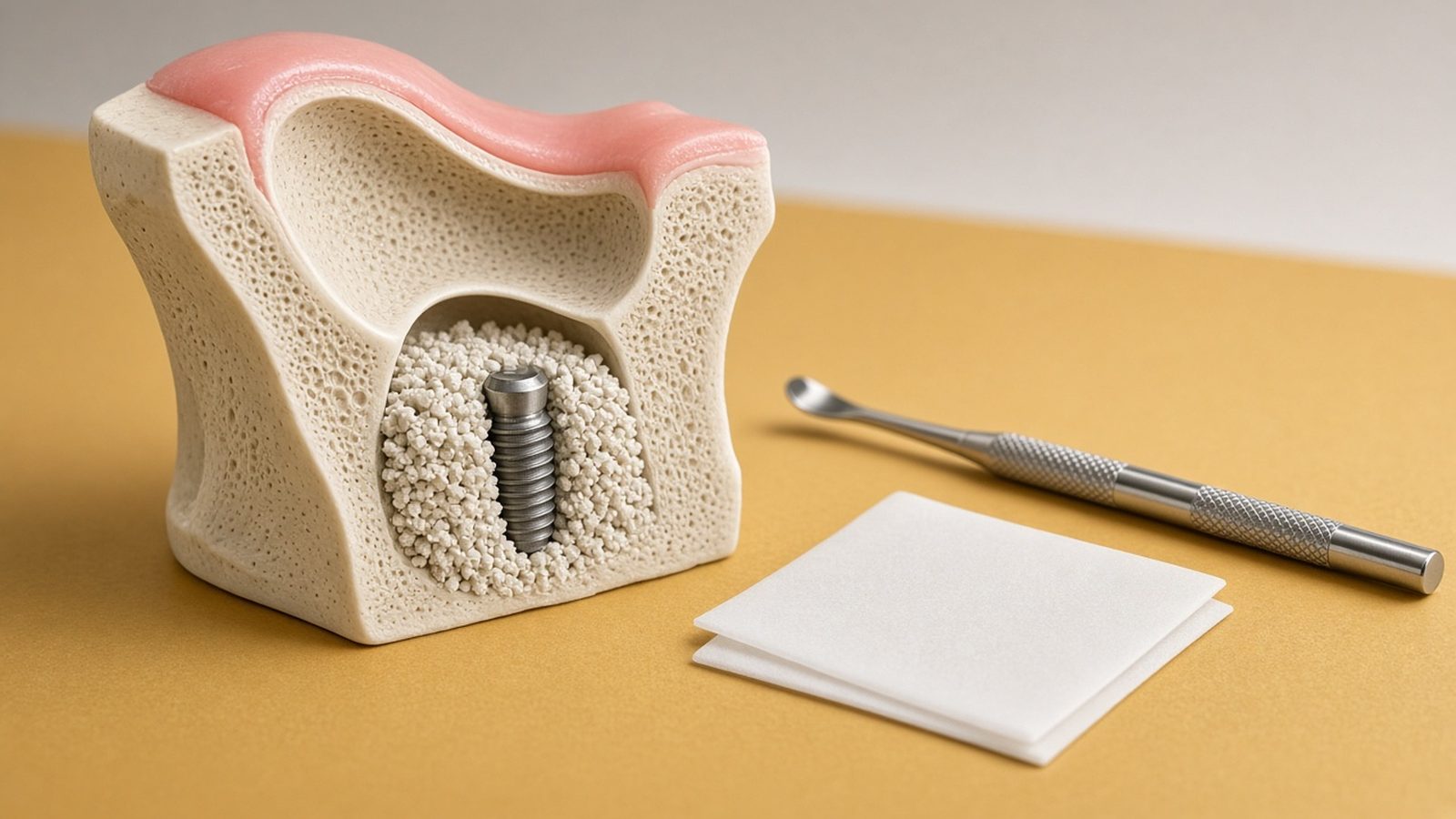
When teeth are removed, the empty sockets can be packed with graft material to limit shrinkage and fill gaps around new implants. In full-arch cases this is often done during the same surgery as the extractions and implants.
The research behind it is modest. A 2021 Cochrane review of ridge preservation after extraction included 16 randomized trials and found that grafting sockets with animal-derived material may reduce the loss of ridge width and height by roughly 1 to 1.4 millimeters at six months compared with extraction alone, but the certainty of that evidence was very low. The review found no clear difference in the need for more grafting later or in implant failure, and no clear winner among graft materials. In plain terms: socket grafting is a common, reasonable step, decided site by site.
Ridge augmentation for a thin or short ridge
Tilted implants still need solid bone at the front of the jaw. If the front ridge is too thin or too short, the surgeon may need to build it up first. The American Academy of Periodontology describes ridge modification as lifting the gum, filling the area of missing bone with graft material and letting it heal, usually for four to 12 months before implants go in. In some cases the implant can be placed at the same time. This is the kind of grafting that most often turns a one-surgery plan into a two-stage plan.
Sinus lift for the upper back jaw
In the upper jaw, the sinus sits just above the back teeth. After those teeth are lost, there may be little bone left under it. A sinus lift raises the sinus floor and places graft material underneath. The American Academy of Periodontology notes that the new bone usually develops for four to 12 months before implants are placed, though in some cases the implant can go in during the same surgery.
Many All-on-4 plans avoid a sinus lift by tilting the back implants; plans with more implants toward the back are more likely to include one. Our article comparing All-on-4 and All-on-6 explains why implant count changes that question, and our guide to sinus lifts versus zygomatic and pterygoid implants compares the upper-jaw options side by side.
Some plans also include soft tissue grafting, which adds or thickens gum tissue rather than bone. Our overview of bone and tissue reconstruction explains how bone and gum support work together.
Same day or staged: what grafting means for your trips from DFW
When grafting happens during implant surgery, it usually does not add trips. When it has to heal first, it adds a surgery, a healing period and more driving.
The table shows the general pattern, not a promise about your case. Healing times vary with graft size and your health.
| Type of bone work | Usually done | Effect on timeline and trips |
|---|---|---|
| Bone reshaping (alveoloplasty) | During implant surgery | No separate stage; usually no extra trip |
| Socket grafting | During extractions and implants | No separate stage; usually no extra trip |
| Small graft around an implant | During implant surgery | Heals with the implants; usually no extra trip |
| Ridge augmentation | Before implants, sometimes same day | Often 4 to 12 months first; extra surgery and visits |
| Sinus lift | Before implants, sometimes same day | Often 4 to 12 months first; extra surgery and visits |
A staged graft means an extra surgery day and at least one healing check before implant surgery. From Dallas or Fort Worth, Hutto is roughly a three-hour drive and Katy roughly four and a half to five hours, so plan for it early. Our article on budgeting for full-arch implants from DFW walks through travel, time off and lodging.
If your plan is staged, ask two things up front: what teeth you will wear while the graft heals, and which visits might be done by phone or video rather than in person.
What bone graft material is made of
Dental bone graft material comes from one of four sources, and it works mainly as a scaffold that your own bone grows into.
Cleveland Clinic describes four types:
- Autogenous bone (autograft): your own bone. In full-arch surgery, bone removed while reshaping the ridge can sometimes be reused, so a separate donor site is not always needed.
- Allograft: human donor bone from a licensed tissue bank.
- Xenograft: animal-derived bone, most often from cows or pigs.
- Alloplast: lab-made bone substitute, such as hydroxyapatite.
The graft is often covered with a thin membrane, and some surgeons add a concentrate made from a small sample of your own blood. If you have religious, dietary or personal concerns about donor or animal-derived material, say so at your consultation. As the Cochrane review found, the evidence does not show one socket-grafting material clearly beating the others.
When grafting is not the best answer
For some patients with severe bone loss, the better path is to use bone that is already there, in a different place, instead of building new bone.
Options include:
- Tilted implants in an All-on-X layout, as described above.
- Pterygoid implants, which anchor in dense bone at the very back of the upper jaw.
- Zygomatic implants, which anchor in the cheekbone when the upper jaw has very little bone left. Our article on zygomatic implant surgery and recovery for DFW patients explains what that surgery involves.
- A snap-on implant overdenture, which can sometimes work with fewer implants where bone is available.
Each has its own risks and trade-offs, and none is right for everyone. See our guides to options after a failed bone graft, severe lower-jaw bone loss and being told you are not a candidate.
What your 3D scan has to show
The grafting decision is made from a CBCT scan, a 3D x-ray, not from a flat x-ray or a quick look.
A panoramic x-ray shows height in two dimensions. A CBCT scan shows width, height and shape in three, along with the sinuses and lower-jaw nerve. With that scan and a design of your new teeth, the team can see:
- Where implants can go in existing bone, and whether the front of the jaw is wide and tall enough for tilted implants.
- How close the sinus or nerve is to each planned site.
- How much bone reshaping the tooth design calls for.
- Whether any site has a defect from infection or an old implant.
If you already have a recent CBCT from another office, ask whether it can be reviewed. Our article on guided implant surgery explains how a scan-based plan can be carried into surgery.
Recovery and risks when grafting is part of your surgery
Most early recovery comes from the extractions and implants. Grafting adds a few rules, a longer healing timeline inside the bone and some specific risks.
According to Cleveland Clinic, initial healing after a dental bone graft takes about a week, the graft itself needs at least three months to heal, and large grafts can take nine to 12 months. Tenderness, swelling and bruising are common in the first week or two, and small, sand-like bits of graft material may come out in the first few days. General tips include ice, keeping your head raised, soft foods, no vigorous spitting or rinsing and no smoking or vaping. Your surgical team's instructions come first, and our article on what to eat after All-on-4 covers diet.
The same source lists infection, nerve injury, bleeding and anesthesia complications as possible risks and notes that grafts fail more often in people who smoke or have certain medical conditions. Call your surgical office if pain or swelling worsens after the first week, or if you notice pus, drainage or fever. To lower your risk:
- Stop smoking and vaping well before surgery and through healing. Our article on smoking and dental implants explains why.
- Tell the team about diabetes, osteoporosis treatment, past head and neck radiation and every medication you take.
- Keep every healing check, even when that means a long drive, and ask whether your team wants you to stay nearby the first night.
How our team plans bone work
At Regional Implant Centers, the bone plan is built backward from the teeth, and the same specialist team handles the design, the scan, the surgery and the bridge.
- Teeth first. Under our RISE Protocol, the prosthodontist maps out your bite, facial support, speech and the long-term plan for your new teeth before surgery begins, and the bone plan follows.
- 3D imaging. Both our Hutto and Katy offices have mobile cone beam CT, which shows bone volume, nerve pathways and sinus position and can capture updated scans during surgery when appropriate.
- Surgery and reconstruction under one roof. The oral surgeon focuses on implant placement, bone reconstruction and surgical execution. Our bone and tissue reconstruction services include bone grafting, ridge augmentation, socket preservation, soft tissue grafting when appropriate and staged reconstruction when needed. Our oral surgery services include extractions and bone shaping. Reconstruction is not required for every patient.
- Sinus lifts and advanced options. Regional Implant Centers offers sinus lifts, and for patients who need them, zygomatic and pterygoid implants performed by Dr. Dan Holtzclaw and Dr. Enrique Tabarini.
- Anesthesia and safety. An anesthesiologist focuses on your safety, comfort and monitoring, with local anesthesia, IV sedation or general anesthesia, in a very safe surgical facility with the highest standards of care. See our anesthesia and patient comfort page.
- Teeth the same day. On the day of full-arch implant surgery, every patient leaves with teeth. Those teeth are temporary; our article on same-day teeth versus final teeth explains the difference.
- Final teeth. Final arches are made in full monolithic zirconia or titanium-reinforced zirconia and are delivered in about 1 to 4 months, depending on healing. Most cases take about 4 to 5 visits in total. A staged graft before the implants can add visits, so ask how your plan affects that number.
- Lab and aftercare. Our in-house dental lab is at the Katy office, and long-term care runs through our maintenance packages.
No graft, implant or technology guarantees a result. Healing depends on your health, your bone, your habits and your follow-up care, and not every patient is a candidate for fixed full-arch teeth.
Hutto or Katy if you may need grafting
For most DFW patients, Hutto is the shorter drive, and it handles the bone work that full-arch cases most often need.
Our Hutto office does bone grafting and sinus work, has CBCT imaging and has an anesthesiologist on site. It is about 75 to 85 miles closer to Dallas and Fort Worth than Katy. Our Katy office is home to our in-house lab and also has mobile CBCT. Both offices offer traditional dentures, snap-on implant overdentures and fixed full-arch teeth. The better fit can depend on your case and where you have support after surgery.
Questions to ask about any bone graft in your plan
Whether you see us or a DFW office, ask:
- Is there a bone graft in my plan, and is it a separate surgery or part of implant surgery?
- Which sites need it, what did my CBCT show there, and is it grafting, reshaping or both?
- Could tilted, pterygoid or zygomatic implants, or a different implant count, avoid a staged graft in my case? What are the trade-offs?
- What graft material will you use, and are there alternatives if I prefer not to have donor or animal-derived material?
- How long must the graft heal before implants, and what will I wear during that time?
- How many trips will a staged plan add, and can any follow-ups be done by phone or video?
- Which parts of the bone work might my medical insurance help with, and what will I pay out of pocket?
For the insurance side of a quote, see our article on whether insurance covers All-on-4 for DFW patients.
A note on insurance and financing
Bone grafting is one of the surgical services that medical insurance may help with, but the implants and teeth are billed separately. At Regional Implant Centers, medical insurance is billed only for surgical professional services, such as extractions, bone grafting and alveoloplasty. Implants, temporaries and the final bridge are billed to the patient separately. Only PPO plans work for out-of-network oral surgery benefits, and most BCBS PPO plans with oral surgery coverage are worth checking, please verify with your plan. We cannot bill Federal Employee Program (FEP) Blue Cross Blue Shield plans. Our Insurance Advantage team reviews dental and medical benefits and explains estimated out-of-pocket costs, but coverage is never guaranteed. Financing through independent third-party companies is available, subject to each provider's approval. See our insurance experts page for more.
Visiting our offices from Dallas-Fort Worth
DFW patients come to one of our two offices:
- Hutto (Austin area): 201 E Wilco Hwy, Suite 203, Hutto, TX 78634. See our Hutto location page.
- Katy (Houston area): 707 S Fry Rd, Suite 150, Katy, TX 77450. See our Katy location page and our Katy full-mouth dental implants page.
Frequently asked questions
Do you always need a bone graft for All-on-4?
No. Many patients do not need a separate graft surgery because the implants can be angled into existing bone. Small grafts in extraction sockets and bone reshaping are common during surgery, and a staged graft is needed only in some cases. A CBCT scan and exam decide which applies to you.
What is the difference between a bone graft and bone reshaping?
A bone graft adds material to build or preserve bone. Bone reshaping, or alveoloplasty, removes and smooths bone so a full-arch bridge has room and its seam stays hidden. Many full-arch surgeries include reshaping, and some include both.
How long does a bone graft need to heal before implants?
When grafting is done during implant surgery, it heals alongside the implants. When it is staged, healing usually takes several months, often four to 12 months for a sinus lift or ridge augmentation, before implants are placed. Your surgeon sets the timing for your case.
What are dental bone grafts made of?
Graft material can be your own bone, human donor bone, animal-derived bone or a lab-made substitute. It acts as a scaffold for your own bone to grow into. Tell your team if you prefer to avoid a certain type.
Will insurance help pay for a bone graft?
Sometimes. At Regional Implant Centers, medical insurance is billed only for surgical services such as extractions, bone grafting and alveoloplasty, and PPO plans with oral surgery coverage are worth checking, please verify with your plan. Implants and teeth are billed to the patient, and coverage is never guaranteed.
Find out what your bone can support
The only way to know whether your All-on-4 or All-on-X plan needs a graft is an exam and a 3D scan. To schedule a consultation, call (832) 632-7037 or book online for our Hutto office or our Katy office. You can also start at our main scheduling page.
Sources & Resources
- Patzelt SB, Bahat O, Reynolds MA, Strub JR. The all-on-four treatment concept: a systematic review. Clinical Implant Dentistry and Related Research. 2014.
- Tan WL, Wong TL, Wong MC, Lang NP. A systematic review of post-extractional alveolar hard and soft tissue dimensional changes in humans. Clinical Oral Implants Research. 2012.
- Atieh MA, Alsabeeha NH, Payne AG, et al. Interventions for replacing missing teeth: alveolar ridge preservation techniques for dental implant site development. Cochrane Database of Systematic Reviews. 2021.
- American Academy of Periodontology. Ridge Modification.
- American Academy of Periodontology. Sinus Augmentation.
- Cleveland Clinic. Dental Bone Graft.
This article is general patient education. It is not medical or dental advice, a diagnosis or a treatment plan. Whether you need bone grafting, and what kind, can only be decided after an exam and imaging. Not every patient is a candidate for dental implants or fixed full-arch teeth. Insurance coverage varies by plan and is never guaranteed; please verify your benefits with your plan.
Ready to Learn What Is Possible?
Schedule a consultation with Regional Implant Centers.
Schedule ConsultationFrequently Asked Questions
Do you always need a bone graft for All-on-4?
No. Many patients do not need a separate graft surgery because the implants can be angled into existing bone. Small grafts in extraction sockets and bone reshaping are common during surgery, and a staged graft is needed only in some cases. A CBCT scan and exam decide which applies to you.
What is the difference between a bone graft and bone reshaping?
A bone graft adds material to build or preserve bone. Bone reshaping, or alveoloplasty, removes and smooths bone so a full-arch bridge has room and its seam stays hidden. Many full-arch surgeries include reshaping, and some include both.
How long does a bone graft need to heal before implants?
When grafting is done during implant surgery, it heals alongside the implants. When it is staged, healing usually takes several months, often four to 12 months for a sinus lift or ridge augmentation, before implants are placed. Your surgeon sets the timing for your case.
What are dental bone grafts made of?
Graft material can be your own bone, human donor bone, animal-derived bone or a lab-made substitute. It acts as a scaffold for your own bone to grow into. Tell your team if you prefer to avoid a certain type.
Will insurance help pay for a bone graft?
Sometimes. At Regional Implant Centers, medical insurance is billed only for surgical services such as extractions, bone grafting and alveoloplasty, and PPO plans with oral surgery coverage are worth checking, please verify with your plan. Implants and teeth are billed to the patient, and coverage is never guaranteed.
This content is educational and not a substitute for a consultation.