Research & Evidence-Based Dentistry
What Full-Arch Implant Research Actually Shows: A Guide for Austin-Area Patients
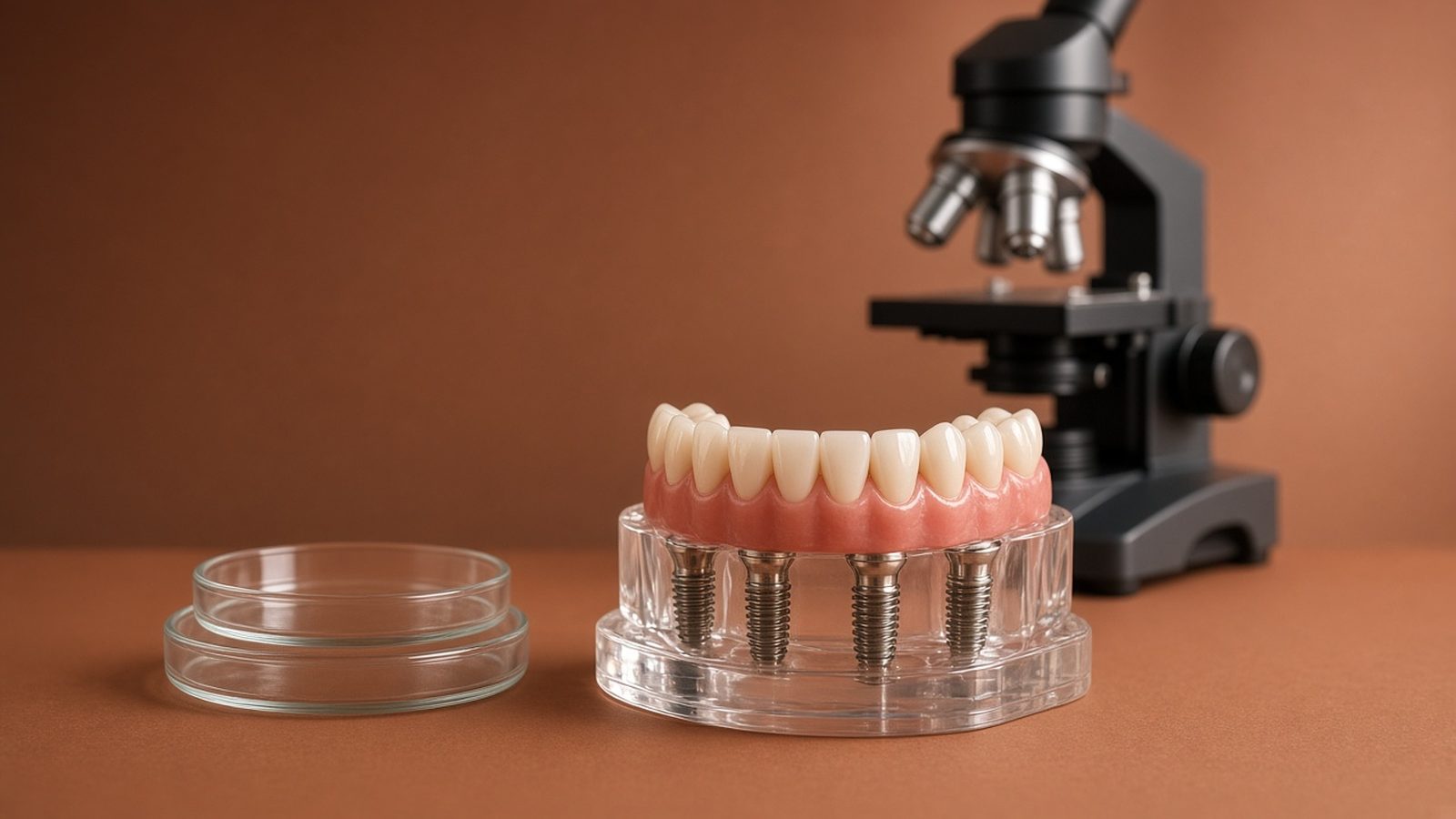
What long-term studies say about full-arch implants, same-day teeth, repairs and risk factors, and what the numbers cannot tell you about your own case.
If you have been reading about All-on-4 or other full-arch implant treatment, you have probably seen numbers like "98 percent success" in ads, on clinic pages and in social media videos. Those numbers come from somewhere, but they rarely come with the details that tell you what they mean for you. This guide is for patients in Austin, Round Rock, Pflugerville, Cedar Park, Georgetown and Hutto who want to understand what the research on full-arch implants says, how strong that evidence is, and what it cannot tell you about your own mouth.
We are not going to summarize every study. We picked a handful of well-known papers that answer the questions patients ask us most: how often the implants and the teeth hold up, whether same-day teeth are as safe as waiting, what tends to go wrong over the years, and which habits and health factors change the odds. Each one is listed at the end with a link so you can read the abstract yourself.
If your main question is how many years implants usually last, our article on how long dental implants last covers that directly. This page is about the evidence behind the treatment and how to judge the claims you see.
The short answer
Long-term studies of full-arch implant bridges report that most implants and most bridges are still working after 10 years or more, but those results come from selected patients who were followed closely, and repairs and maintenance along the way are common, not rare. Smoking, a history of gum disease and skipping maintenance visits show up again and again as factors that change the odds. A study's headline number describes a group of people. Whether you fit that group is something only an exam, a 3D scan and a plan built around your final teeth can tell you.
Why "success rate" can mean three different things
Before looking at any study, it helps to know what is being counted. Research on full-arch implants usually reports some mix of these:
- Implant survival: the implant is still in the jaw at follow-up. It says nothing about whether the bone or gums around it are healthy.
- Implant success: the implant is still in place and also meets a set of health criteria, such as limited bone loss and no ongoing infection or pain. Different studies use different criteria, so success numbers are harder to compare.
- Prosthesis survival or success: the bridge of teeth is still in use. A bridge can stay in use even after one implant under it is lost, if the remaining implants can support it, which is one reason prosthesis numbers are often higher than implant numbers.
When you see a single percentage without being told which of these it is, how many people were studied and for how long, it is not yet useful information. That is not a reason to distrust it. It is a reason to ask.
What one of the largest long-term All-on-4 studies reported
One of the most cited sources is a 2019 study from the clinic in Lisbon where the All-on-4 concept was developed. It followed 1,072 patients who had 4,288 implants placed in the upper jaw with that approach, with follow-up from 5 to 13 years.
What the authors reported:
- Prosthetic success was 99.2 percent.
- Implant cumulative survival was 94.7 percent and implant success was 93.9 percent, with up to 13 years of follow-up.
- Average bone loss around the implants was 1.18 mm at 5 years and 1.67 mm at 10 years.
- Smoking was linked to implant failure, to more bone loss and to more biological complications. Male gender was also linked to implant failure in this group.
- Mechanical complications, such as fractures or loosening, occurred in 58.8 percent of the provisional (temporary) bridges and 7.3 percent of the definitive (final) bridges.
What to keep in mind when you read those numbers:
- It is a retrospective case series from a single, highly experienced clinic, not a trial that compared one treatment against another.
- About one in five patients (20.4 percent) were lost to follow-up. We do not know how those patients did.
- The temporary bridge numbers matter. A temporary set of teeth is built to be worn during healing and is more likely to need repairs than the final bridge. That matches what many patients experience: the first months are the time for careful chewing and close follow-up.
The fair reading is that the approach can work very well over the long term in the hands of a team that plans carefully and keeps seeing its patients. It is not proof that every clinic, or every patient, will get the same result.
Same-day teeth versus waiting: what the review found
Many full-arch plans attach a fixed temporary bridge to the implants the same day they are placed. That is called immediate loading. The older approach is to let the implants heal for a few months before attaching teeth.
A Cochrane systematic review, a type of review that pools randomized trials and grades their quality, looked at this question across 26 trials with 1,217 participants and 2,120 implants. Its main findings:
- Across all 26 trials, the average implant failure rate in the first year was 2.5 percent.
- Comparing immediate loading with conventional loading, the review found no evidence of a difference in implant failure or prosthesis failure in the first year.
- There was a very small difference in bone loss favoring immediate loading, about a tenth of a millimeter, which the authors said may not be clinically important.
- The authors rated the overall quality of the evidence as very low, because many of the trials had a high or unclear risk of bias, and they asked for better-designed studies.
- They noted that a high insertion torque, at least 35 Ncm, seems to be one of the prerequisites for successful immediate or early loading. Insertion torque is a measure of how firmly an implant is held by the bone when it is placed.
Two practical points come out of this. First, same-day teeth are not a shortcut that the research says is riskier, as long as the case is right for it. Second, "right for it" depends on how firmly the implants are anchored at surgery, which is measured in the operating room, not promised in a consultation.
At Regional Implant Centers, many patients are able to leave surgery with a fixed temporary set of teeth on the same day as implant placement. Your treatment plan, and what the surgeon finds during surgery, determine whether immediate teeth are appropriate for your case. Those teeth are temporary. They are worn while the implants heal, and the final bridge is made later. Our article on temporary versus final teeth explains that sequence in more detail.
Repairs over the years are part of the picture
A 2012 systematic review from a group at the Harvard School of Dental Medicine looked at complications with fixed full-arch implant bridges in studies that followed patients for at least 5 years. It is one of the more sobering papers on this topic, and one of the most useful.
The review estimated that only 29.3 percent of bridges were free of any complication after 5 years and 8.6 percent after 10 years. The complications it counted were mostly the kind that are repaired rather than the kind that end treatment:
- Chipping or fracture of the veneering material on the teeth was the most common prosthesis problem.
- Screw fracture was the most common implant-related technical problem.
- Bone loss of more than 2 mm around implants and overgrowth of gum tissue around the bridge were the most common biological findings.
The authors concluded that these events occur continuously over time from fatigue and stress, and that they may not lead to implant or bridge failure, but that they matter in terms of repair, maintenance, time and cost for both the clinician and the patient.
Many of the bridges in that review were older designs, and materials have changed since then. Still, the lesson holds. A full-arch bridge is something you chew on thousands of times a day for years. Planning for checkups, cleanings, screw checks and the occasional repair is more realistic than expecting nothing to happen. If you want to compare today's final bridge materials, see our article on zirconia versus acrylic full-arch teeth. If you grind or clench, teeth grinding and All-on-4 covers why a night guard is often part of the plan.
What raises the odds of problems, and how strong the evidence is
Not every risk factor you read about online has the same weight behind it. Here is what the sources we checked say.
Smoking
A 2015 systematic review and meta-analysis pooled 107 studies. Implants placed in smokers failed at a rate of 6.35 percent compared with 3.18 percent in nonsmokers, a risk about 2.2 times higher. Smokers also had more infections after surgery and more bone loss around implants. The authors cautioned that many included studies did not control for other factors, so the exact size of the effect is uncertain, but the direction is consistent across studies, including the long-term All-on-4 series above. If you vape, use nicotine pouches or use cannabis, our Austin article on vaping and implants covers what is known and what is not.
A history of gum disease
In 2017, an international workshop of periodontal and implant specialists reviewed the evidence on peri-implantitis, an infection that destroys bone around implants. Its consensus report found strong evidence that the risk is higher in people with a history of severe periodontitis (gum disease), poor plaque control and no regular maintenance care after implant treatment. Many people who need full-arch treatment lost their teeth to gum disease, so this one applies to a lot of our patients. It does not rule them out. It means cleaning access, home care and follow-up deserve extra attention. Our article on dental implants with gum disease goes further.
Smoking and diabetes as causes of peri-implantitis: less settled than you might think
The same 2017 consensus report called the evidence that smoking and diabetes are risk indicators specifically for peri-implantitis inconclusive. That can sound like it conflicts with the smoking section above, but the two findings measure different things. Smoking is consistently linked to implants failing to heal in and to bone loss, while the evidence tying it to the later gum-and-bone infection around implants is mixed. For diabetes, most guidance focuses on how well blood sugar is controlled at the time of surgery and during healing. If you have diabetes, our article on dental implants with diabetes explains what is usually checked.
Skipping maintenance
This is the factor you control most directly. A 5-year study published in 2012 followed 80 people who already had peri-implant mucositis, an early, reversible gum inflammation around implants. Among those who kept up preventive maintenance visits, 18.0 percent went on to develop peri-implantitis. Among those who did not, 43.9 percent did. It was a small study in patients with single and partial implants, not full-arch bridges, but it lines up with the 2017 consensus, which lists lack of regular maintenance among the factors with strong evidence.
What the research cannot tell you about your case
Studies describe groups. You are one person, and several things that matter most are only known after an exam and imaging:
- How much bone you have and where it is. A 3D cone beam CT (CBCT) scan shows bone height, width and density, the position of the sinuses and nerves, and how the bone relates to where your teeth should sit.
- Whether your case fits a standard design or needs something else. Some patients need bone grafting or a sinus lift. Some with severe upper jaw bone loss are evaluated for zygomatic or pterygoid implants, which anchor in denser bone further back or higher in the face. Our article on sinus lift versus zygomatic implants compares those paths.
- Your health picture. Medications, past radiation, bone-strengthening drugs, heart conditions and diabetes control all affect planning and timing.
- Your bite and habits. Grinding, a strong bite, or opposing natural teeth change how a bridge is designed and maintained.
- Whether you will keep up with follow-up. The research is clear that this changes outcomes.
That is also why a full-arch implant plan is not right for everyone. Some patients are better served by a snap-on implant overdenture or a well-made traditional denture, and some need other treatment first. Our article for patients who were told they are not a candidate for dental implants covers the options when the standard answer does not fit.
How our team uses this evidence at the Hutto office
The research above keeps pointing to the same things: careful planning, firm implant anchorage before same-day teeth, a bite and bridge design that limit stress, and long-term maintenance. That is close to how the RISE Protocol is organized at Regional Implant Centers.
- The teeth are planned first. Your prosthodontist maps out your bite, facial support, speech and the long-term plan for your new teeth before surgery begins, so the implants are placed to support the teeth that were planned. Our article on why the final teeth should guide surgery planning explains why that order matters.
- Surgery is done by surgeons who focus on surgery. The oral surgeon focuses on implant placement, bone reconstruction and surgical execution. Our Hutto office does bone grafting and sinus procedures. For patients who need them, Regional Implant Centers also offers zygomatic and pterygoid implants, performed by Dr. Dan Holtzclaw and Dr. Enrique Tabarini.
- Imaging is part of the plan. The Hutto office has CBCT imaging, so your bone and anatomy are reviewed in 3D before decisions are made. You can read more about our mobile cone beam CT technology.
- Anesthesia has its own provider. The Hutto office has an on-site anesthesia provider who is a dentist anesthesiologist, so the person monitoring you is not also the person doing the surgery. Options may include IV sedation or general anesthesia, and monitoring covers oxygen levels, breathing, heart rate and blood pressure. See anesthesia and patient comfort for more.
- The teeth are made by our own lab. Final bridges are made in our in-house dental lab, which is located at our Katy office.
- Maintenance is built in. After your final bridge is delivered, ongoing care runs through a required Maintenance Package rather than a traditional implant warranty, and enrollment begins within 30 days of delivery. The details are on our implant warranty page and maintenance packages page. Our article on cleaning and maintaining All-on-4 teeth covers what a maintenance visit involves.
None of this guarantees a result. Implant and prosthetic outcomes depend on biology, healing, hygiene, habits, follow-up care and long-term maintenance, which is exactly what the studies show.
Questions to ask about any full-arch plan
Whether you are seeing us or getting a second opinion elsewhere, these questions turn research into something you can use:
- When you quote a success rate, is that implant survival, implant success or bridge survival, and over how many years?
- Does that number come from your own patients or from published studies?
- What did my CBCT scan show about my bone, and does my case need grafting, a sinus lift or a different implant approach?
- Who plans my final teeth, and is that done before surgery?
- What will decide on surgery day whether I get same-day teeth?
- What are my temporary teeth made of, how long will I wear them, and what should I avoid chewing?
- What is my personal risk picture, such as smoking, gum disease history, diabetes, grinding or medications, and what are we doing about each one?
- What does maintenance look like each year, and what is and is not covered?
Our article on comparing full-arch implant quotes in the Austin area has more questions about what a plan includes.
A note on insurance and financing
Research does not change how insurance works, so it is worth being clear. At Regional Implant Centers, medical insurance is billed only for surgical professional services, such as extractions, bone grafting and similar oral surgery. Implants, temporaries and the final bridge are billed to the patient separately. Only PPO plans work for out-of-network oral surgery benefits, and most BCBS PPO plans with oral surgery coverage are worth checking, please verify with your plan. We cannot bill Federal Employee Program (FEP) Blue Cross Blue Shield plans. Our Insurance Advantage team reviews dental and medical benefits and explains estimated out-of-pocket costs, but coverage is never guaranteed. Financing through independent third-party companies is available, subject to each provider's approval. See our insurance experts page and our article on dental implant financing in Austin.
Visiting our Hutto office from the Austin area
Our Austin-area office is at 201 E Wilco Hwy STE 203, Hutto, TX 78634, on US-79. Patients come to us from Austin, Round Rock, Pflugerville, Cedar Park, Georgetown and nearby communities. We do not have offices in those cities; Hutto is our Austin-area location. You can learn more on our Hutto location page or in our article on full-mouth dental implants near Austin.
Frequently asked questions
What is the success rate of All-on-4 implants?
It depends on what is measured. In one large long-term study of upper-jaw All-on-4 treatment with up to 13 years of follow-up, implant survival was 94.7 percent and prosthetic success was 99.2 percent. Those figures come from one experienced clinic and selected patients, and about 20 percent were lost to follow-up, so they describe what is possible rather than a promise for any individual.
Is getting teeth the same day as surgery riskier than waiting?
A Cochrane review of randomized trials found no evidence of a difference in implant or prosthesis failure in the first year between immediate and conventional loading, although the quality of the evidence was rated very low. Firm implant anchorage at surgery appears to be an important prerequisite, so whether same-day teeth are appropriate is decided case by case.
What is the biggest factor I can control after full-arch implants?
Maintenance and home care. A 2017 international consensus found strong evidence that the risk of peri-implantitis is higher in people with poor plaque control and no regular maintenance. Not smoking also matters, since smoking is consistently linked to higher implant failure.
Do full-arch implant bridges need repairs?
Often, at some point. A systematic review of fixed full-arch bridges followed for at least 5 years found that most had at least one complication by 10 years, most commonly chipping of the tooth material or a screw problem. Most of these are repaired rather than ending treatment, which is why regular checkups matter.
Can I have full-arch implants if I lost my teeth to gum disease?
Many people can, but a history of severe gum disease is linked to a higher risk of peri-implantitis, so cleaning access, home care and maintenance get extra attention. Whether you are a candidate depends on an exam, imaging and your overall health.
Talk through your own case
Published research can tell you what is possible. An exam, a 3D scan and a plan built around your final teeth can tell you what is likely for you. To schedule a consultation at our Hutto office, call (832) 632-7037 or book online for the Austin area. You can also start at our main scheduling page.
Sources & Resources
- Malo P, de Araujo Nobre M, Lopes A, Ferro A, Nunes M. The All-on-4 concept for full-arch rehabilitation of the edentulous maxillae: a longitudinal study with 5-13 years of follow-up. Clinical Implant Dentistry and Related Research. 2019.
- Esposito M, Grusovin MG, Maghaireh H, Worthington HV. Interventions for replacing missing teeth: different times for loading dental implants. Cochrane Database of Systematic Reviews. 2013. Plain-language summary at Cochrane.
- Papaspyridakos P, Chen CJ, Chuang SK, Weber HP, Gallucci GO. A systematic review of biologic and technical complications with fixed implant rehabilitations for edentulous patients. International Journal of Oral and Maxillofacial Implants. 2012.
- Chrcanovic BR, Albrektsson T, Wennerberg A. Smoking and dental implants: a systematic review and meta-analysis. Journal of Dentistry. 2015.
- Berglundh T, Armitage G, Araujo MG, et al. Peri-implant diseases and conditions: consensus report of workgroup 4 of the 2017 World Workshop on the Classification of Periodontal and Peri-Implant Diseases and Conditions. Journal of Clinical Periodontology. 2018.
- Costa FO, Takenaka-Martinez S, Cota LO, Ferreira SD, Silva GL, Costa JE. Peri-implant disease in subjects with and without preventive maintenance: a 5-year follow-up. Journal of Clinical Periodontology. 2012.
This article is general patient education. It is not medical or dental advice, a diagnosis or a treatment plan. Study results describe groups of patients and do not predict the outcome for any individual. Not every patient is a candidate for dental implants or same-day teeth. Insurance coverage varies by plan and is never guaranteed; please verify your benefits with your plan.
Ready to Learn What Is Possible?
Schedule a consultation with Regional Implant Centers.
Schedule ConsultationFrequently Asked Questions
What is the success rate of All-on-4 implants?
It depends on what is measured. In one large long-term study of upper-jaw All-on-4 treatment with up to 13 years of follow-up, implant survival was 94.7 percent and prosthetic success was 99.2 percent. Those figures come from one experienced clinic and selected patients, and about 20 percent were lost to follow-up, so they describe what is possible rather than a promise for any individual.
Is getting teeth the same day as surgery riskier than waiting?
A Cochrane review of randomized trials found no evidence of a difference in implant or prosthesis failure in the first year between immediate and conventional loading, although the quality of the evidence was rated very low. Firm implant anchorage at surgery appears to be an important prerequisite, so whether same-day teeth are appropriate is decided case by case.
What is the biggest factor I can control after full-arch implants?
Maintenance and home care. A 2017 international consensus found strong evidence that the risk of peri-implantitis is higher in people with poor plaque control and no regular maintenance. Not smoking also matters, since smoking is consistently linked to higher implant failure.
Do full-arch implant bridges need repairs?
Often, at some point. A systematic review of fixed full-arch bridges followed for at least 5 years found that most had at least one complication by 10 years, most commonly chipping of the tooth material or a screw problem. Most of these are repaired rather than ending treatment, which is why regular checkups matter.
Can I have full-arch implants if I lost my teeth to gum disease?
Many people can, but a history of severe gum disease is linked to a higher risk of peri-implantitis, so cleaning access, home care and maintenance get extra attention. Whether you are a candidate depends on an exam, imaging and your overall health.
This content is educational and not a substitute for a consultation.