Nutrition & Oral Health
Protein and Nutrition Before and After Full-Arch Implant Surgery: A Guide for Austin-Area Patients
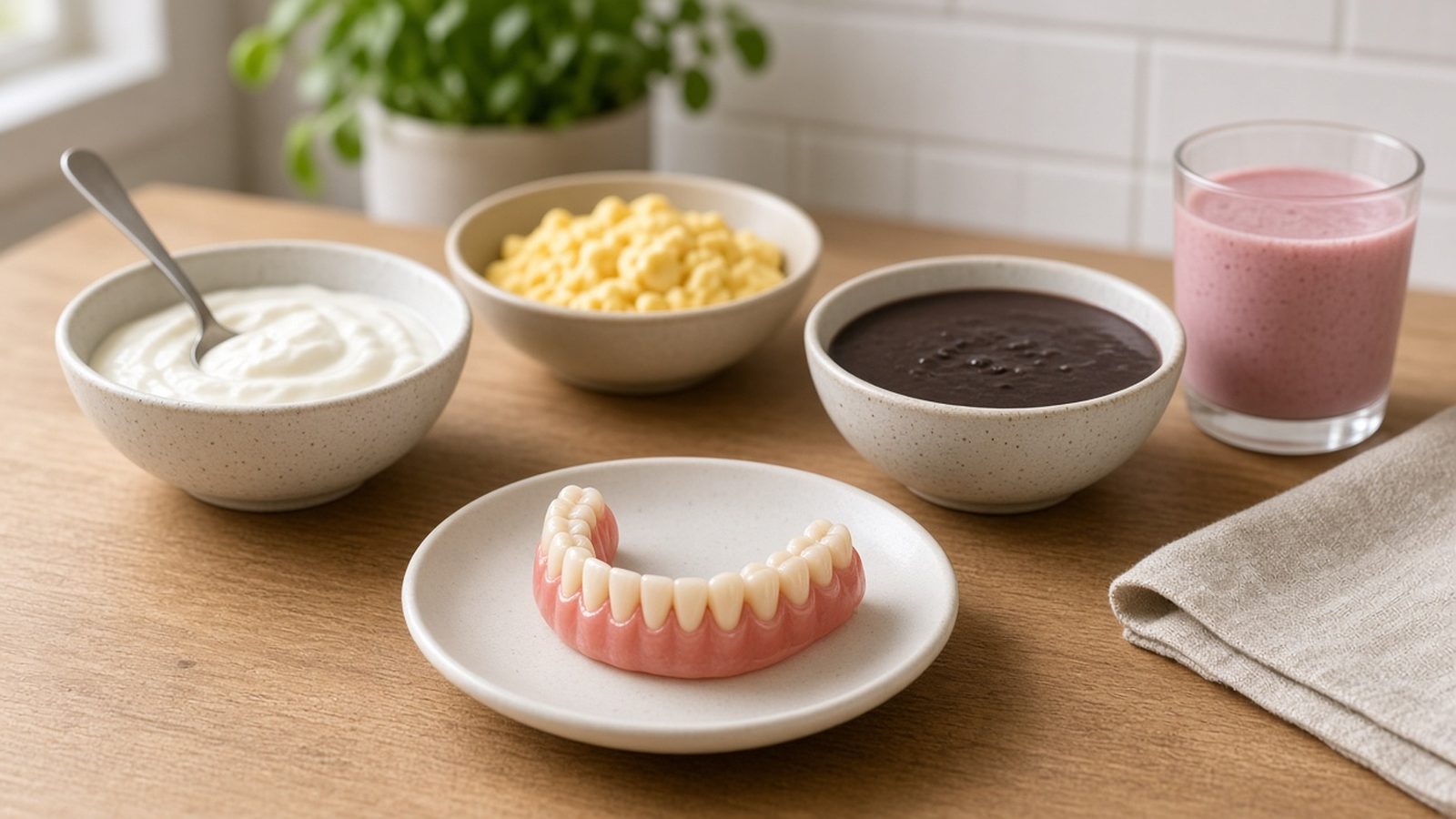
How to eat well before and after full-arch implant surgery: protein on a soft diet, supplement cautions and special rules for diabetes and kidney disease.
Protein and nutrition before and after full-arch implant surgery get less attention than they deserve. Most of the planning conversation is about implants, bone and anesthesia, yet the body doing the healing runs on food, and many people arrive at surgery after years of eating around loose, painful or missing teeth. This article is for patients in Austin, Hutto, Round Rock, Cedar Park, Pflugerville and Georgetown who are preparing for full-arch treatment at our Hutto office and want to go in well fed and come out with a plan for the months of soft food ahead.
We already have a week-by-week article on what to eat during All-on-4 recovery, with food lists, the fork test and the warning signs to call about. This one sits next to it. It covers the part that a food list does not: why protein runs short on a soft diet, how to check your nutrition before surgery, what to ask about supplements, and which health conditions change the rules.
This is general patient education, not a meal plan or medical advice. If you have diabetes, kidney disease or another condition that affects what you eat, your physician or a registered dietitian sets your targets, and your surgical team sets your texture and timing rules.
The short answer
Go into surgery as well nourished as you can, tell your team about any recent weight loss and every supplement you take, and plan your soft-food weeks around protein rather than around whatever is easiest to swallow. Do not start high-dose vitamins or other supplements on your own, and if you have kidney disease or diabetes, let your physician or dietitian decide how much protein and carbohydrate is right for you.
The rest of this article explains each of those points and where they come from.
Why nutrition matters more than people expect
Healing after oral surgery uses protein, calories and fluids, and a soft diet makes all three harder to get. People with failing teeth or loose dentures often start from behind.
The American Association of Oral and Maxillofacial Surgeons (AAOMS) says that after oral and maxillofacial surgery the body's nutrient needs increase to help it heal, and that incisions and swelling in and around the mouth can make chewing and swallowing difficult at exactly that moment. In a 2023 editorial in the Journal of Oral and Maxillofacial Surgery, Dr. Tara Aghaloo described adequate protein as a nutrient "with obvious importance for a surgical patient", because amino acids are needed to build collagen, and noted that every oral surgery involves healing of skin or the lining of the mouth. She also pointed out a practical problem: post-surgical diets are often blended or very soft, and tend to be high in carbohydrate and low in protein.
Then there is the starting point. Many people who need full-arch treatment have spent years avoiding meat, raw vegetables, nuts and anything that has to be bitten. Research on how tooth loss affects nutrition is mixed, and researchers are careful about cause and effect. Still, a 2022 meta-analysis in JDR Clinical and Translational Research, which pooled six studies of adults 60 and older, found that people who had lost all their teeth or lacked a functional set of teeth had about a 21 percent higher likelihood of being malnourished or at risk of malnutrition than people with adequate teeth. A 2022 systematic review of denture wearers found that dentures appear to help nutritional status compared with having no teeth, but that chewing ability remains reduced compared with people who have natural teeth.
None of this means you are malnourished because your teeth are failing. It means it is worth checking, because the soft-food stretch after surgery is a poor time to discover you were already short.
A nutrition check before your surgery date
In the weeks before surgery, take an honest look at your weight, appetite and what you have been avoiding, and share it with your team and your physician. Small problems are easier to correct before surgery than during healing.
You do not need lab work to start. Ask yourself:
- Have I lost weight in the last six months without trying?
- Have I been skipping meals because eating hurts, or living mostly on bread, pasta, rice and soup?
- Which foods have I stopped eating altogether, such as meat, fresh fruit or vegetables?
- Do I take vitamins, minerals, herbal products, protein powders or meal replacement drinks, and how much?
- Do I have diabetes, kidney disease, heart disease, a history of bariatric surgery or a condition that restricts my diet?
- Do I drink alcohol most days?
If any answer worries you, tell the team at your consultation and bring it up with your primary care physician as well. Our Hutto office reviews your medical history as part of planning, and our dental clearance and physician communication page explains how the team works with physicians when medical questions affect dental care. Whether you need blood work, and what it should include, is your physician's call.
Dr. Aghaloo's editorial raises vitamin D as an open question. Vitamin D deficiency is common and often undiagnosed, and a 2022 systematic review in the International Journal of Implant Dentistry found that animal studies link deficiency to poorer bone healing around implants. In humans, the authors found only slight evidence that supplementation helps implants bond to bone, based on two clinical studies and three case reports. That is a reason to ask your physician whether your vitamin D should be checked. It is not a reason to start taking a high dose on your own.
How much protein do you need?
For most healthy adults, the Recommended Dietary Allowance is a floor, not a target for healing. Surgery can raise your needs, but kidney disease and some other conditions lower the safe amount, so get a personal number from your physician or a registered dietitian.
A few reference points help you think about it:
- The Academy of Nutrition and Dietetics lists the Recommended Dietary Allowance (RDA) as 46 grams of protein a day for women and 56 grams for men age 19 and older, and notes that needs vary with activity and medical conditions.
- MedlinePlus, from the National Library of Medicine, puts healthy adult intake at 10 to 35 percent of total calories, and gives a simple rule: about 7 grams of protein in 1 ounce of meat, fish or poultry, one large egg, a quarter cup of tofu or half a cup of cooked beans or lentils.
- AAOMS notes that protein needs may increase after surgery to promote healing, and gives a general figure for the healing period of about half a gram of protein per pound of body weight.
- A protein fact sheet from the U.S. Administration for Community Living notes that research suggests older adults may need more protein than younger adults, and makes an explicit exception for people with kidney disease.
Those numbers do not agree with each other perfectly, which is the point. A 130-pound woman with healthy kidneys, a 230-pound man with type 2 diabetes and an 80-year-old with early kidney disease should not be using the same target. Use the figures to start a conversation with your physician or dietitian, not to set your own plan.
Why soft diets run low on protein, and how to fix it
The easiest soft foods, such as broth, applesauce, pudding, juice and plain mashed potatoes, carry very little protein. The fix is to build each soft meal around a protein food and let the starch play a supporting role.
Picture a typical first week on a soft diet: broth at lunch, applesauce and pudding as snacks, mashed potatoes at dinner. It goes down easily and fills you up, yet it supplies very little protein. Add a few weeks of eating that way to the strain of surgery, and it is easy to see how people lose weight and strength during healing.
The swaps below keep the texture soft while moving protein to the center of the plate. Your surgical team decides which textures you are allowed and when, so check each idea against your written instructions.
| Low-protein soft food | Protein-forward swap (once your team allows the texture) |
|---|---|
| Plain broth | Blended bean, lentil or split pea soup, or broth with smooth blended chicken or tofu |
| Applesauce or pudding as a snack | Plain or Greek yogurt, cottage cheese or a smooth milk-based shake |
| Mashed potatoes on their own | Mashed potatoes with a side of flaked fish, soft scrambled eggs or smooth refried beans |
| Plain oatmeal or grits made with water | Oatmeal or grits cooked in milk or a soy beverage, with a soft-scrambled egg on the side |
| Juice | Milk, a fortified soy beverage or a smoothie blended with yogurt |
| Plain pasta | Soft pasta with a smooth meat, lentil or ricotta sauce |
A few more habits help:
- Eat protein first. When your appetite is small, start the meal with the egg, fish, beans or yogurt and finish with the rest.
- Spread it out. The Administration for Community Living fact sheet advises older adults to spread protein through the day rather than saving it for one meal. AAOMS also notes that on a liquid diet, small amounts every few hours are often easier than three large meals.
- Use your blender. AAOMS recommends blending cooked portions of your favorite foods with milk, juice, water or broth to the consistency you need, and straining out particles when your surgeon asks for a smooth diet.
- Plan for plant-based eating if that is how you eat. MedlinePlus notes that you do not need animal products to get enough protein. Tofu, soy milk, smooth bean dishes and well-cooked lentils all work on a soft diet.
- Keep Central Texas favorites, in a softer form. Soft-scrambled migas without the crispy tortilla strips, smooth refried beans, black bean soup blended until creamy and flaky baked fish all fit into a protein-forward soft diet once your team clears the texture. Brisket, jerky, chips and crusty breakfast tacos wait until your surgeon says otherwise.
Ready-made nutrition drinks can fill gaps. AAOMS mentions over-the-counter liquid nutritional supplements as one way to meet daily needs during a liquid diet, and notes that blended home-cooked food is often more affordable. If you have diabetes or kidney disease, ask your physician or dietitian which drinks fit your plan, because many are high in sugar, potassium or phosphorus.
Fluids, calories and your weight during healing
Water comes first, calories come second and protein rides on both. If you are losing weight steadily during the soft-food weeks, tell your team and your physician rather than waiting for the next appointment.
AAOMS calls water the single most important nutrient for the body and gives six to eight glasses of fluids a day as a general rule of thumb, counting broth, juice, gelatin and even popsicles. It also gives a rough calorie estimate of about 15 calories per pound of body weight a day. Those are starting points for healthy adults. People with heart failure or kidney disease may have fluid limits, which their physician sets.
A soft diet can quietly cut calories. Weigh yourself once a week at the same time of day during healing. Some change in the first week is common. Steady loss over several weeks, especially if you are already lean or older, deserves a call to your physician and a mention at your next follow-up with us. Under-eating also leaves less energy for the visits, cleaning routines and daily life that healing involves.
Follow the AAOMS cautions about drinking through a straw and carbonated drinks until your surgeon clears them. If you drink alcohol, ask your team when it is safe, and skip it while you are taking prescription pain medicine. For smoking, vaping and nicotine pouches, see our article on nicotine, vaping and dental implants.
Supplements: tell your team everything
Some supplements can increase bleeding or change how you respond to anesthesia, so list every vitamin, mineral, herbal product and powder you take, and do not start new ones before surgery without asking.
The NIH Office of Dietary Supplements (ODS) notes that supplements can help fill gaps when someone does not eat a variety of foods, but cannot take the place of that variety. It also warns that some supplements can increase the risk of bleeding or, if taken before surgery, can change your response to anesthesia, and that supplements can interact with medicines. One example it gives is vitamin K reducing the effect of the blood thinner warfarin.
That is why full-arch planning includes a medicine and supplement review. At our Hutto office, a dentist anesthesiologist is on site and manages sedation and general anesthesia, so bring a complete written list, including over-the-counter products, to your consultation and again before surgery. Your anesthesia team will also give you eating and drinking instructions for the hours before surgery. Follow those exactly, even if they seem to conflict with the advice to stay well fed. Our article on IV sedation vs general anesthesia for dental implants explains how the anesthesia plan is chosen.
We do not recommend specific supplement products or doses in this article. If your physician finds a deficiency, they will tell you what to take and for how long.
Health conditions that change the rules
Diabetes, kidney disease, heart conditions, older age and past bariatric surgery can each change how much protein, carbohydrate, fluid or which supplements are right for you. In each case, your physician or dietitian leads the nutrition plan and your surgical team adjusts the dental plan around it.
Diabetes. Soft diets lean toward starch and sugar: mashed potatoes, oatmeal, juice, pudding, smoothies. That can push blood sugar up at a time when steady control helps healing. Ask your physician or diabetes educator how to adjust medicines and meals for surgery day and the soft-food weeks, and whether a dietitian visit makes sense. Our article on dental implants with diabetes in the Austin area covers how diabetes affects full-arch planning more broadly.
Kidney disease. The National Institute of Diabetes and Digestive and Kidney Diseases (NIDDK) explains that some people with chronic kidney disease may need moderate amounts of protein so waste does not build up in the blood, while too little protein can lead to malnutrition. It also notes that people with kidney disease may need to limit fluids, potassium, phosphorus and sodium, and that a registered dietitian can build an eating plan. In other words, "eat more protein" is not safe advice for everyone. If you have kidney disease, the protein and drink ideas in this article need your nephrologist's or dietitian's approval first.
Heart conditions and blood thinners. Fluid and sodium limits may apply, and some supplements interact with blood thinners. Keep your cardiologist in the loop, and see our heart disease and dental implants article for how planning works.
Older adults. Muscle tends to decline with age, and the ACL protein fact sheet ties too little protein to muscle loss, falls and loss of independence. A month of eating poorly can matter more at 78 than at 48. Our articles on dental implants for seniors near Austin and full-arch implants in your 70s and 80s cover the wider health review.
Past bariatric surgery. Stomach capacity, protein needs and vitamin absorption can all be different after weight-loss surgery. Ask your bariatric team for guidance on a soft diet before your implant surgery date, and tell us what they recommend.
Food allergies, lactose intolerance and dietary choices. Lactose-free milk, fortified soy beverages, tofu and smooth bean dishes cover most gaps. Tell the team about any allergy before they recommend a rinse, medicine or nutrition drink.
Grafting, sinus work and longer soft-food phases
If your plan includes bone grafting, sinus procedures, or zygomatic or pterygoid implants, your soft-food phase may be stricter or last longer, so plan your protein strategy for months, not weeks.
Our Hutto office performs bone grafting and sinus procedures, and Dr. Dan Holtzclaw and Dr. Enrique Tabarini perform zygomatic and pterygoid implants for patients who qualify. Our articles on why bone grafting may be needed before dental implants and sinus lift vs zygomatic implants explain those options. Each comes with its own instructions, and they outrank anything general you read here.
Many patients leave surgery with a fixed temporary set of teeth the same day, when their plan shows that immediate teeth are appropriate. Those teeth are temporary, they are offered only to qualifying patients, and they are not built for hard chewing. Some patients follow a staged plan where bone heals before teeth are attached. Either way, the soft-food period usually lasts until healing is verified, which is why a protein plan you can live with for several months matters more than a perfect first week. Our article on temporary vs final teeth explains the difference.
After your final teeth: new teeth do not change your diet by themselves
Final teeth make far more foods possible, but research suggests diet improves most when new teeth are paired with deliberate changes in what you eat. Use your final teeth as a reason to bring back the foods you gave up.
A 2020 systematic review and meta-analysis in Critical Reviews in Food Science and Nutrition started from a striking observation: as natural teeth are lost, many older adults shift to softer foods lacking in micronutrients and fiber, yet replacing missing teeth alone does not positively influence diet. Across nine studies that paired dental treatment with dietary advice, the authors found support for combining the two, while noting that the evidence was limited and the studies varied widely.
The practical lesson is simple. After years of avoiding certain foods, habits do not reset on the day your final teeth go in. When your team clears a normal diet, work vegetables, fruit, lean meats, fish and whole grains back in on purpose. If you have been eating mostly soft starches for a long time, a session with a registered dietitian can help you rebuild a balanced routine. The Academy of Nutrition and Dietetics offers an online directory for finding one.
Some limits stay. Final teeth are not meant for chewing ice, cracking bones or tearing open packages, and sugary, sticky foods leave more to clean around a fixed bridge. Within 30 days of your final teeth, you enroll in a required Maintenance Package with professional implant cleanings and exams, and our All-on-4 cleaning and maintenance article shows what home care looks like.
How this fits into planning at our Hutto office
Nutrition is part of the medical history the team reviews before full-arch surgery. Raise it early, and the team can plan around it.
Under our RISE Protocol, a prosthodontist maps out your bite, facial support, speech and the long-term plan for your new teeth before surgery begins, and the evaluation covers overall oral health, bone structure, bite, facial anatomy, medical history, airway considerations and long-term goals. CBCT imaging is available at our Hutto office to study bone volume, nerve pathways, sinus position and jaw anatomy. Both of our offices, in Hutto and in Katy, offer traditional dentures, snap-on implant overdentures and fixed full-arch teeth, so the conversation about how you eat can include more than one kind of tooth replacement. Our in-house dental lab is at the Katy office, and your team will tell you which visits for your final teeth happen where.
Our Hutto office is at 201 E Wilco Hwy, Suite 203, Hutto, TX 78634, and serves patients from Austin, Round Rock, Cedar Park, Pflugerville, Georgetown and nearby communities. You can start with a phone consultation from home. For a broader picture of a visit, see full-mouth dental implants near Austin.
Treatment is not right for everyone, and the exam and imaging decide which options fit your mouth and your health.
Insurance and cost questions
Medical insurance may help with some surgical parts of full-arch care in some cases, but it does not pay for implants, temporaries or final teeth, and coverage is never guaranteed.
On our Insurance Advantage page, nutritional concerns are listed among the issues, along with severe dental disease, bone loss, infection, trauma and functional impairment, that may create a medical necessity discussion in some cases. That is a discussion, not a promise. When medical insurance applies, it is billed only for surgical professional services, such as extractions, bone grafting and alveoloplasty. Implants, the prosthesis and temporary teeth are billed to the patient separately. For out-of-network oral surgery benefits, only PPO plans work, and we cannot bill Federal Employee Program (FEP) Blue Cross Blue Shield plans. If you have a PPO plan with oral surgery coverage, there is a possible match worth checking, and we will help you look, but please verify your benefits with your carrier. Our insurance disclaimer explains why a benefit estimate is not a guarantee of payment.
Visits with a registered dietitian or your physician are separate from your dental care and are billed by those providers. Before treatment, you receive a written plan with estimated insurance benefits, financing options and your expected out-of-pocket investment. Financing may be available for qualified patients through independent third-party companies, which set their own approval requirements and terms.
Questions to ask before surgery
Bring these to your consultation or pre-surgery visit:
- How long should I expect to stay on liquids, and then on soft foods, with my specific plan?
- Does my plan include grafting, sinus work or a staged approach that would lengthen the soft-food phase?
- Which supplements or herbal products should I stop before surgery, and when? (Bring your full list.)
- What are the eating and drinking instructions for the hours before my anesthesia?
- Who should I call if I am losing weight or cannot keep up with fluids during healing?
- Should I see my physician or a dietitian about my nutrition before surgery?
- When can I start working tougher foods back in, and in what order?
Frequently asked questions
How much protein should I eat after full-arch implant surgery?
It depends on your body size and health. The RDA for adults is 46 grams a day for women and 56 grams for men, and AAOMS notes that needs may rise during healing. People with kidney disease may need less, so ask your physician or a registered dietitian for a personal target before surgery.
Should I take vitamins or supplements before dental implant surgery?
Only if your physician recommends them. The NIH Office of Dietary Supplements warns that some supplements can increase bleeding or change your response to anesthesia. Tell your surgical and anesthesia team about every vitamin, herbal product and powder you take, and do not start new ones on your own.
Are protein shakes a good idea during implant recovery?
They can help on days when chewing is hard, and AAOMS mentions liquid nutritional supplements as one way to meet daily needs on a liquid diet. Check with your physician first if you have diabetes or kidney disease, since many drinks are high in sugar, potassium or phosphorus, and follow your surgeon's rule about straws.
Is it normal to lose weight on a soft diet after full-arch implants?
Some change in the first week is common. Steady weight loss over several weeks is a sign you are not getting enough calories or protein. Tell your physician and your implant team, and build each soft meal around eggs, fish, dairy, beans, tofu or smooth meat dishes.
Will my diet improve automatically once I have my final teeth?
Not always. A 2020 review found that replacing missing teeth alone does not reliably change what people eat, while pairing new teeth with dietary advice showed more promise. Once your team clears a normal diet, bring back vegetables, fruit, lean meats and whole grains on purpose, and consider a dietitian if you need help.
Plan your nutrition with your treatment
If you are preparing for full-arch treatment in the Austin area, bring your weight history, your supplement list and your questions about food to your first visit. Qualified patients receive a complimentary consultation, an advanced CBCT scan and an insurance benefits evaluation. Schedule an Austin consultation at our Hutto office, in person or by phone, use our main scheduling page, or call (832) 632-7037.
Sources & Resources
- American Association of Oral and Maxillofacial Surgeons. Nutrition After Oral and Maxillofacial Surgery.
- Aghaloo T. How Important Is Nutrition in Oral and Maxillofacial Surgery?00986-2/fulltext) Journal of Oral and Maxillofacial Surgery, 2023.
- Zelig R, Goldstein S, Touger-Decker R, et al. Tooth Loss and Nutritional Status in Older Adults: A Systematic Review and Meta-analysis. JDR Clinical and Translational Research, 2022.
- Moynihan P, Varghese R. Impact of Wearing Dentures on Dietary Intake, Nutritional Status, and Eating: A Systematic Review. JDR Clinical and Translational Research, 2022.
- McGowan L, McCrum LA, Watson S, et al. The impact of oral rehabilitation coupled with healthy dietary advice on the nutritional status of adults: a systematic review and meta-analysis. Critical Reviews in Food Science and Nutrition, 2020.
- Werny JG, Sagheb K, Diaz L, et al. Does vitamin D have an effect on osseointegration of dental implants? A systematic review. International Journal of Implant Dentistry, 2022.
- MedlinePlus, National Library of Medicine. Protein in diet.
- Academy of Nutrition and Dietetics. How Much Protein Should I Eat? and Find a Nutrition Expert.
- U.S. Administration for Community Living. Nutrition Needs for Older Adults: Protein (PDF).
- National Institute of Diabetes and Digestive and Kidney Diseases. Healthy Eating for Adults with Chronic Kidney Disease.
- NIH Office of Dietary Supplements. Dietary Supplements: What You Need to Know.
This article is general patient education and is not medical or nutrition advice, a diagnosis or a treatment plan. Protein, calorie, fluid and supplement needs differ from person to person; if you have diabetes, kidney disease, heart disease, a history of bariatric surgery or another medical condition, follow the guidance of your physician or registered dietitian. Your surgical and anesthesia team's written instructions on diet, texture and fasting come first. Same-day teeth are temporary and offered only to qualifying patients. Implant treatment is not appropriate for every patient, outcomes vary, and no surgery or anesthesia is free of risk. Insurance coverage is never guaranteed, and financing is provided by independent third-party companies. Regional Implant Centers has offices in Katy and Hutto, Texas.
Ready to Learn What Is Possible?
Schedule a consultation with Regional Implant Centers.
Schedule ConsultationFrequently Asked Questions
How much protein should I eat after full-arch implant surgery?
It depends on your body size and health. The RDA for adults is 46 grams a day for women and 56 grams for men, and AAOMS notes that needs may rise during healing. People with kidney disease may need less, so ask your physician or a registered dietitian for a personal target before surgery.
Should I take vitamins or supplements before dental implant surgery?
Only if your physician recommends them. The NIH Office of Dietary Supplements warns that some supplements can increase bleeding or change your response to anesthesia. Tell your surgical and anesthesia team about every vitamin, herbal product and powder you take, and do not start new ones on your own.
Are protein shakes a good idea during implant recovery?
They can help on days when chewing is hard, and AAOMS mentions liquid nutritional supplements as one way to meet daily needs on a liquid diet. Check with your physician first if you have diabetes or kidney disease, since many drinks are high in sugar, potassium or phosphorus, and follow your surgeon's rule about straws.
Is it normal to lose weight on a soft diet after full-arch implants?
Some change in the first week is common. Steady weight loss over several weeks is a sign you are not getting enough calories or protein. Tell your physician and your implant team, and build each soft meal around eggs, fish, dairy, beans, tofu or smooth meat dishes.
Will my diet improve automatically once I have my final teeth?
Not always. A 2020 review found that replacing missing teeth alone does not reliably change what people eat, while pairing new teeth with dietary advice showed more promise. Once your team clears a normal diet, bring back vegetables, fruit, lean meats and whole grains on purpose, and consider a dietitian if you need help.
This content is educational and not a substitute for a consultation.