Complications
Teeth Grinding and All-on-4: How Houston Patients Can Protect a Full-Arch Bridge
Bruxism can chip, loosen or crack a full-arch bridge. Here is how grinding affects All-on-4 teeth and how Houston-area patients can protect them.
Maybe your temporary teeth cracked twice before the finals were ready. Maybe your partner has heard you grinding at night for years, or you wake up with a tight jaw and a dull headache and never connected the two. If you are planning full-arch implants, or already have them, teeth grinding and All-on-4 is a combination worth taking seriously. Grinding rarely rules out fixed implant teeth, but it changes how the bite is designed, which materials make sense and what you wear at night. This guide is for patients in Katy, Cypress, Sugar Land, Fulshear, Richmond and the rest of the Houston area who want to protect a full-arch bridge from the forces of clenching and grinding.
If something has already broken, our guide to a loose, cracked or broken All-on-4 bridge covers repair, remake and revision, and our All-on-4 cleaning guide covers daily home care. This article stays with one question: how to keep grinding from shortening the life of your new teeth.
The short answer
Most people who grind or clench can still have All-on-4 or All-on-X teeth, but the habit raises the risk of chipped teeth, loose or broken screws and, in some studies, implant and bridge failure. The usual protection is layered: a bite planned around your habit before surgery, a material chosen for your forces, a custom nightguard, and maintenance visits that check the bite and screws over time.
None of those layers works alone. A strong bridge without a guard can still chip, and a guard on a poorly balanced bite still leaves screws under strain. Grinding is managed rather than cured, so the protection has to last as long as the teeth do.
Why grinding is harder on implants than on natural teeth
Natural teeth sit in a thin, cushioning ligament that gives a little under pressure and tells your brain when you are biting too hard. Implants are fused directly to bone, so grinding forces travel more directly into the screws, the bridge and the bone around each implant.
That difference matters most at night, when clenching can go on far longer than anything you would do while awake. On natural teeth, the damage shows up as worn edges and cracked fillings. On a full-arch bridge, it tends to show up as chipped teeth, screws that loosen and, less often, a crack through the bridge itself.
Most of the research points the same way. A 2023 systematic review and meta-analysis in the Journal of Oral Rehabilitation pooled 27 studies covering 2,105 implants in people with probable bruxism and 10,264 implants in people without it. Implants in the grinding group had about twice the odds of failing. The authors could not analyze bone loss separately for grinders, because the studies did not report it that way.
The most useful data for full-arch patients comes from a specialist clinic in Malmo, Sweden, which reviewed 709 patients with 869 full-arch fixed bridges followed for an average of almost 11 years. In that group, bruxism was linked to roughly three times the risk of screw loosening, about five times the risk of a broken screw, between five and six times the risk of chipped or fractured ceramic, and about twice the risk of lost or broken acrylic teeth. Patients with bruxism also had about three times the risk of losing the bridge itself. Nearly half of all the bridges in that study had at least one technical complication over the years, grinders or not, which is a good reminder that mechanical upkeep is a normal part of life with a full arch.
Those numbers describe risk across a population, not a forecast for you. They are why a careful team asks about grinding before it designs anything.
How to tell whether you grind or clench
Many people grind without knowing it. Worn or chipped teeth, a sore jaw on waking, dull headaches, and a partner who hears grinding at night are the most common clues, and dentists are often the first to notice them.
The American Dental Association notes that most people are not aware they clench or grind, and that dentists and hygienists often spot it first through chipped or cracked teeth and worn edges. People who grind may notice jaw pain or tenderness, dull headaches, plugged or painful ears, or neck pain. The ADA also lists possible contributors beyond stress, including sleep disorders, teeth that do not line up properly, and missing or crooked teeth. It points to research finding that people who smoke or drink alcohol or coffee are about twice as likely to grind.
Bruxism comes in two forms. An international expert consensus published in 2018 separates sleep bruxism, jaw-muscle activity during sleep, from awake bruxism, which shows up as repeated or sustained tooth contact or bracing of the jaw during the day. The same group made a point patients find reassuring: in otherwise healthy people, bruxism is considered a behavior that can raise the risk of certain problems, not a disease in itself.
If you already wear a full-arch bridge, the clues look a little different:
- Small chips or flat, shiny spots on the biting surfaces
- A bridge that starts to click or feel slightly loose, especially in the morning
- A nightguard that is worn thin, cracked or has holes in it
- Jaw tightness, soreness or headaches when you wake
- Temporary teeth that cracked more than once during healing
None of these proves you grind, and some have other causes. All are worth mentioning at your next visit.
Does grinding rule out All-on-4?
Usually not. Grinding changes the plan rather than ending it. In some mouths, the better answer is a different bridge design, more implant support or a removable overdenture, and an honest team will explain why.
What decides it is the whole picture: how much bone you have and where, how strong your bite is, what the opposite jaw has in it, how worn your current teeth are, and whether you are willing to wear a guard every night for as long as you have the bridge. Someone who has ground their natural teeth down to stubs and broken several crowns is starting from a different place than someone with occasional morning jaw soreness.
Both of our offices offer traditional dentures, snap-on implant overdentures and fixed full-arch teeth. That matters here, because a removable overdenture comes out at night and is easier to repair or reline if it wears, which can make it a reasonable choice for some heavy grinders. Our comparison of All-on-X, implant dentures and traditional dentures lays out the trade-offs.
Mention grinding at your first consultation, even if you are not sure. Old night guards, broken crowns and a partner's comments are all useful evidence.
Planning the bite before surgery
For a patient who grinds, the most protective decisions happen before surgery: where the implants go, how far the teeth extend past the last implant, and how the upper and lower teeth meet.
At Regional Implant Centers, our RISE Protocol starts with the prosthodontist, who maps out your bite, facial support, speech and the long-term plan for your new teeth before surgery begins. The surgical team then plans implant positions to support those teeth. Our CBCT imaging shows bone volume and anatomy in 3D, and the SegMark Workflow combines that scan with intraoral scans, bite records and facial references into one digital plan the specialists review together.
For grinders, the general planning ideas found in the dental literature include spreading the implants as widely as the bone allows, keeping teeth that extend past the last implant short, and arranging the bite so forces are shared evenly instead of landing on one corner of the bridge. Some cases call for more implants than four. The number is chosen for your jaw and your forces rather than fixed in advance, which is the idea behind All-on-X. Which of these apply to you is a clinical decision.
Fit matters too. A bridge that does not sit passively on all of its implants puts constant strain on the screws, and grinding adds to that strain every night. After surgery, our team uses photogrammetry, when appropriate, to record the exact position of each implant so the final bridge can be designed for passive fit, which helps reduce stress on implants, screws and restorative materials.
The temporary-teeth months
The healing phase is the most vulnerable stretch. Temporary teeth are usually made from an acrylic-based material that is weaker than a final bridge, and the implants are still bonding with the bone.
Many qualifying patients leave surgery with fixed temporary teeth the same day. Those temporaries are meant to get you through healing, not to stand up to heavy clenching, and a crack at night is one of the more common frustrations of this phase. Our guide to same-day temporary teeth vs. final teeth explains why the two are different, and our All-on-4 recovery guide covers the soft-food weeks.
If you know you grind, a few habits help during healing. Stick to the diet your team gives you. Notice daytime clenching and let your jaw rest with your lips together and teeth slightly apart. Call promptly if a temporary cracks, loosens or starts to feel different when you bite, because healing implants need protection from uneven force. Whether you also wear an appliance during healing depends on your case, so ask your team rather than buying something online.
Choosing final teeth when you grind
No full-arch material is grind-proof. The choice is about how each material tends to fail under heavy force, how easily it can be repaired, and what it bites against.
Final full-arch bridges are commonly made from solid (monolithic) zirconia, zirconia with a layer of porcelain added for appearance, or acrylic or composite teeth on a metal framework. Each behaves differently under grinding. Layered porcelain can chip at the surface. Acrylic teeth wear and can break off or need replacing, though they are often simpler to repair. Solid zirconia resists chipping and wear well, but it does not absorb force, so the bite design, the screws and the nightguard still carry the job of protecting the system.
Two studies show the pattern. In the Swedish full-arch study above, bruxism raised the risk of both ceramic chipping and broken acrylic teeth, and acrylic tooth problems were also more likely when the opposite jaw had natural teeth or a fixed bridge. A smaller 2022 study from Tel Aviv University followed 16 patients with bruxism whose whole mouths were restored with zirconia crowns and short bridges on teeth and implants. Over an average of about five years, survival of the implants and restorations was high, but about 16 percent of the porcelain-layered restorations had minor chipping that needed only polishing. Every patient in that study received a night appliance with the final teeth. It was not a study of All-on-4 bridges, so it shows a tendency, not a rule.
The final options at Regional Implant Centers include a Monolithic Zirconia Full Arch, made of solid zirconia, and Titanium-Reinforced Zirconia, which pairs an internal titanium framework with a zirconia exterior for added rigidity in demanding cases. Your prosthodontist recommends one based on your bite, your habits and what your opposite jaw holds. Our Katy office has an in-house dental lab where technicians work beside the surgical and restorative team and can see you in person, which helps when a bridge needs to be shaped for a strong bite. For more on how final teeth are designed, see how prosthodontists design implant-supported teeth.
What a nightguard does, and what it does not
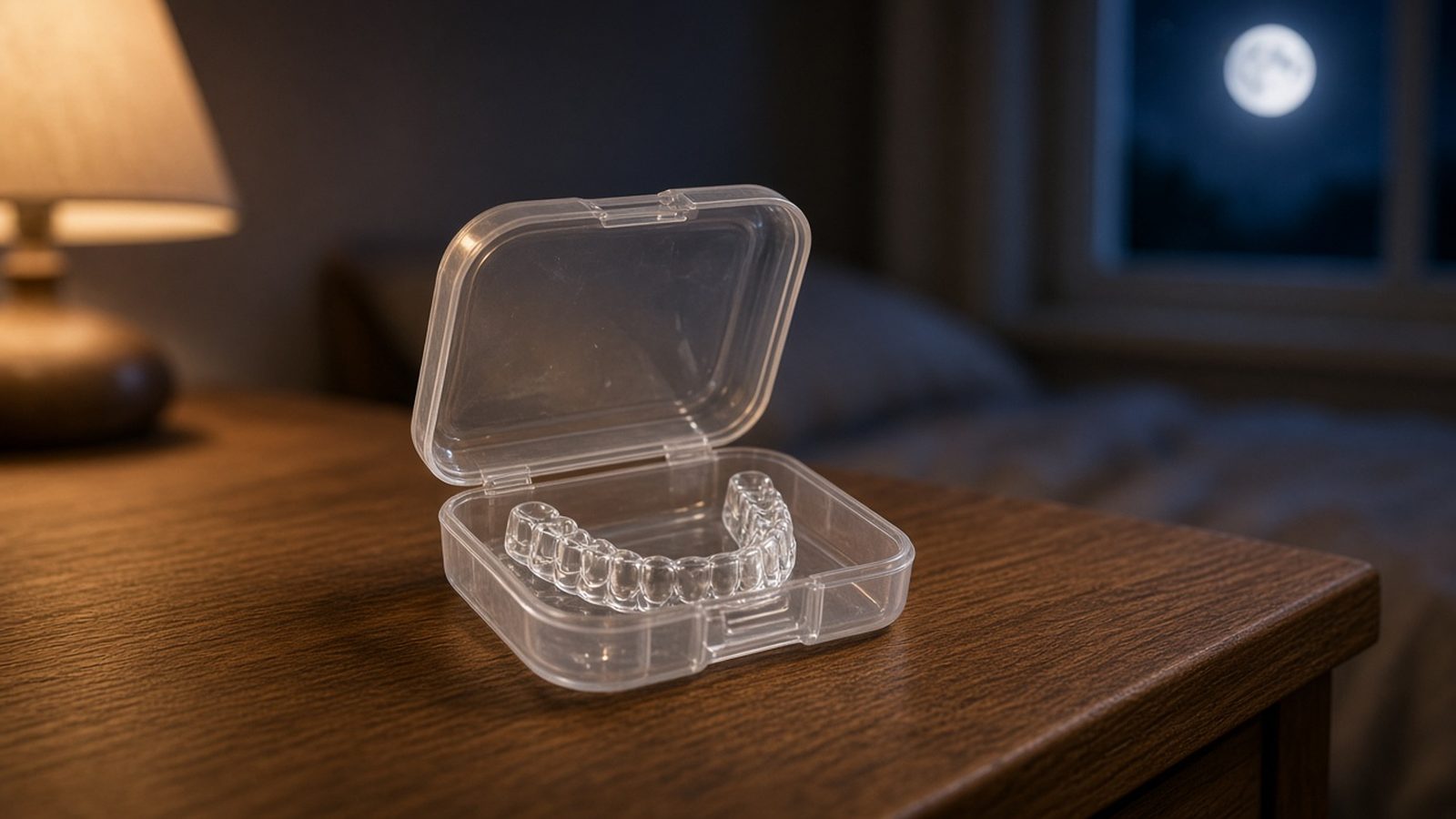
A custom nightguard puts a protective layer between your upper and lower teeth while you sleep, so the guard takes the wear instead of your bridge. It does not stop grinding, and it only protects you on the nights you wear it.
The ADA says a custom guard made from a mold or scan of your teeth gives the closest, most comfortable fit, and that guards sold online and in stores may not provide the same protection. It also points out that night guards are not the same as sports mouth guards, which are built with extra cushioning for impact. For a full-arch bridge, fit matters even more, because a guard that rocks or presses unevenly can load some implants more than others.
At Regional Implant Centers, the Protective Nightguard service starts with a digital scan or impression and an evaluation of your bite and biting forces. The guard is custom-designed to protect the implant bridge and reduce stress on the implants and screws, and the delivery visit includes a fit check, bite adjustments and instructions for wear and care. It is included in the Silver and Gold tiers of our required Maintenance Package and is also available as an individual service.
A few practical points help a guard do its job:
- Wear it as your team directs, which for most grinders means every night, including when you travel.
- Bring it to your maintenance visits so the team can check its fit and wear.
- Clean it daily and store it in its case, away from heat and pets.
- If it cracks, wears through or stops fitting, call rather than keep using it.
If your bridge is repaired or remade, the guard usually needs to be checked or replaced, because it was made for the old shape.
Snoring, sleep apnea and your guard
If you snore heavily, wake up tired or have been told you stop breathing in your sleep, tell your team before a nightguard is made. Sleep problems and grinding often appear together, and a standard guard is not the right answer for everyone.
A 2024 review in the Journal of Prosthodontics, published for the American College of Prosthodontists, reports that the two conditions are found together in roughly 30 to 50 percent of adults in published studies, although research has not shown that one causes the other. The authors warn that in a person with sleep apnea, a standard occlusal splint carries a risk of making breathing during sleep worse. Care in that situation may involve a sleep test, CPAP, an oral appliance designed to hold the jaw forward, or a combination, decided with a physician. The ADA's advice points the same way: when there are signs you are not resting well, a sleep study can show what is happening at night. A nightguard protects teeth. It does not treat sleep apnea.
Daytime clenching and the habits around it
Awake bruxism is mostly clenching and bracing rather than side-to-side grinding, and it often happens during concentration or stress. Because you are awake for it, it is the form you have the most power to change.
Notice when your teeth touch during the day. For many people it is at the computer, in the gym, or sitting in traffic on I-10 or the Grand Parkway. At rest, your teeth should not be touching at all: lips together, teeth slightly apart, tongue relaxed. Some people put a small reminder on the dashboard or the edge of a monitor.
The ADA suggests talking with your physician about stress management, such as meditation, counseling, exercise, massage and deep breathing, paired with a night guard. Cutting back on tobacco, alcohol and coffee, which the ADA links with grinding, is worth trying too. The Journal of Prosthodontics review describes sleep bruxism as recurring and variable over time, which is why the realistic goal is management rather than a cure.
Some patients ask about botulinum toxin injections in the jaw muscles. The same review lists them among the medications used for sleep bruxism in some cases and flags a possible risk to breathing during sleep in older adults. That is a conversation for a qualified provider who knows your history, not a routine step in full-arch care. And whatever you do at night, skip chewing ice, cracking nuts or bones, and opening packages with your teeth.
When grinding has already caused damage
A chipped tooth, a clicking bridge or a cracked guard is a signal to call, not something to live with. Small problems caught early are usually simpler to fix, and the cause needs to be addressed so it does not keep happening.
Stop chewing on that side, save any broken pieces, and do not glue, file or tighten anything at home. A loose screw shifts load onto the other implants, and a crack can spread. Our article on All-on-4 problems explains what each kind of damage usually means. If an implant itself feels loose or sore, see our guide to All-on-4 implant failure. If a bridge made elsewhere keeps breaking, our All-on-4 revision guide walks through the options, from adjusting the bite to a new bridge on the same implants.
What maintenance visits watch for
Regular visits let the team catch wear, loosening screws and bite changes before they become fractures. For a grinder, they are where the guard, the bite and the bridge are checked together.
After your final teeth are delivered, enrollment in a required Maintenance Package begins within 30 days. Maintenance visits inspect implant stability, the condition of the bridge, the bite and the gum tissue, and depending on your tier they include services such as implant cleanings, periodic exams with CBCT, screw service, repairs and the protective nightguard. The package is not dental insurance, and we do not offer a traditional implant warranty that promises lifetime success. Our implant warranty page lists bruxism without protection among the events that are not covered, alongside trauma, smoking and failure to follow instructions. That rule is not meant as a trap. It follows from the evidence above.
Questions to ask at your consultation
If you grind or clench, these questions help you see whether a plan accounts for it.
- How will my grinding change the number or position of the implants?
- Which final material do you recommend for my bite, and why?
- What does the bridge bite against, and does that change the material choice?
- When will my nightguard be made, and how often should it be checked or replaced?
- Should I have a sleep evaluation before the guard is made?
- What happens, and what does it cost, if a tooth chips or a screw loosens?
A good plan answers these in writing. Before treatment begins at Regional Implant Centers, you receive a written plan with the recommended care, estimated insurance benefits, financing options and your expected out-of-pocket cost.
Getting evaluated at our Katy office
Our Katy office brings together a prosthodontist, oral surgeons, CBCT imaging, anesthesia support and our in-house dental lab, so the bite, the bone and the bridge design can be reviewed in one place.
The office is at 707 S Fry Rd, Suite 150, in Katy, and serves patients from Cypress, Sugar Land, Fulshear, Richmond, Memorial and the rest of West Houston. It is open Monday through Thursday, 8 AM to 5 PM, with Fridays reserved for surgery. Our prosthodontist, Dr. Polyxeni Konti, sees patients at the Katy office, and our technicians work beside the clinical team in the in-house lab. See our Katy location page for directions. Austin-area patients are seen at our Hutto office.
We also see patients whose full-arch treatment was done elsewhere and whose bridge keeps chipping or loosening. Bring your implant brand and system if you know it, any scans or X-rays, and your current nightguard. Our Insurance Advantage team reviews dental and medical benefits, though coverage is never guaranteed, and our financing page lists independent lenders that set their own terms. Not every case suits fixed teeth, and if yours does not, we will tell you.
Frequently asked questions
Can I get All-on-4 if I grind my teeth? Usually, yes. Grinding is not an automatic reason to rule out fixed full-arch teeth, but it changes the plan: the bite design, the number and spread of implants, the material and a custom nightguard. For some heavy grinders, a removable implant overdenture is the steadier choice.
Do I need a night guard with All-on-4? If you grind or clench, a custom nightguard is the usual protection for a full-arch bridge, and it is made to fit your final teeth. Whether you need one, and when it is made, is decided by your team after evaluating your bite and habits.
Can grinding break a zirconia bridge? It can. Solid zirconia resists chipping and wear well, but no material is grind-proof. Heavy grinding can still chip teeth, loosen or break screws and, less often, crack a bridge, which is why bite design and a nightguard matter even with zirconia.
Will grinding make my implants fail? Not necessarily, but it raises the risk. A 2023 review of 27 studies found implants in people with probable bruxism had about twice the odds of failing. Careful planning, a nightguard and regular maintenance visits are how that risk is managed.
Can I use a drugstore night guard over my bridge? It is not recommended. The ADA notes that store-bought guards may not protect as well as a custom guard, and a guard that fits unevenly can push harder on some implants than others. Ask your implant team for a guard made from a scan of your bridge.
Talk with our Katy team about protecting your bridge
If you grind or clench and are considering full-arch implants, or your current bridge keeps chipping or loosening, an exam and a 3D scan are the place to start. Schedule a Houston-area consultation, in person at our Katy office or by phone, or call (832) 632-7037. Bring any old night guards and a list of past dental breakages. Qualified patients receive a complimentary consultation, advanced CBCT scan and insurance benefits evaluation, and by the end of the appointment you will have a clear understanding of your next steps.
Sources & Resources
- American Dental Association, MouthHealthy: Teeth Grinding
- Lobbezoo F, Ahlberg J, Raphael KG, et al. International consensus on the assessment of bruxism: Report of a work in progress. Journal of Oral Rehabilitation, 2018;45(11):837-844.
- Haggman-Henrikson B, Ali D, Aljamal M, Chrcanovic BR. Bruxism and dental implants: A systematic review and meta-analysis. Journal of Oral Rehabilitation, 2024;51(1):202-217 (published online 2023).
- Chrcanovic BR, Kisch J, Larsson C. Retrospective evaluation of implant-supported full-arch fixed dental prostheses after a mean follow-up of 10 years. Clinical Oral Implants Research, 2020;31(7):634-645.
- Matalon S, Heller H, Beitlitum I, et al. Retrospective 1- to 8-year follow-up study of complete oral rehabilitation using monolithic zirconia restorations with increased vertical dimension of occlusion in patients with bruxism. Journal of Clinical Medicine, 2022;11(18):5314.
- Dal Fabbro C, Bornhardt-Suazo T, Landry Schonbeck A, de Meyer M, Lavigne GJ. Understanding the clinical management of co-occurring sleep-related bruxism and obstructive sleep apnea in adults: A narrative and critical review. Journal of Prosthodontics, 2025;34(S1):46-61.
This article is general education, not a diagnosis or treatment recommendation. Whether full-arch implants suit you, which materials and appliances fit your bite, and the timeline and cost depend on an individual clinical evaluation. Same-day teeth are temporary and offered only to qualifying patients. Insurance coverage is never guaranteed, and financing is provided by independent third-party companies. Regional Implant Centers has offices in Katy and Hutto, Texas.
Ready to Learn What Is Possible?
Schedule a consultation with Regional Implant Centers.
Schedule ConsultationFrequently Asked Questions
Can I get All-on-4 if I grind my teeth?
Usually, yes. Grinding is not an automatic reason to rule out fixed full-arch teeth, but it changes the plan: the bite design, the number and spread of implants, the material and a custom nightguard. For some heavy grinders, a removable implant overdenture is the steadier choice.
Do I need a night guard with All-on-4?
If you grind or clench, a custom nightguard is the usual protection for a full-arch bridge, and it is made to fit your final teeth. Whether you need one, and when it is made, is decided by your team after evaluating your bite and habits.
Can grinding break a zirconia bridge?
It can. Solid zirconia resists chipping and wear well, but no material is grind-proof. Heavy grinding can still chip teeth, loosen or break screws and, less often, crack a bridge, which is why bite design and a nightguard matter even with zirconia.
Will grinding make my implants fail?
Not necessarily, but it raises the risk. A 2023 review of 27 studies found implants in people with probable bruxism had about twice the odds of failing. Careful planning, a nightguard and regular maintenance visits are how that risk is managed.
Can I use a drugstore night guard over my bridge?
It is not recommended. The ADA notes that store-bought guards may not protect as well as a custom guard, and a guard that fits unevenly can push harder on some implants than others. Ask your implant team for a guard made from a scan of your bridge.
This content is educational and not a substitute for a consultation.