Full-Mouth Dental Implants
All-on-4 vs. All-on-6: How Many Implants Does a Full Arch Need? A Guide for San Antonio Patients
Four implants or six? Research finds similar survival for both. What matters is where the implants go and why, and how San Antonio patients can ask.
If you have been reading about full-arch implants around San Antonio, you have probably seen All-on-4 and All-on-6 offered side by side, sometimes with a confident line about which one is stronger. The All-on-4 vs All-on-6 question comes down to how many implants support one fixed arch of teeth, and the honest answer is that the number on its own tells you less than the ads suggest. Where the implants sit, how far apart they are, what kind of bone they are in and how the bridge is designed all matter as much as the count. This guide explains what the names mean, what the research shows when four and six implants are compared, why a plan might call for one or the other, and what to ask when an office gives you a number. It is written for patients in San Antonio, New Braunfels, Schertz, Boerne and the surrounding area who are thinking about traveling to our Hutto or Katy office.
A quick note on scope. Cost, insurance and the trip itself are separate questions with their own answers, so they get only a line or two here. The focus is the implant count: why it differs from plan to plan, and how to tell whether the number you were given fits your mouth.
The short answer
Neither four nor six implants is better for everyone. Large reviews have found similar implant and bridge survival with fewer than five and five or more implants per arch, and an international consensus recommends at least four well-distributed implants for a one-piece fixed arch. The right number for you depends on your bone, the spread of the implants, your bite and the design of the final teeth.
That means the more useful question is not "four or six?" but "why this number, in these positions, for my jaw?" A clinician who has studied your 3D scan should be able to answer that in plain terms.
What All-on-4, All-on-6 and All-on-X actually mean
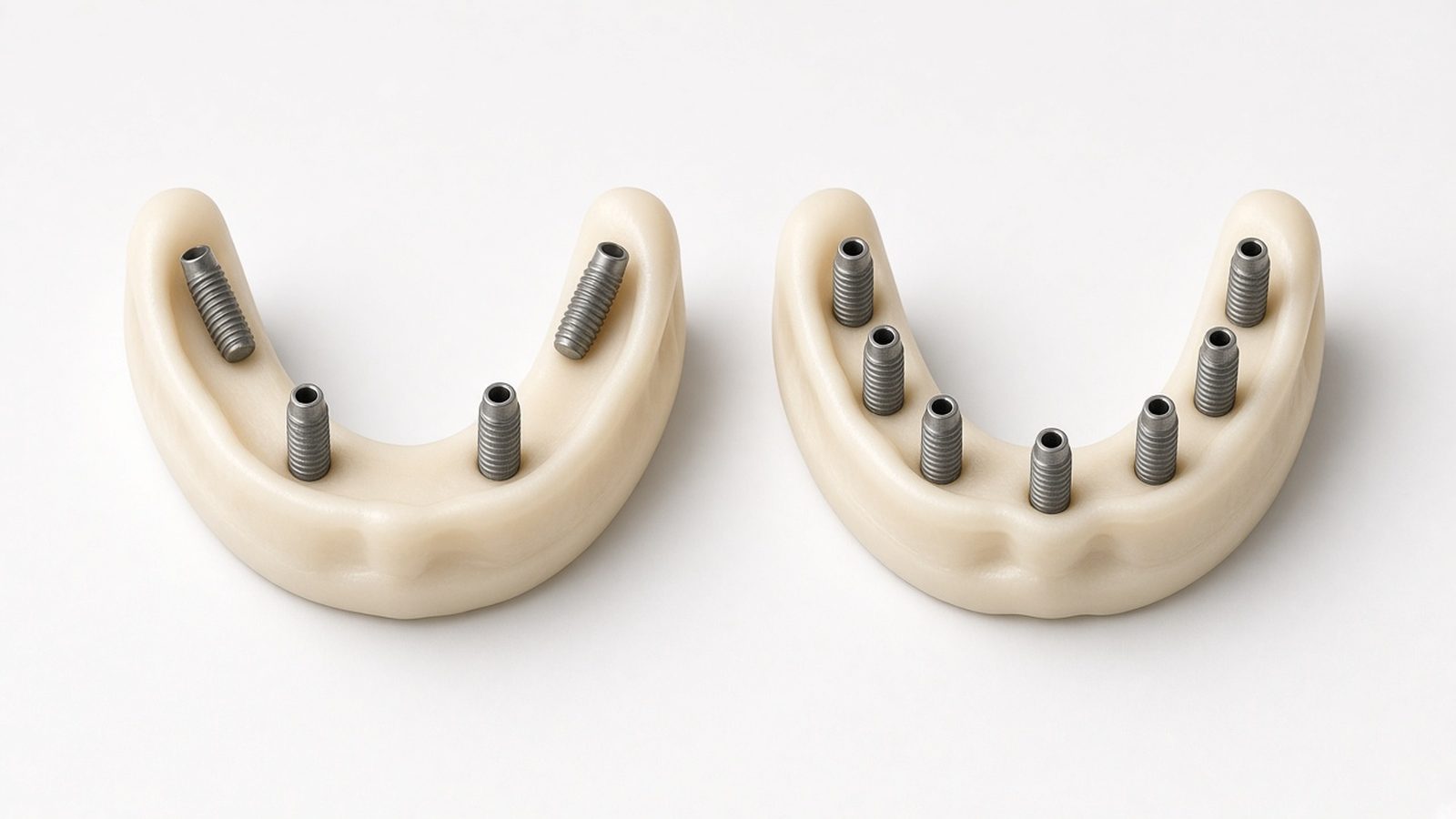
All-on-4 refers to a full arch of fixed teeth held by four implants, usually two upright implants in front and two angled implants farther back. All-on-6 uses six implants per arch. All-on-X is the umbrella term for any full-arch plan where the number is chosen for the patient.
The All-on-4 name began as a specific treatment protocol tied to one implant company, and it has since become shorthand for four-implant full arches in general. In the classic layout the back implants are tilted so they can reach firmer bone in front of the sinus in the upper jaw, or in front of the nerve canal in the lower jaw, while the bridge still extends back to give you chewing teeth. All-on-6 usually places implants in a more upright pattern spread around the arch, which takes more bone in more places.
On our Katy full-mouth implant page, we describe All-on-X as a term for full-arch treatment that uses "the number of implants your anatomy and restorative plan require," with the "X" meaning the count "is individualized rather than fixed at four for every patient." That is how we think about it. The count is a result of planning, not a product you pick from a menu.
All of these are fixed options: the teeth are screwed to the implants and only a dental professional removes them. A snap-on implant overdenture, which you take out to clean, is a different design that often uses fewer implants. Both our offices offer traditional dentures, snap-on overdentures and fixed full-arch teeth, so a consultation can compare all three.
What the research says about four versus six implants
Studies comparing four and six implants have mostly found similar survival for both the implants and the bridge. Differences show up in narrower measures, such as bone levels around the implants and minor technical problems, and they do not all point the same way.
The International Team for Implantology (ITI) reviewed this question at its 2018 consensus conference. The review behind it, by Daudt Polido and colleagues, pooled 93 studies with a median follow-up of eight years. The consensus statements report no statistically significant difference in implant or prosthesis survival between fewer than five and five or more implants, in either the upper or the lower jaw. Most of the four-implant upper-jaw studies used tilted back implants, while most of the upper-jaw studies with more implants used six in a parallel layout.
From that, the ITI recommends "a minimum number of four appropriately distributed implants" for a one-piece full-arch fixed bridge. The same recommendation adds two qualifiers worth knowing. It says "the impact of future implant loss/complications on prosthesis support should be considered when choosing implant number," and that additional implants "can provide options for fixed full-arch segmented prostheses," meaning a bridge made in sections rather than one piece.
More recent upper-jaw research fills in some detail:
- A 2025 randomized trial by Toia and colleagues followed 47 patients with 233 implants for five years. Bone levels around the implants were not significantly different between the four-implant and six-implant groups, and implant survival was 100 percent with four and 99.3 percent with six. The four-implant group had more technical complications (16.6 percent versus none), while costs favored four implants. Patients and clinicians tended to prefer the four-implant bridges for appearance and the six-implant bridges for function, especially speech early on.
- A 2024 systematic review and meta-analysis by Sharaf and colleagues pooled 53 studies of upper-jaw fixed bridges. It found no significant difference in implant survival, bridge survival or complications between four and six implants, but bone loss around the implants was significantly greater in the four-implant group.
Put plainly, the evidence does not crown a winner. Both approaches have long track records when the case suits them. What the studies keep returning to is distribution: how well the implants are spread around the arch and how the bridge is built on top of them.
Why a plan might call for four implants
Four implants are often chosen when bone is limited in the back of the jaw, because tilted implants can use the bone that is there and may reduce the need for grafting. Four can also mean fewer surgical sites and a simpler framework.
After years of missing teeth, gum disease or denture wear, the back of the upper jaw often has thin bone under an enlarged sinus, and the back of the lower jaw has the nerve canal running through it. Placing six upright implants in that situation may require a sinus lift or other grafting first. Tilting the back two implants lets the surgeon anchor in the bone in front of those structures instead. The ITI lists tilted implants among the placement options that can reduce how invasive surgery needs to be, when the clinician's skill and the patient's mouth are favorable.
The lower jaw is a common place for four. The front of the lower jaw, between the two nerve exits, is often dense, and in the ITI review most lower-jaw studies of fewer than five implants used four.
Why a plan might call for five, six or more
More implants are more often chosen for the upper jaw, for patients with a heavy bite, when the arch is long, or when the team wants a margin of safety in case one implant has a problem later. They require enough bone in more places.
Upper-jaw bone is usually softer than lower-jaw bone, which is one reason many clinicians plan more implants in the upper arch when the bone allows it. A strong bite or a clenching habit puts more load on each connection, and spreading that load across more implants is one way to manage it. Extra implants can also make it easier to keep a fixed temporary in place on surgery day if one implant is not as stable as hoped, though that depends on the case.
Then there is the question the ITI raises directly: what happens if an implant is lost years from now? With six well-placed implants, losing one may leave enough support for the bridge while the site is treated. With four, each implant carries a larger share of the bite, and losing one can be harder to manage, depending on where it sits. That is not a reason to assume four is risky. The studies above show four working well for many patients. It is a reason to ask how your plan would handle that possibility.
More implants are not free of trade-offs. Each one is another surgical site, another connection the bridge must fit precisely and, usually, more cost. The ITI also notes that grafting is recommended when the prosthetic plan needs more implants or wider distribution than the bone allows, and those procedures are more invasive and demanding.
The count is only part of the picture
How far apart the implants are, how far the teeth extend past the last implant and how much room there is for the bridge can matter as much as the number of implants. Four well-spread implants can give better support than six crowded together.
Clinicians talk about the anterior-posterior spread, meaning the distance from the front implants to the back ones, and the cantilever, meaning how many teeth extend past the last implant. A long cantilever on a short spread puts leverage on the back implants and on the bridge itself. The ITI's planning factors include exactly these points, along with the bridge material, whether it is one piece or segmented, lip support and smile line, the opposing teeth, the space available for the bridge, the anatomy of the jaw, room for hygiene, and the patient's preferences.
The first item on that list is telling: the ITI says the final prosthetic plan "should be considered when developing a surgical plan." In other words, decide what the teeth need to look like and do, then decide where the implants go. That is the same principle behind our article on why the final teeth should guide oral surgery planning, and it is why the bridge design and the implant count should be explained together rather than separately.
Material and framework enter here too. When there is limited vertical space, or the teeth extend beyond the last implant, a bridge may need a stronger internal structure. One of the final options we offer is titanium-reinforced zirconia, which has an internal titanium framework with a zirconia exterior. Whether your case needs that is a design decision, not an upgrade to buy.
When the count includes zygomatic or pterygoid implants
When the upper jaw has too little bone for standard implants, a plan may combine a few conventional implants in front with longer implants anchored in the cheekbone (zygomatic) or in dense bone at the very back of the upper jaw (pterygoid). In those cases the count reflects where bone exists, not a label.
A patient told they do not have enough bone for implants may hear "All-on-4" described with two zygomatic implants and two conventional ones, or a plan that uses four zygomatic implants when the front bone is also thin. Pterygoid implants are another way to gain support at the back of the upper arch without a sinus lift. At Regional Implant Centers, zygomatic and pterygoid implants are performed by Dr. Dan Holtzclaw and Dr. Enrique Tabarini. These are specialized surgeries with their own risks, and they are not the right answer for everyone. Some patients do better with grafting first, and some are better served by a removable overdenture. Our Hutto office performs bone grafting and sinus procedures, and our article on why bone grafting may be needed before dental implants covers the basics.
Can the number of implants change on surgery day?
It can. A 3D scan shows bone volume and anatomy, but the surgeon confirms bone quality and how firmly each implant seats at the time of placement. A good plan explains in advance what would change the count and how that affects your temporary teeth.
The ITI lists implant stability at placement, the need for grafting at the same time, systemic health and the clinician's experience among the conditions to weigh at each implant site. If one implant does not reach the stability needed, the surgeon may place another, choose a different position or decide against same-day teeth. Same-day fixed teeth are temporary, and they are offered only when the implants are stable enough to carry them; otherwise the implants are usually left to heal first.
Our mobile CBCT technology can capture updated scans during the procedure when the team decides it is useful, so implant positions can be verified during surgery. Ask any office, including ours, whether your plan lists a range or a fixed number, what would trigger a change and how the written plan accounts for it.
Upper and lower arches often get different numbers
It is common for the upper and lower arches to be planned with different implant counts, because the bone, the forces and the anatomy are different in each jaw.
In the ITI review, most upper-jaw studies with five or more implants used six, while most lower-jaw studies used four, or five when more were placed. A plan with six on top and four on the bottom, or the reverse, is not a mix-up. What should be explained is why each arch got its number and how the two bridges will meet when you bite.
Four versus six at a glance
| Question | Four implants per arch | Six implants per arch |
|---|---|---|
| Bone needed | Less in the back of the jaw; tilted implants can use bone in front of the sinus or nerve | More bone in more locations; grafting is more likely when bone is thin |
| Survival in reviews | Similar to six in pooled studies | Similar to four in pooled studies |
| Reported differences | Some studies show more bone loss around implants or more minor repairs | More surgical sites and higher cost; more support points |
| If one implant is lost later | Each implant carries more of the bite, so losing one can be harder to manage | Remaining implants may support the bridge while the site is treated |
| Bridge options | One-piece bridge | One-piece, or segmented bridges in some cases |
The table describes tendencies from the research and common planning logic. Your own scan can move any row.
Questions to ask about the number you were given
Whether you are holding a plan from a San Antonio office or comparing several, these questions get to the reasoning behind the count:
- Why this number of implants for my upper arch, and why for my lower arch?
- Where will each implant go, and how far will the teeth extend past the last one?
- Would I need grafting or a sinus lift to place more implants, and what would that add to treatment time?
- If one implant has a problem years from now, how would my bridge be supported while it is treated?
- Was the plan built from a 3D scan and a design of my final teeth, or from a standard layout?
- What happens on surgery day if an implant is not stable enough for same-day teeth?
- What is the final bridge made of, and does its design depend on the number of implants?
If the answers are specific to your scan, the number is probably well reasoned, whatever it is. If the answer is "we always do four" or "six is always stronger," it is fair to ask for more.
How our team decides how many implants you need
At Regional Implant Centers the implant count comes out of a plan for the final teeth. A prosthodontist maps your bite and facial support first, the team studies your anatomy on a 3D scan, and the surgeon places implants where the planned teeth and the available bone agree.
That sequence is the R and I of our RISE Protocol. In the Rehabilitation step, your prosthodontist "maps out bite, facial support, speech, and the long-term plan for your new teeth before surgery begins." In Imaging and Planning, we use CBCT to study "bone volume, nerve pathways, sinus position, and jaw anatomy before surgery," and our SegMark Workflow "aligns CBCT imaging, intraoral scans, bite information, facial references, and restorative goals into one coordinated digital plan." The surgical step brings in the oral surgeon and a dedicated anesthesia provider, so the surgeon can focus on placing the implants while someone else focuses on your safety and comfort. Our Hutto office has CBCT imaging, performs bone grafting and sinus procedures and has a dentist anesthesiologist on site.
After the implants are placed, we use photogrammetry to capture their exact three-dimensional positions so the final bridge can be made for a passive fit across every implant, whether there are four or six. Our in-house lab is at the Katy office, where technicians work beside the surgical and restorative team. For more on how the teeth themselves are designed, see how prosthodontists design implant-supported teeth.
Before any treatment begins, you receive a detailed written treatment plan outlining the recommended care, estimated insurance benefits, financing options and your expected out-of-pocket investment. The plan should tell you how many implants we recommend for each arch and why. If a fixed bridge is not the right fit, we will say so and talk through a snap-on overdenture or a traditional denture instead. We do not offer a traditional implant warranty that promises lifetime success. Long-term protection comes through a required Maintenance Package, and as our implant warranty page explains, there is no guarantee that implants or prosthetics will never need adjustment, repair or replacement.
Planning from San Antonio
We do not have an office in San Antonio. Our offices are in Hutto, in the Austin area, and in Katy, near Houston, and you can start with a phone consultation before deciding whether to make the drive.
From San Antonio, New Braunfels and Schertz, the drive to Hutto runs up the I-35 corridor, and some drivers use the SH 130 toll road to stay east of central Austin. Katy sits off I-10, a straight run east from Boerne or San Antonio. If another office has already given you a plan with an implant count, bring it, along with any 3D scans and X-rays, and we can talk through how its reasoning compares with what our own exam and imaging show.
It is also worth thinking about follow-up before you commit to any office. Full-arch implants need ongoing maintenance, and our maintenance visits take place at Regional Implant Centers unless your written agreement states otherwise, so a realistic plan includes how often you would make the trip. For a broader set of questions to ask before choosing a provider, see how to avoid failed implant dentistry.
Frequently asked questions
Is All-on-6 better than All-on-4? Not as a rule. Large reviews have found similar implant and bridge survival with four and six implants per arch. Six can add support points and a margin of safety if one implant is lost later, and four can avoid grafting when bone is limited. The better choice depends on your bone, bite and bridge design.
How many implants do I need for a full arch? An international consensus recommends at least four well-distributed implants for a one-piece fixed full arch. Many plans use four to six, and some upper-jaw plans add zygomatic or pterygoid implants when bone is very thin. Only a 3D scan and an exam can tell you the right number for each arch.
What happens if one implant fails with All-on-4? It depends on which implant is affected and how the bridge is built. Sometimes the bridge can be adjusted to work on the remaining implants while the site is treated or a new implant is placed. In other cases interim teeth are needed until the arch is rebuilt. Ask how your plan would handle this before surgery.
Do I need a bone graft for All-on-6? Not always, but six upright implants need enough bone in more places than four tilted ones, so grafting or a sinus lift is more likely when the back of the jaw has thinned. Your 3D scan shows whether the bone is there.
Do you have an office in San Antonio? No. Our offices are in Hutto and Katy, and Hutto is the shorter drive for most of the San Antonio area. You can start with a phone consultation from home, and the in-person exam and 3D imaging happen at either office.
Talk with our team about your implant plan
If you are in San Antonio, New Braunfels, Schertz, Boerne or nearby and want to understand how many implants your arches may need, the first conversation can happen by phone. Schedule a consultation by phone or in person, choosing Hutto or Katy, or call (832) 632-7037. Bring any plans, scans or X-rays you already have. Qualified patients receive a complimentary consultation, advanced CBCT scan and insurance benefits evaluation, and by the end of the appointment you will have a clear understanding of your next steps.
Sources & Resources
- U.S. Food and Drug Administration: Dental Implants: What You Should Know
- International Team for Implantology: Number of Implants Placed for Complete-Arch Fixed Prostheses, Consensus Statements
- Daudt Polido W, Aghaloo T, Emmett TW, Taylor TD, Morton D. Number of implants placed for complete-arch fixed prostheses: A systematic review and meta-analysis. Clinical Oral Implants Research, 2018;29 Suppl 16:154-183.
- Toia M, Moreira CS, Dias DR, Corra E, Ravida A, Cecchinato D. Fixed full-arch maxillary prostheses supported by four versus six implants: 5-year results of a multicenter randomized clinical trial. Clinical Oral Implants Research, 2025;36(3):298-313.
- Sharaf MA, Wang S, Mashrah MA, Xu Y, Haider O, He F. Outcomes that may affect implant and prosthesis survival and complications in maxillary fixed prosthesis supported by four or six implants: A systematic review and meta-analysis. Heliyon, 2024;10(3):e24365.
This article is general education, not a diagnosis or treatment recommendation. The number and position of implants, whether grafting or zygomatic or pterygoid implants are appropriate, and the timeline and cost depend on an individual clinical evaluation and imaging. Same-day teeth are temporary and offered only to qualifying patients. Insurance coverage is never guaranteed, and financing is provided by independent third-party companies. Regional Implant Centers has offices in Katy and Hutto, Texas only, and no office in San Antonio.
Ready to Learn What Is Possible?
Schedule a consultation with Regional Implant Centers.
Schedule ConsultationFrequently Asked Questions
Is All-on-6 better than All-on-4?
Not as a rule. Large reviews have found similar implant and bridge survival with four and six implants per arch. Six can add support points and a margin of safety if one implant is lost later, and four can avoid grafting when bone is limited. The better choice depends on your bone, bite and bridge design.
How many implants do I need for a full arch?
An international consensus recommends at least four well-distributed implants for a one-piece fixed full arch. Many plans use four to six, and some upper-jaw plans add zygomatic or pterygoid implants when bone is very thin. Only a 3D scan and an exam can tell you the right number for each arch.
What happens if one implant fails with All-on-4?
It depends on which implant is affected and how the bridge is built. Sometimes the bridge can be adjusted to work on the remaining implants while the site is treated or a new implant is placed. In other cases interim teeth are needed until the arch is rebuilt. Ask how your plan would handle this before surgery.
Do I need a bone graft for All-on-6?
Not always, but six upright implants need enough bone in more places than four tilted ones, so grafting or a sinus lift is more likely when the back of the jaw has thinned. Your 3D scan shows whether the bone is there.
Do you have an office in San Antonio?
No. Our offices are in Hutto and Katy, and Hutto is the shorter drive for most of the San Antonio area. You can start with a phone consultation from home, and the in-person exam and 3D imaging happen at either office.
This content is educational and not a substitute for a consultation.