Physician Referral Resources
Prolia, Fosamax and Full-Arch Implants: A Guide for Houston Patients and the Doctors Who Prescribe Them
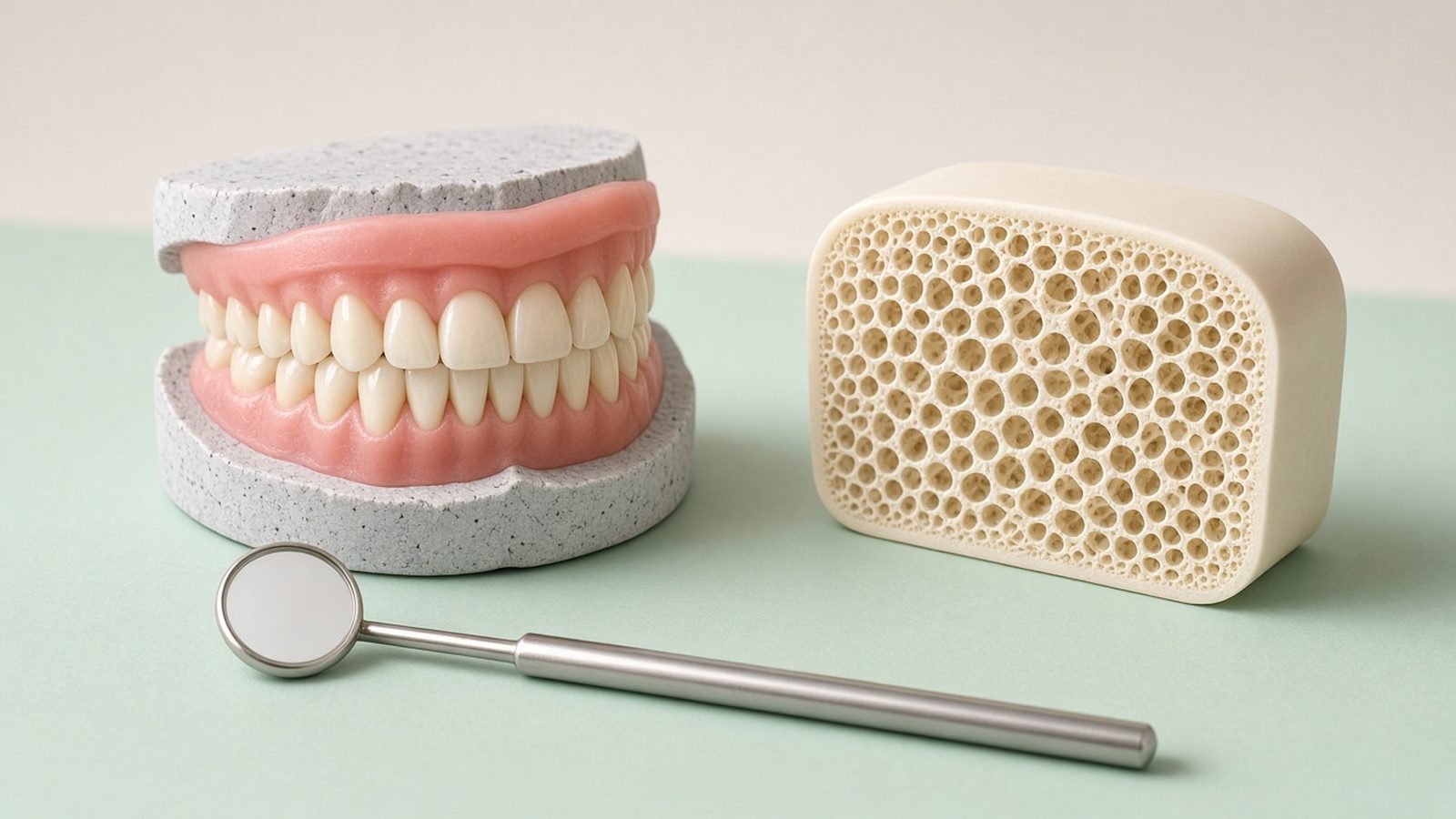
Bone medicines and full-arch implants: the real jaw risk, why you should not stop Prolia on your own, and how patients and doctors plan surgery together.
If you take a medicine for osteoporosis and your teeth are failing, you may have heard two warnings that seem to cancel each other out. One says bone medicines can cause a serious jaw problem after dental surgery. The other says you should never stop your osteoporosis treatment because your fracture risk goes up. Both warnings are real. The good news is that, for most people taking these medicines at osteoporosis doses, they can be handled with planning rather than fear.
This article is written for two audiences at once: patients in Katy, Cypress, Sugar Land, Richmond, Fulshear, the Memorial area and the rest of Houston who take drugs such as Prolia, Fosamax, Boniva, Actonel, Reclast or Evenity, and the physicians, endocrinologists, rheumatologists, gynecologists and nurse practitioners who prescribe them. It explains what the jaw risk actually is, what the research says about dental implants in people on these medicines, why full-arch treatment raises its own questions, and what information makes coordination between your doctor and your implant team go smoothly.
It is general education. It does not replace the advice of the clinician who manages your bone health, and nothing here is a reason to change a dose or skip an injection.
The short answer
Taking an osteoporosis medicine does not automatically rule out full-arch dental implants. At osteoporosis doses, the risk of a serious jaw bone complication is low, the evidence does not show that these medicines make implants fail more often, and current expert groups do not generally advise stopping them before implant surgery. Cancer-treatment doses are a different situation.
What changes is the planning. Your implant team needs to know exactly which drug you take, why, how it is given, how long you have taken it and when your last dose was. Your prescribing doctor should be part of any decision about timing. And because full-arch treatment usually means removing several teeth and placing implants in the same visit, your surgeon will weigh the extent of surgery as carefully as the medicine itself.
Which bone medicines matter for your jaw
"Osteoporosis medicine" covers several drug families, and they are not equal when it comes to the jaw. The American Dental Association (ADA) groups them this way:
| Medicine family | Common names | How it is usually given for osteoporosis | Jaw concern |
|---|---|---|---|
| Oral bisphosphonates | Alendronate (Fosamax), risedronate (Actonel), ibandronate (Boniva) | Pill, often weekly or monthly | Low risk at osteoporosis doses; rises with years of use |
| IV bisphosphonate | Zoledronic acid (Reclast) | Infusion, usually once a year | Low risk at osteoporosis doses |
| RANKL inhibitor | Denosumab (Prolia) | Injection every 6 months | Low risk, somewhat higher estimates than bisphosphonates |
| Sclerostin inhibitor | Romosozumab (Evenity) | Monthly injections for 12 months | Low risk, similar to alendronate in early data |
| Bone-building and other agents | Teriparatide (Forteo), abaloparatide (Tymlos), raloxifene | Daily injection or pill | Not associated with the same jaw risk, according to the ADA |
Two details in that table matter more than people expect.
First, the same drug can be given at very different doses. Denosumab for osteoporosis (Prolia) is 60 mg every six months. Denosumab for cancer that has spread to bone (Xgeva) is 120 mg every four weeks. Zoledronic acid is also used at higher, more frequent cancer doses. When you tell your implant team "I get a bone shot," the brand name and the reason matter.
Second, these drugs stay active in bone in different ways. Bisphosphonates bind to bone and can remain there for years after the last pill, so past use counts. Denosumab works differently: its effect fades over the months after each injection, which is why the date of your last shot matters so much and why stopping it has its own risk, covered below.
What MRONJ is, in plain language
The jaw problem linked to these drugs is called medication-related osteonecrosis of the jaw, or MRONJ. It means an area of jaw bone that becomes exposed through the gum, or can be probed through a small opening, and does not heal over a period of weeks. It can be painless or painful, and it can become infected.
The American Association of Oral and Maxillofacial Surgeons (AAOMS) published its most recent position paper on MRONJ in 2022. Its estimates for people taking these medicines for osteoporosis:
- Oral bisphosphonates: about 0.05 percent or less (no more than about 5 in 10,000 people).
- IV zoledronic acid at osteoporosis doses: about 0.02 percent or less.
- Denosumab: a wider range, from about 0.04 percent to 0.3 percent after 10 years of follow-up.
- Romosozumab: about 0.03 to 0.05 percent in early data.
For comparison, AAOMS notes that the risk in people receiving these drugs for cancer ranges up to several percent, which is why the two situations are handled so differently.
Tooth extraction is the most common trigger. AAOMS reports that among osteoporosis patients taking bisphosphonates, estimates of MRONJ after an extraction range from 0 to 0.15 percent, and one study found about 1 percent after extraction in people taking denosumab. MRONJ can also appear with no dental procedure at all.
The ADA lists factors that appear to raise risk, including age over 65, gum disease, poor oral hygiene, dental surgery, long-term use (more than two years), smoking, diabetes, denture wearing, steroid use and some cancer treatments. Several of those apply to many people who are considering full-arch implants, which is part of why this deserves a careful conversation rather than a quick yes or no.
What the research says about implants specifically
This is where the evidence has moved in the past few years.
In 2025, the International Osteonecrosis of the Jaw Taskforce published a systematic review and consensus statement in Endocrine Practice on dental implants in people with osteoporosis on antiresorptive drugs (the family that includes bisphosphonates and denosumab). Its main points:
- Current evidence does not show that these medicines, at osteoporosis doses, make dental implants fail more often. The pooled studies were small, and the authors rated the certainty as very low, so this is reassurance, not proof.
- The Taskforce suggested that antiresorptive therapy does not need to be stopped before implant placement. It labeled this a weak recommendation based on very low-quality evidence.
- Long-term bisphosphonate use may carry a small added risk of MRONJ after implants, estimated at about 3 extra cases per 1,000 patients in the one study that adjusted for other risk factors.
- Stopping denosumab is not advised, because of rebound bone loss and fracture risk.
A companion meta-analysis by the same group, also published in 2025, pooled 21 groups of patients and found an MRONJ rate of about 0.5 percent after implant placement in people exposed to these drugs.
The AAOMS paper adds a detail that patients rarely hear. In published reports of implant-related MRONJ, most cases did not start with the implant surgery. They appeared later, often more than 12 months after the implant was placed, and frequently around implants that had been placed before the patient started a bisphosphonate. AAOMS describes a pattern in which the implant stays fused to a piece of dead bone that separates from the jaw, which is different from the more common gum-and-bone infection around implants (peri-implantitis). Some reviews have also reported higher risk with implants in the back of the jaw when bisphosphonates had been taken for more than three years along with steroid medicines, while other reviews found no increase.
AAOMS sums it up plainly: robust data do not exist, and the available data conflict. Its advice is that if implants are placed, patients should be told about the low risk of MRONJ and about early and late implant failure, and should stay on a regular long-term follow-up schedule.
What this means for you: the decision is not "safe" or "unsafe." It is a weighing of a low but real risk against the problems caused by failing teeth, infection and loose dentures, made by people who know your full history.
Why full-arch treatment raises its own questions
Most studies above involve single implants or a few implants. Full-arch treatment is different in ways that matter for someone on a bone medicine.
Several extractions in one visit. A typical full-arch surgery removes the remaining failing teeth and places implants the same day. Extraction is the most common trigger for MRONJ, and in 2011 an ADA expert panel suggested that, for people on these drugs, treating one region of the mouth at a time may help gauge how someone heals, while noting that this does not apply to emergencies. Your surgeon will weigh that idea against the benefits of a single coordinated surgery, the number of teeth involved, how infected they are and your other risk factors.
Infected teeth are a risk too. AAOMS describes existing infection and inflammation, such as advanced gum disease or abscesses at the root tips, as a risk factor in its own right. The ADA panel advised treating abscesses, draining infections and severe gum disease promptly. Leaving badly infected teeth in place to avoid surgery is not automatically the safer choice. Our article on chronic tooth infections and implants explains how those infections are found and treated.
Dentures press on the gums. Ill-fitting dentures are listed on the Prolia label as a risk factor, and AAOMS reports that denture wearing was linked with higher MRONJ risk in studies of cancer patients on these drugs. Whether that applies to people at osteoporosis doses is less clear, but it is one reason sore spots under any denture or temporary should be reported and adjusted promptly rather than tolerated.
Bone quality and the jaw itself. Osteoporosis affects the skeleton, but the jaw is assessed separately. A cone beam CT scan shows the height, width and density of the bone where implants would go, as well as old infection sites and the position of nerves and sinuses. It helps your team decide where implants can go and how many are needed.
Healing time and same-day teeth. At Regional Implant Centers, every patient leaves full-arch surgery with same-day temporary teeth, and final arches are delivered in 1 to 4 months depending on healing and progress. For someone on a bone medicine, how the gums and bone heal in those first months is watched closely, and the timing of the final arch follows healing rather than a fixed calendar. Our article on temporary versus final teeth explains the two stages.
Should you stop your medicine before surgery?
Do not stop or delay any osteoporosis medicine on your own. Whether anything changes is a decision for your prescribing doctor and your oral surgeon together.
Here is what the major sources say, so you can have that conversation with clear expectations:
- The idea of a "drug holiday" is unsettled. AAOMS reports that its own working group could not agree. Half favored offering holidays case by case; half would never recommend them because the risks of suspending treatment may outweigh any benefit. The ADA states there is insufficient evidence to recommend a holiday or a waiting period before dental treatment for people taking these drugs for osteoporosis.
- The 2025 Taskforce suggested that these drugs do not need to be stopped before implant placement in people with osteoporosis.
- Denosumab is a special case. The Prolia prescribing information warns that after treatment stops, bone turnover rises above pretreatment levels around 9 months after the last dose, and new spine fractures, sometimes several at once, occurred as early as 7 months after the last injection. It says that if Prolia is stopped, patients should be moved to another antiresorptive medicine. This is why a missed or delayed Prolia shot is not a harmless precaution.
- If a prescriber and surgeon do decide to adjust denosumab timing, AAOMS describes one approach: performing the surgery 3 to 4 months after the last dose, when its effect on bone is waning, and resuming 6 to 8 weeks after surgery. The aim is to keep any interruption as short as possible. Whether that applies to you is not something an article can decide.
Blood tests will not settle it. Some patients are told to get a "CTX" bone-turnover blood test before surgery. Both AAOMS and the ADA state that these markers are not a validated way to predict MRONJ risk.
If you have not started your osteoporosis medicine yet
If your doctor has just recommended a bone medicine and you already know your teeth are failing, tell both your doctor and your dentist now. AAOMS describes early dental screening before these drugs are started as worthwhile, and the Prolia label recommends a dental exam with preventive care before starting treatment in people with risk factors such as planned extractions, implants or oral surgery.
For osteoporosis, AAOMS also says dental treatment can happen alongside the start of therapy. In other words, this is a reason to coordinate, not a reason for your physician to postpone fracture protection while dental planning plays out. Your physician decides when to start; your dental team works around that.
For prescribing physicians: what helps us plan
If you are referring a patient on bone-modifying therapy, or a patient tells you they are considering full-arch treatment, these details make the plan safer and faster. Our separate guide for physicians referring patients for dental clearance covers general referral logistics; this list is specific to bone medicines.
- Indication: osteoporosis or osteopenia, or a cancer-related indication. This changes the whole discussion.
- Every bone-modifying drug, current and past: name, dose, route (oral, IV, injection) and approximate start and stop dates, including earlier bisphosphonates before a switch to denosumab or romosozumab.
- Date of the last dose and the next scheduled dose, especially for denosumab and zoledronic acid.
- Systemic steroids, chemotherapy, targeted cancer therapies or other immune-modifying drugs.
- Diabetes control, smoking status and kidney function where relevant.
- Fracture history, particularly prior vertebral fractures, which the Prolia label identifies as a predictor of multiple vertebral fractures after discontinuation.
- Your view on any timing adjustment, if one is being considered, and who should be contacted to approve it.
What you can expect back from the dental side: the planned procedures, the number of extractions and implants, the proposed timing, the anesthesia plan and the follow-up schedule. If a question comes back to you, it will usually be about timing relative to the next dose, not about stopping therapy.
Signs to report after surgery, now and years later
After any extraction or implant surgery, some soreness, swelling and tenderness are expected. Call your surgical team promptly if you notice:
- Bone visible or felt through the gum, especially after the first few weeks
- A sore spot that does not heal, or keeps returning under your temporary or final teeth
- Swelling, drainage or a bad taste that persists
- Numbness or a heavy feeling in the lip or chin that was not explained to you before surgery
- An implant or section of the arch that suddenly feels loose
Because AAOMS reports that many implant-related cases appear more than a year after surgery, these signs matter long after you have healed. Keep your bone-medicine changes on your dental record too: if you start, stop or switch a drug years after your implants are placed, tell your implant team.
Long-term care is the other half of prevention. Both AAOMS and the ADA emphasize good oral hygiene and regular dental care for people on these drugs. Our guide to cleaning and maintaining full-arch teeth covers daily care, and our maintenance packages cover professional follow-up. Regional Implant Centers provides a 1-year warranty plus extended maintenance packages.
How we plan these cases at Regional Implant Centers
Our RISE Protocol is built around a team rather than a single provider: a prosthodontist who plans the teeth and the bite, an oral surgeon who plans and performs the surgery, an anesthesiologist who focuses on safety and monitoring, and lab technicians who build the teeth. For a patient on a bone medicine, that structure means:
- A medical history review that goes beyond a checkbox. Expect to be asked for the drug details listed above, and for permission to coordinate with your prescribing doctor when your history calls for it.
- 3D imaging before decisions. Both our Katy and Hutto offices have a mobile cone beam CT, used to study bone volume, infection sites, nerves and sinuses. Your $25 consultation includes a CBCT 3D scan.
- Surgical planning by specialists. Our oral surgeons, including Dr. Enrique Tabarini, plan the extent and sequence of surgery around your health history. Not every patient is a candidate, and for some people a less extensive option is the better fit.
- A full range of options. Both offices offer traditional dentures, snap-on implant overdentures and fixed full-arch teeth. Our comparison of All-on-X, implant dentures and dentures walks through the trade-offs.
- Anesthesia choices. Options include local anesthesia, IV sedation and general anesthesia, planned by an anesthesiologist, and surgery takes place in a very safe surgical facility held to the highest standards of care. Our anesthesia and patient comfort page explains more.
- Teeth made close to the team. Our in-house dental lab is at our Katy office. Final arches are full monolithic zirconia or titanium-reinforced, and typical cases take 4 to 5 total visits.
If your situation involves cancer treatment rather than osteoporosis, the considerations are different and more restrictive. Our article on implants after head and neck radiation and bone-modifying cancer drugs covers that situation. Older adults may also want to read our guide to full-arch implants in your 70s and 80s, which places bone medicines alongside blood thinners, dry mouth and other common health factors.
Visiting our Katy office from around Houston
Our Houston-area office is at 707 S Fry Rd, Suite 150, in Katy, and serves patients from Katy, Cypress, Sugar Land, Fulshear, Richmond, Memorial and across West Houston. See the Katy location page for directions. If you live closer to the Austin area, our Hutto office offers the same range of denture, overdenture and fixed options, along with bone grafting and sinus procedures.
Bring a printed medication list to your first visit, along with your prescribing doctor's name and phone number. If you have the date of your last Prolia injection or Reclast infusion, write it down.
Insurance notes, without promises
Medical insurance may apply only to surgical services, such as extractions or bone grafting, when a plan covers oral surgery. Implants, the prosthesis and temporary teeth are billed to the patient. Only PPO plans are relevant for our out-of-network oral surgery benefits, and Federal Employee Program (FEP) Blue Cross Blue Shield plans cannot be billed. If you have a PPO plan with oral surgery coverage, the surgical portion may be worth checking; that is not a guarantee, so please verify. Your $25 consultation includes an insurance benefits check. Our Houston article on medical insurance for oral surgery in full-arch treatment explains how surgical claims work, and financing options are available through independent third-party companies.
Questions to bring to your consultation
- Based on my medicine, dose and how long I have taken it, how would you describe my jaw risk?
- Will you contact my prescribing doctor, and what will you ask them?
- Does the number of teeth being removed change your recommendation or the sequence of surgery?
- Do I have infected teeth or gum disease that adds to the risk if left alone?
- If my doctor and you agree a timing change is worth considering, who decides and who tells me?
- What healing signs will you watch for after surgery, and how soon should I call?
- Would an overdenture or a smaller first step make sense for me?
- What follow-up schedule do you recommend for the years after my final teeth are placed?
Frequently asked questions
Can I get dental implants if I take Prolia?
Often, yes. At osteoporosis doses, the risk of a serious jaw bone problem is low, and current evidence does not show that denosumab makes implants fail more often. Your team needs the date of your last injection and should coordinate with your prescriber. Do not skip or delay an injection on your own.
Do I have to stop Fosamax before All-on-4 surgery?
Not usually, and never on your own. A 2025 international taskforce suggested that osteoporosis medicines do not need to be stopped before implant placement, and the ADA finds insufficient evidence for a drug holiday. Your prescribing doctor and oral surgeon should decide together.
What is MRONJ?
Medication-related osteonecrosis of the jaw is an area of jaw bone that becomes exposed and does not heal, linked to certain bone medicines. It is most often triggered by tooth extraction but can occur on its own. At osteoporosis doses it is uncommon; at cancer-treatment doses the risk is much higher.
Is it dangerous to stop Prolia?
It can be. The Prolia prescribing information warns that fracture risk, including multiple spine fractures, increases after treatment stops, with new fractures seen as early as 7 months after the last dose. If Prolia is stopped, patients should be moved to another bone medicine under their doctor's care.
Will a CTX blood test tell me if implant surgery is safe?
No. Both the American Association of Oral and Maxillofacial Surgeons and the ADA state that bone-turnover blood tests such as CTX are not a validated way to predict jaw bone risk from these medicines. Your history, exam and imaging guide the plan.
Plan your treatment with your doctor in the loop
If you take an osteoporosis medicine and your teeth are failing, the right next step is a conversation that includes your medical history from the start.
Schedule your $25 consultation, which includes a CBCT 3D scan and an insurance benefits check, at /schedule-consultation or call (832) 632-7037, the same number for both offices. Physicians who want to coordinate a patient's care can use the same number. Learn more about the centers' leadership on Jeffry Tobon's team page.
Sources & Resources
- Ruggiero SL, Dodson TB, Aghaloo T, et al. American Association of Oral and Maxillofacial Surgeons' Position Paper on Medication-Related Osteonecrosis of the Jaws - 2022 Update. Journal of Oral and Maxillofacial Surgery, 2022. https://pubmed.ncbi.nlm.nih.gov/35300956/ (full text: https://aaoms.org/wp-content/uploads/2024/03/mronj_position_paper.pdf)
- American Dental Association. Osteoporosis Medications and Medication-Related Osteonecrosis of the Jaw. https://www.ada.org/resources/ada-library/oral-health-topics/osteoporosis-medications
- Hellstein JW, Adler RA, Edwards B, et al. Managing the care of patients receiving antiresorptive therapy for prevention and treatment of osteoporosis: executive summary of recommendations from the American Dental Association Council on Scientific Affairs. Journal of the American Dental Association, 2011. https://pubmed.ncbi.nlm.nih.gov/22041409/
- Ali DS, Khan AA, Morrison A, et al. Antiresorptive Therapy to Reduce Fracture Risk and Effects on Dental Implant Outcomes in Patients With Osteoporosis: A Systematic Review and Osteonecrosis of the Jaw Taskforce Consensus Statement. Endocrine Practice, 2025. https://doi.org/10.1016/j.eprac.2025.02.016
- Mirza R, El Rabbany M, Ali DS, et al. Dental Implant Failure and Medication-Related Osteonecrosis of the Jaw Related to Dental Implants in Patients Taking Antiresorptive Therapy for Osteoporosis: A Systematic Review and Meta-Analysis. Endocrine Practice, 2025. https://doi.org/10.1016/j.eprac.2025.06.003
- Prolia (denosumab) injection, prescribing information (Amgen). DailyMed, U.S. National Library of Medicine. https://dailymed.nlm.nih.gov/dailymed/drugInfo.cfm?setid=49e5afe9-a0c7-40c4-af9f-f287a80c5c88
Disclaimer
This article is general patient and professional education. It is not a diagnosis, a treatment plan or medical advice, and it is not a promise that implants or any other treatment will work for every patient. Never stop, delay or change an osteoporosis medicine, or any prescribed medicine, without talking to the doctor who prescribed it. Whether implants, an overdenture, fixed teeth or a denture are appropriate, and how surgery and anesthesia are planned, depends on an individual examination, imaging and medical review, and no surgery is free of risk. Insurance language here is general; please verify your own benefits. Financing is provided by independent third-party companies. Regional Implant Centers has offices in Katy and Hutto, Texas.
Ready to Learn What Is Possible?
Schedule a consultation with Regional Implant Centers.
Schedule ConsultationFrequently Asked Questions
Can I get dental implants if I take Prolia?
Often, yes. At osteoporosis doses, the risk of a serious jaw bone problem is low, and current evidence does not show that denosumab makes implants fail more often. Your team needs the date of your last injection and should coordinate with your prescriber. Do not skip or delay an injection on your own.
Do I have to stop Fosamax before All-on-4 surgery?
Not usually, and never on your own. A 2025 international taskforce suggested that osteoporosis medicines do not need to be stopped before implant placement, and the ADA finds insufficient evidence for a drug holiday. Your prescribing doctor and oral surgeon should decide together.
What is MRONJ?
Medication-related osteonecrosis of the jaw is an area of jaw bone that becomes exposed and does not heal, linked to certain bone medicines. It is most often triggered by tooth extraction but can occur on its own. At osteoporosis doses it is uncommon; at cancer-treatment doses the risk is much higher.
Is it dangerous to stop Prolia?
It can be. The Prolia prescribing information warns that fracture risk, including multiple spine fractures, increases after treatment stops, with new fractures seen as early as 7 months after the last dose. If Prolia is stopped, patients should be moved to another bone medicine under their doctor's care.
Will a CTX blood test tell me if implant surgery is safe?
No. Both the American Association of Oral and Maxillofacial Surgeons and the ADA state that bone-turnover blood tests such as CTX are not a validated way to predict jaw bone risk from these medicines. Your history, exam and imaging guide the plan.
This content is educational and not a substitute for a consultation.