Sleep Apnea & Full-Mouth Rehabilitation
How to Sleep After All-on-4 Surgery: A Night-by-Night Guide for Austin-Area Patients
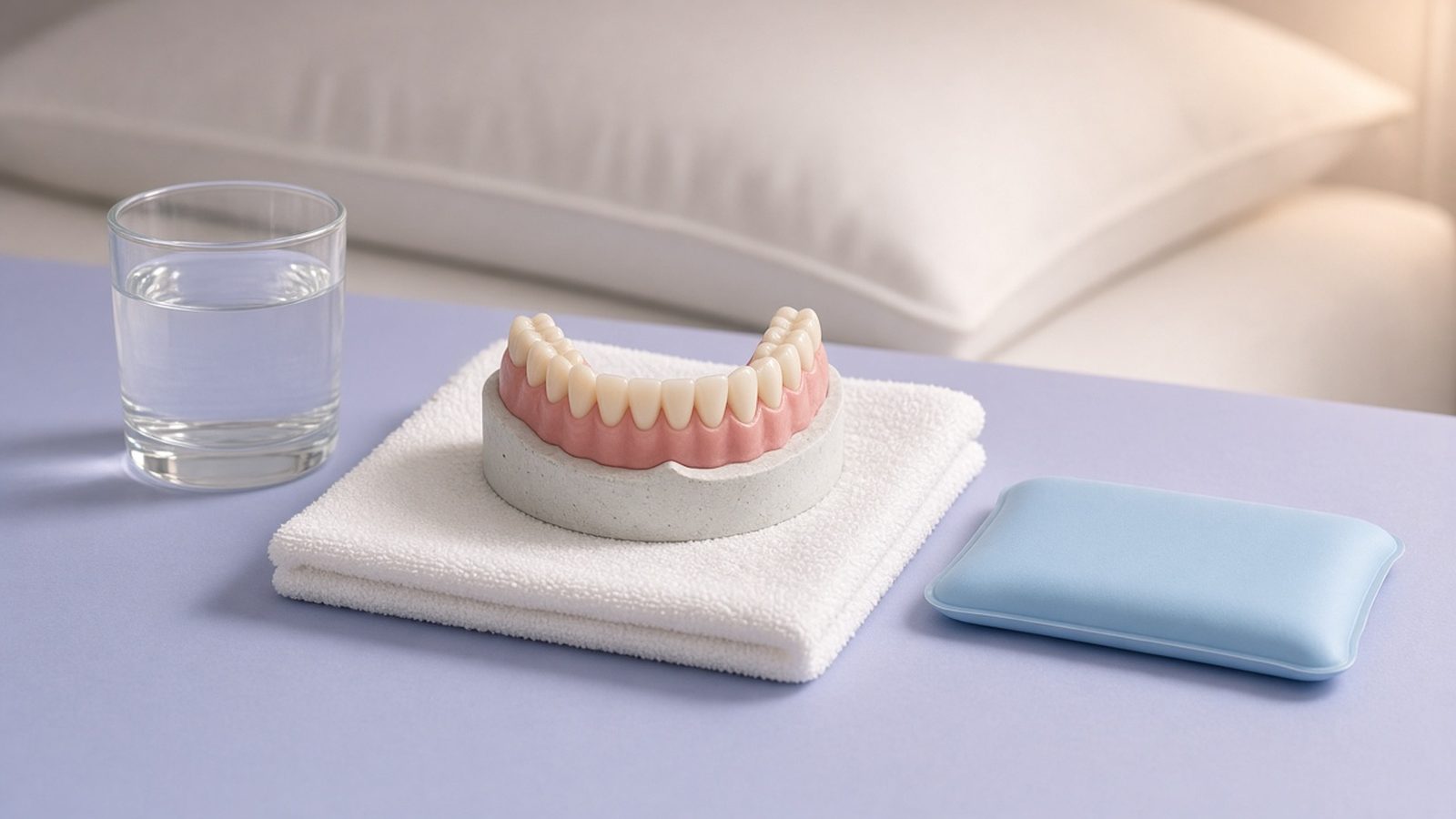
A night-by-night guide to sleeping after All-on-4 and full-arch implant surgery: bed setup, swelling peaks, temporary teeth, CPAP and medicine safety.
Most people planning full-arch treatment think hard about surgery day. Fewer think about the night that follows it, and the two or three after that. Yet when patients call with questions in the first week, a lot of them are about sleep: how to lie down when both sides of the mouth are tender, whether the new teeth stay in overnight, why they feel wide awake at 2 AM, and what to do about a CPAP mask.
This guide explains how to sleep after All-on-4 surgery and other full-arch (All-on-X) procedures, night by night. It covers how to set up your bed before surgery, which positions tend to work when there is no "good side," how swelling usually behaves, how medicines and anesthesia affect sleep, and when something you notice at night deserves a phone call. It is written for patients from Hutto, Round Rock, Pflugerville, Georgetown, Cedar Park and the wider Austin area who are treated at our Hutto office, but the advice applies wherever you heal. Your surgeon's written instructions always come first; this article is general education that helps you prepare.
The short answer
For the first few nights after full-arch surgery, sleep on your back with your head and upper body raised, not just your head. Keep pressure off your cheeks, take your medicines exactly as prescribed, have a responsible adult with you the first night, and expect the second and third nights to feel more swollen than the first.
A few points that are specific to full-arch care:
- Because work is usually done across the whole arch, there is no "good side" to lie on. Back sleeping, propped up, is the practical choice until swelling clearly starts to go down.
- At Regional Implant Centers, every patient leaves surgery with same-day temporary teeth. If your plan uses fixed temporary teeth, they stay in at night. You do not take them out.
- Swelling commonly peaks around the second or third day, not the first night. Plan to keep sleeping elevated through that window.
- If you use CPAP or have sleep apnea, do not change your therapy on your own. Make a plan with your sleep physician and our team before surgery.
- Sleeping poorly for a few nights is common. Sudden worsening swelling, bleeding that will not stop, fever, or any trouble breathing is not, and should not wait until morning.
Why sleep matters after full-arch surgery
Rest supports recovery, and sleep and pain affect each other. Poor sleep can make discomfort feel worse the next day, and discomfort can make it harder to sleep, so a little planning pays off.
A 2013 review in the Journal of Pain by Finan, Goodin and Smith looked at studies of sleep and pain and concluded that the relationship runs in both directions, and that impaired sleep may predict worsening pain more reliably than pain predicts impaired sleep. That research was mostly about longer-term pain rather than dental surgery, so it should not be stretched too far. But the practical message fits what patients describe: a well-planned first week, with the bed ready and medicines timed sensibly, tends to feel more manageable than one improvised at midnight.
Full-arch surgery is also different from having one tooth pulled. Depending on your plan, it may involve extractions across the arch, smoothing and reshaping the bone, implant placement, and sometimes bone grafting or a sinus lift, followed by same-day temporary teeth. The American Association of Oral and Maxillofacial Surgeons (AAOMS) notes that some discomfort, swelling and bruising at the surgical site is normal after implant surgery and that rest helps the body focus on healing. More surgical work generally means more swelling, which is exactly what you are managing at night.
Before surgery: set up your bed and your bedside
Do the setup a day or two before surgery. When you get home, you will be sleepy and numb, and nobody wants to be hunting for pillows.
A simple checklist:
- Something that raises your back and shoulders, not just your head. Two or three firm pillows stacked in a ramp, or a foam wedge pillow, works better than soft pillows piled under your head alone. Pillows only under the head bend the neck forward, which is uncomfortable and can make breathing feel more restricted. A recliner is a good alternative if you have one and can sleep in it.
- A pillow under your knees. It keeps you from sliding down the ramp during the night.
- Pillows along both sides. These make it harder to roll onto your face or cheek while you sleep.
- An old pillowcase or a towel over the top pillow. NHS aftercare guidance after tooth removal notes that a small amount of oozing is common and may show up on your pillow for a few days. A dark towel saves your good linens and your nerves.
- A bedside station. Water, your written instructions, your medicines and the schedule for taking them, clean gauze if your surgeon provided it, a small flashlight, and your phone with our number saved: (832) 632-7037.
- A cool, quiet room. A fan or humidifier can help if your nose feels stuffy or you end up breathing through your mouth.
- A clear path to the bathroom. After sedation or general anesthesia, and with some pain medicines, you may feel unsteady when you first stand up. Night lights help.
If you share a bed, think about whether your partner will sleep better elsewhere for a night or two. You may be propped up, restless, or snoring more than usual because of swelling, and you will both rest better if nobody is elbowing a sore cheek.
The first night: anesthesia, numbness and your new temporary teeth
On the first night, the anesthesia is still wearing off, numbness fades, and your temporary teeth will feel strange. Have a responsible adult with you, sleep propped up on your back, and keep your medicines on schedule.
Someone stays with you
Full-arch surgery is usually done with IV sedation or general anesthesia. At Regional Implant Centers, anesthesia options include local anesthesia, IV sedation and general anesthesia, and an anesthesiologist manages sedation or general anesthesia so the surgeon can focus on surgery. Surgery takes place in a very safe surgical facility with the highest standards of care, with breathing, oxygen levels, heart rate and blood pressure monitored throughout.
The effects of anesthesia do not end when you leave. The American Society of Anesthesiologists (ASA) explains that after general anesthesia you may continue to be sleepy, your judgment and reflexes may take time to return to normal, you cannot drive yourself home, and it is best to have someone with you for at least the first 24 hours. After sedation, recovery is usually quicker, but you still cannot drive and should have someone with you for at least several hours. For most full-arch patients, the simplest plan is to have the same responsible adult drive you home and stay overnight. Our article on IV sedation vs general anesthesia explains how the choice is made.
Numbness wears off in the evening
Local anesthetic often fades in the late afternoon or evening, which is roughly when you are trying to settle down. That is one reason surgeons often give a schedule for pain medicines rather than "take as needed." Follow the schedule you were given. Do not double up on doses, and do not add over-the-counter products, sleep aids or alcohol without asking first (more on that below).
While your lips and cheeks are numb, you can bite them without noticing, so avoid chewing anything at bedtime and stick to the cool liquids or very soft foods your instructions allow. Our article on what to eat after All-on-4 covers the first-day menu.
Your temporary teeth stay in
Every Regional Implant Centers patient leaves surgery with same-day temporary teeth. With a fixed temporary bridge, the teeth are attached to the implants and are not something you remove at night. That surprises some people who have worn removable dentures for years and are used to sleeping without them.
The temporary teeth will feel bulky at first, your tongue will explore them constantly, and your bite may feel slightly off while swelling changes the way your jaw closes. That is common in the first days. Do not try to adjust the teeth yourself. If something feels sharp, loose or like it is pressing on your gums, call us; adjustments are part of the follow-up process. Our article on temporary vs final teeth explains why the temporary set is built differently from your final arch.
If your plan uses a removable option instead, such as an immediate denture or a snap-on implant overdenture, ask specifically whether it should stay in or come out the first night. Instructions differ by plan, and this is one detail worth writing down before you leave.
Cold packs while you are awake, not while you sleep
Many surgeons recommend cold packs on the outside of the face during waking hours for the first day or two. If yours does, use them as directed with a cloth between the pack and your skin, and set them aside before you fall asleep. Falling asleep with a cold pack against your face can irritate the skin, especially while it is still numb.
Nights two and three: when swelling usually peaks
Many people feel more swollen on the second and third mornings than on the first. Keep sleeping elevated on your back through this stretch, even if the first night went well.
A study by Gonzalez-Santana and colleagues followed 41 patients who received 131 implants and found that swelling was moderate in most and peaked at about 48 hours in nearly half of them. Swelling was greater in older patients, when more than four implants were placed, when implants were in the back of the mouth, and when sinus lifts or bone regeneration were part of the surgery. Those are common features of full-arch cases, so it makes sense to expect a noticeable peak and to keep the extra pillows in place a little longer. The NHS aftercare guidance cited above similarly describes swelling and bruising lasting up to a week, and many patients find days two and three the most uncomfortable.
Why elevation helps is straightforward. Swelling is fluid in the soft tissues. When you lie flat, that fluid tends to collect in the face overnight, and many people wake up with a tight, throbbing feeling. Keeping your head above your heart lets gravity help. It does not prevent swelling, but it often makes nights more comfortable and mornings less dramatic.
A few things patients notice at this stage:
- Bruising may appear on the cheeks, under the eyes or along the jaw and can drift downward toward the neck. It usually changes color as it fades.
- Jaw stiffness can make opening wide feel awkward. Do not force it.
- Mouth breathing is common when lips and cheeks are swollen, which can leave your mouth dry when you wake. Sips of water at the bedside and a humidifier help. Follow your instructions on rinsing; many surgeons ask you to avoid vigorous rinsing early on.
- Snoring may be louder than usual for a few nights, simply because swollen tissue changes how air moves. If you have never been diagnosed with sleep apnea but someone notices you stop breathing or gasp in your sleep, mention it to us and to your physician.
If you wake up having slid flat, do not worry. Simply reposition and go back to sleep. One night of sliding down is not going to undo your surgery.
Nights four to seven and beyond: easing back to normal
From around the fourth night, many people notice swelling going down and can start lowering the pillows gradually, still on their back. Go at your body's pace and follow your surgeon's timeline.
There is no single day when everyone can go back to sleeping on their side. A reasonable guide is comfort: if lying flatter brings back throbbing or facial pressure, go back up a pillow. With full-arch work, both cheeks and both sides of the jaw are healing, so side sleeping usually waits until pressing your cheek into a pillow no longer feels sore. Your surgeon may give a longer elevation period after bone grafting, a sinus lift or zygomatic implants.
Even after the first week, remember that your temporary teeth are temporary. They are designed to let you smile, speak and eat soft foods while the implants integrate with the bone, and they are not built for heavy force. Your final arch, made in full monolithic zirconia or titanium-reinforced zirconia, is typically delivered one to four months after surgery, depending on how healing progresses.
Sleep apnea and CPAP: plan these nights before surgery
If you have sleep apnea, the nights after surgery deserve their own plan. Pain medicines and sedatives can affect breathing during sleep, and the ASA guideline flags the third and fourth nights after surgery as a time to stay alert. Do not stop or change CPAP without your sleep physician.
We cover sleep apnea, CPAP masks and full-arch planning in detail in our article on sleep apnea, CPAP and full-arch dental implants. Here are the points that matter most for the nights at home.
The ASA's practice guidelines for patients with obstructive sleep apnea having surgery list the severity of the sleep apnea, opioid pain medicines, sedatives and the type of surgery among the risk factors for breathing problems after surgery. They also describe a possible return of more intense dream (REM) sleep around the third or fourth night after surgery, often called REM rebound, as sleep patterns re-establish themselves, a stage when apneas can be more frequent. The same guidelines note that people with sleep apnea often breathe better on their side or sitting up than flat on their back, and that a randomized trial found better breathing with CPAP after surgery than without it.
What that means in practice:
- Bring it up early. Tell us at your consultation if you have sleep apnea, use CPAP or BiPAP, use an oral appliance, or have been told you snore loudly and stop breathing in your sleep.
- Make a mask plan together. A CPAP mask that rests on the lips or chin may press on healing tissue or temporary teeth. Some patients need a different mask style for a while. That is a decision for your sleep physician, with input from our team, made before surgery, not a pause you decide on alone.
- Upper jaw surgery and nasal masks. If you had a sinus lift or upper bone grafting, ask how nasal CPAP fits with your sinus precautions. Our Hutto office performs bone grafting and sinus work, and our article on sinus problems after dental implants explains what is normal.
- Sleeping propped up helps here too. The semi-upright position you are already using for swelling is also the kind of position the ASA guideline describes as easier on breathing for people with sleep apnea.
- Your overnight companion matters more. Make sure the person staying with you knows you have sleep apnea and knows to call 911 if you are very hard to wake or are struggling to breathe.
Medicines, sleep aids and alcohol
Take only what your surgeon prescribed or approved, on the schedule you were given. Do not combine prescription pain medicines with sleeping pills, anxiety medicines or alcohol unless the prescribing clinician has said it is safe.
The night is when people are most tempted to "add something" to get to sleep. That is worth resisting. In 2016 the U.S. Food and Drug Administration required its strongest boxed warnings about combining opioid pain medicines with benzodiazepines (a class of medicines often used for anxiety or sleep) or other central nervous system depressants, including alcohol, because the combination can cause extreme sleepiness, slowed or difficult breathing, coma and death. Not every full-arch patient receives an opioid, but if you do, this warning applies directly to your first nights at home.
Practical rules:
- Bring a full list of everything you take, including sleep aids, supplements, cannabis products and over-the-counter medicines, to your consultation and pre-surgery visit.
- Ask before taking any sleep aid or allergy medicine that causes drowsiness during recovery.
- Avoid alcohol while taking prescription pain medicine and for as long as your surgeon advises. NHS aftercare advice also notes that alcohol can increase bleeding in the first days after tooth removal.
- If you take medicines for diabetes, blood pressure, blood thinning or sleep apnea, follow the plan your physicians and our team agreed on before surgery.
Feeling wired at 2 AM
Some patients are surprised to be wide awake the first night or two. Many things can cause that: leftover effects of anesthesia, discomfort as numbness wears off, an unfamiliar sleeping position, and sometimes medicines. Some surgeons use steroid medicines such as dexamethasone around oral surgery to help control swelling, and MedlinePlus lists insomnia and restlessness among dexamethasone's possible side effects. It can also raise blood sugar in people with diabetes. If you were given a steroid and you are sleeping badly, ask whether the timing of the dose can be adjusted. Do not stop or skip any prescribed medicine on your own.
A short nap during the day is fine in the first days, but long afternoon sleeps can make the night harder. Dim lights in the evening and keep the phone screen away while you are settling down.
Special cases: sinus lifts, grafting and zygomatic implants
Upper jaw surgery near the sinuses, bone grafting and zygomatic implants can mean more swelling and extra precautions at night, so ask for procedure-specific instructions.
When upper implants need more bone, a sinus lift may be part of the plan, and Regional Implant Centers does sinus lifts. After sinus work, surgeons commonly give precautions such as not blowing your nose and sneezing with your mouth open, because pressure in the nose pushes against the healing area. At night that often means sleeping elevated, keeping tissues by the bed and using any prescribed nasal sprays exactly as directed.
Timing matters in Central Texas. The Texas A&M Forest Service explains that mountain cedar pollen season typically starts in mid-December, peaks in January and tapers by early March, and congestion and sneezing make sinus precautions harder to follow at night. If your upper surgery falls in that window, ask before surgery which allergy medicines are fine to take. Our article on sinus lift vs zygomatic implants explains the anatomy.
For patients with severe upper bone loss, zygomatic and pterygoid implants are placed at Regional Implant Centers by Dr. Enrique Tabarini. These procedures reach farther back and higher in the upper jaw, so expect specific instructions, possibly including a longer period of elevated sleeping. Our article on zygomatic implant surgery recovery walks through that recovery.
Clenching and grinding on temporary teeth
If you clench or grind at night, tell us before surgery. Temporary teeth are not built for heavy nighttime forces, and planning ahead protects them while you heal.
Many people do not know they grind until a partner hears it or a dentist sees the wear. Clenching can also be more noticeable when you are stressed, sore or sleeping in an unfamiliar position. Heavy forces on healing implants and on temporary teeth are worth avoiding, so mention any history of grinding, broken dentures or cracked teeth at your consultation. Do not use an over-the-counter mouth guard over new temporary teeth unless our team has said it is appropriate; a poorly fitting guard can press on healing tissue. Some guards can also affect breathing in people with sleep apnea. Our article on teeth grinding with All-on-4 explains how grinding is managed once your final teeth are in.
When a nighttime problem should not wait until morning
Most discomfort at night is expected and improves day by day. Some signs need a call right away, and trouble breathing needs 911.
Call us at (832) 632-7037 if you notice:
- Bleeding that keeps going after you have followed your instructions for pressure, or that soaks through more than light oozing
- Swelling that suddenly gets worse after it had started to improve, especially after the third or fourth day
- Fever, chills, or a bad taste or discharge that suggests infection
- Pain that is getting worse instead of better, or is not controlled by your prescribed medicines
- Temporary teeth that feel loose, cracked or are pressing painfully into your gums
- Nausea or vomiting that keeps you from taking fluids or medicines
Call 911 for difficulty breathing or swallowing, swelling that spreads toward the eye or neck and affects breathing, chest pain, or if your companion cannot wake you normally.
The person staying with you should know these signs too. On the first night especially, they are your safety net.
What our team plans before your recovery starts
Good nights after surgery start at the consultation, when your medical history, imaging, anesthesia plan and home support are reviewed together.
Under our RISE Protocol, each part of treatment is handled by the specialist who owns that phase. A prosthodontist plans your bite, facial support and final teeth before surgery. Our imaging and digital planning team studies your anatomy; both our Katy and Hutto offices have a mobile cone beam CT, which is used to study bone volume, nerve pathways, sinus position and jaw anatomy and can capture updated scans during surgery when appropriate. During surgery, the oral surgeon focuses on the surgical work while an anesthesiologist focuses on your safety, comfort and monitoring. That split is especially relevant if you have sleep apnea, take several medicines, or have had a hard time waking up after anesthesia before. Our anesthesia and patient comfort page and our article on anesthesia monitoring during implant surgery describe what is watched.
Our in-house dental lab, where technicians work alongside the surgical and restorative team, is at our Katy office. A typical full-arch case takes four to five visits in total, from consultation through delivery of the final arch, and the exact sequence depends on your plan. Treatment comes with a one-year warranty, and extended maintenance packages are available for ongoing care after your final teeth are in.
Not every plan ends in fixed teeth, and not every patient is a candidate for implants. Both our Hutto and Katy offices offer traditional dentures, snap-on implant overdentures and fixed full-arch implant teeth, and the right option depends on your health, bone and goals. Some cases need staged care or bone grafting first.
For patients in Hutto, Round Rock, Pflugerville and the Austin area
Our Austin-area office is at 201 E Wilco Hwy, Suite 203, in Hutto. Plan your ride home and your first night before surgery day.
The Hutto office sits on E Wilco Hwy (US-79). Posted hours are Monday through Thursday, 8 to 5, and Fridays are reserved for surgeries. For many patients, the drive home to Round Rock, Pflugerville, Georgetown or Cedar Park is short, but you still need someone else driving, and it helps if that person has already set up the bedroom and picked up any prescriptions so you can go straight to rest. If you are coming from farther away, ask whether staying nearby the first night makes sense for your case, especially if you have sleep apnea or live alone.
Patients from the Houston side are treated at our Katy office. Our article on full-mouth dental implants near Austin walks through the visits from consultation to final teeth, and the All-on-4 timeline shows how the weeks and months usually unfold.
Insurance and financing, briefly
At Regional Implant Centers, medical insurance is reviewed only for surgical professional services, such as extractions, bone grafting and alveoloplasty. Implants, temporary teeth and the final prosthesis are billed to you directly. Only PPO plans work for our out-of-network oral surgery benefits, and we cannot bill Federal Employee Program (FEP) Blue Cross Blue Shield plans. If you have a PPO plan with oral surgery coverage, it is worth checking whether some surgical services may be covered; please verify your benefits with your carrier, because coverage is never guaranteed. Our insurance team and financing pages explain the options, and financing is provided by independent third-party companies.
Questions to ask before surgery
Bring these to your consultation or pre-surgery visit and write the answers on your instruction sheet:
- How long should I sleep with my head raised, and at about what angle?
- Will my temporary teeth be fixed or removable, and what do I do with them at night?
- Which medicines will I take at bedtime, and what should I avoid combining them with?
- I use CPAP (or snore heavily). What is the plan for my mask and the first nights?
- Are there extra precautions for my sinus lift, grafting or zygomatic implants?
- What signs should make me call that night, and what number do I call?
- When is my first follow-up visit?
Frequently asked questions
How should I sleep after All-on-4 surgery?
On your back, with your head and upper body raised on firm pillows, a wedge or a recliner, and a pillow under your knees so you do not slide down. Because full-arch surgery usually involves both sides of the mouth, avoid sleeping on your side or face until swelling has clearly gone down. Follow your surgeon's written instructions for how long to stay elevated.
How many nights should I sleep elevated after full-arch implant surgery?
Plan on at least the first three nights, because swelling commonly peaks around the second or third day. Many people start lowering the pillows from about the fourth night as swelling eases, but grafting, sinus lifts or zygomatic implants may call for longer. Let your surgeon's timeline and your comfort guide you.
Do I take my temporary teeth out at night?
Not if they are fixed. Every Regional Implant Centers patient leaves surgery with same-day temporary teeth, and a fixed temporary bridge is attached to the implants and stays in day and night. If your plan uses a removable denture or snap-on overdenture instead, ask your team whether it stays in or comes out the first night.
Can I use my CPAP after implant surgery?
Do not stop or change CPAP on your own. Pain medicines and sedatives can affect breathing during sleep, and the ASA guideline highlights the third and fourth nights after surgery as a time to stay alert. Plan your mask and therapy with your sleep physician and our team before surgery, since a mask that presses on healing tissue may need to be changed.
Is it normal not to sleep well after dental implant surgery?
A few restless nights are common, from leftover anesthesia effects, an unfamiliar position, discomfort as numbness wears off, and sometimes steroid medicines. Do not add sleeping pills or alcohol without asking, especially if you take a prescription pain medicine. Call us if pain is worsening or swelling suddenly increases.
Plan your recovery with our team
The best time to plan your first nights at home is before surgery is scheduled. Schedule a consultation at our Hutto office. The $25 consultation includes a CBCT 3D scan and an insurance benefits check, and it is the right time to talk through your medical history, sleep apnea or CPAP use, anesthesia options and what your recovery at home will look like.
Schedule your consultation or call (832) 632-7037.
Related reading: Sleep apnea, CPAP and full-arch dental implants, What to eat after All-on-4, Sinus problems after dental implants, IV sedation vs general anesthesia for implants, Temporary vs final teeth, Teeth grinding with All-on-4, Zygomatic implant surgery recovery, Anesthesia and patient comfort, Mobile cone beam CT, Dr. Enrique Tabarini, Hutto office and Katy office.
About the author: Jeffry Tobon, CDT, is President of Regional Implant Centers.
Sources & Resources
- American Association of Oral and Maxillofacial Surgeons. Healing process for dental implants.
- American Society of Anesthesiologists, Made for This Moment. Anesthesia recovery.
- American Society of Anesthesiologists. Practice guidelines for the perioperative management of patients with obstructive sleep apnea. Anesthesiology, 2014.
- Gonzalez-Santana H, Penarrocha-Diago M, Guarinos-Carbo J, Balaguer-Martinez J. Pain and inflammation in 41 patients following the placement of 131 dental implants. Medicina Oral, Patologia Oral y Cirugia Bucal, 2005.
- Kingston and Richmond NHS Foundation Trust. Dental extraction after-care.
- U.S. Food and Drug Administration. New safety measures announced for opioid analgesics, prescription opioid cough products, and benzodiazepines.
- MedlinePlus, U.S. National Library of Medicine. Dexamethasone.
- Finan PH, Goodin BR, Smith MT. The association of sleep and pain: an update and a path forward. Journal of Pain, 2013.
- Texas A&M Forest Service. Cedar fever season in Texas.
This article is general patient education and is not a diagnosis, treatment plan or medical advice. Follow the written instructions from your own surgeon and anesthesia provider, which take priority over anything here. Do not start, stop or change any medicine, CPAP or oral appliance without talking to the clinician who prescribed it. If you have trouble breathing, call 911. Whether implants are appropriate, and which anesthesia is used, depends on an individual exam, imaging and medical review, and no surgery or anesthesia is free of risk. Insurance coverage is never guaranteed; at Regional Implant Centers, medical insurance is reviewed only for surgical professional services, and implants, temporary teeth and the final prosthesis are billed to the patient. Financing is provided by independent third-party companies. Implant treatment is not appropriate for every patient, and outcomes vary. Regional Implant Centers has offices in Katy and Hutto, Texas.
Ready to Learn What Is Possible?
Schedule a consultation with Regional Implant Centers.
Schedule ConsultationFrequently Asked Questions
How should I sleep after All-on-4 surgery?
On your back, with your head and upper body raised on firm pillows, a wedge or a recliner, and a pillow under your knees so you do not slide down. Because full-arch surgery usually involves both sides of the mouth, avoid sleeping on your side or face until swelling has clearly gone down. Follow your surgeon's written instructions for how long to stay elevated.
How many nights should I sleep elevated after full-arch implant surgery?
Plan on at least the first three nights, because swelling commonly peaks around the second or third day. Many people start lowering the pillows from about the fourth night as swelling eases, but grafting, sinus lifts or zygomatic implants may call for longer. Let your surgeon's timeline and your comfort guide you.
Do I take my temporary teeth out at night?
Not if they are fixed. Every Regional Implant Centers patient leaves surgery with same-day temporary teeth, and a fixed temporary bridge is attached to the implants and stays in day and night. If your plan uses a removable denture or snap-on overdenture instead, ask your team whether it stays in or comes out the first night.
Can I use my CPAP after implant surgery?
Do not stop or change CPAP on your own. Pain medicines and sedatives can affect breathing during sleep, and the ASA guideline highlights the third and fourth nights after surgery as a time to stay alert. Plan your mask and therapy with your sleep physician and our team before surgery, since a mask that presses on healing tissue may need to be changed.
Is it normal not to sleep well after dental implant surgery?
A few restless nights are common, from leftover anesthesia effects, an unfamiliar position, discomfort as numbness wears off, and sometimes steroid medicines. Do not add sleeping pills or alcohol without asking, especially if you take a prescription pain medicine. Call us if pain is worsening or swelling suddenly increases.
This content is educational and not a substitute for a consultation.