Medical Necessity Dentistry
Rheumatoid Arthritis, Biologics and Full-Arch Implants: A Planning Guide for San Antonio Patients
Rheumatoid arthritis and full-arch implants: what the research shows, why infected teeth matter on biologics, and how medicine timing is decided.
If you live with rheumatoid arthritis, your mouth probably is not the first thing your rheumatologist asks about. Yet many people with RA reach a point where their teeth are loose, sore or failing, and they start wondering about full-arch implants. That is usually when the harder questions show up. Will my medicine slow healing? Do I have to stop Humira or methotrexate? Is it safer to leave infected teeth alone until my arthritis settles down?
This guide is written for San Antonio-area adults with rheumatoid arthritis and related autoimmune conditions who are weighing fixed teeth, implant overdentures or a denture. It explains what research shows about implants in people with RA, why infected teeth deserve attention when you take immune-suppressing medicine, how medication timing is usually decided, and what a careful plan looks like at Regional Implant Centers. It is education, not a treatment plan, and it never replaces the doctor who prescribes your medicine.
The short answer
Rheumatoid arthritis by itself does not rule out dental implants. Systematic reviews of the published cases, which are mostly small and retrospective, report implant survival in people with RA that is broadly similar to what is reported in the general population. The weaker points show up in the details: people with RA in these studies tended to lose more bone around implants over time, steroids can affect bone, and stiff or painful hands can make daily cleaning harder.
Medication timing is a joint decision between your prescribing doctor and your surgical team. There is no dental-specific guideline for biologics, so teams often borrow principles from rheumatology guidance written for joint replacement surgery. Never stop, skip or delay an RA medicine on your own. A disease flare is a real risk, and your rheumatologist is the one who weighs it.
Why RA and failing teeth so often show up together
People with rheumatoid arthritis are not simply unlucky with their teeth. Researchers have studied the link between RA and periodontitis, the gum infection that destroys the bone holding teeth in place, for years. A 2023 review in the Japanese Dental Science Review by Kobayashi and Bartold found that most clinical studies in the prior decade reported a positive association between periodontitis and RA. One proposed mechanism involves Porphyromonas gingivalis, a gum bacterium that produces an enzyme able to modify proteins in a way that may feed the same antibody response seen in RA. The same review notes that several studies found improvements in RA measures after non-surgical gum treatment. The relationship is still being worked out, and it does not mean gum disease causes RA, but it does mean the two conditions often travel together.
Daily life with RA adds practical pressure on teeth:
- Hands and wrists. Swollen or stiff finger joints make brushing and flossing harder, so plaque builds up even in motivated patients.
- Jaw joints. RA can involve the temporomandibular joints, which may limit how wide you can open and can make long dental visits tiring.
- Dry mouth. Some people with RA also have secondary Sjogren's syndrome or take medicines that reduce saliva. Less saliva generally means more decay and gum problems.
- Fatigue and flares. When the arthritis is active, dental appointments are often the first thing to slip.
None of this is a personal failure. It is why so many people with RA arrive at a full-arch consultation with several teeth that are beyond saving at once.
Why infected teeth matter more when you take immune-suppressing medicine
This is the part of the conversation that makes full-arch care for RA patients more than a cosmetic decision. Methotrexate, biologics such as adalimumab (Humira) or etanercept (Enbrel), JAK inhibitors such as tofacitinib (Xeljanz) or upadacitinib (Rinvoq), and long-term prednisone all change how your immune system responds. That is their purpose. The trade-off is that an infection your body might otherwise contain can become harder to manage.
A mouth with abscessed teeth, deep gum pockets or broken roots is a standing source of bacteria. For a patient on immune-suppressing medicine, removing chronic dental infection is often a medical goal in its own right, separate from the goal of new teeth. That is also why dental clearance comes up before other major medical procedures; our Austin guide to dental clearance before surgery covers transplants, joint replacement, heart valve surgery and cancer treatment, and our guide on when dental treatment is recommended before medical clearance explains how that decision is usually framed.
If you are about to start a biologic, or your rheumatologist is considering a stronger medicine, ask whether it makes sense to have your teeth evaluated first. Dealing with infected teeth before an immune-suppressing medicine is started or increased is often simpler to schedule than fitting surgery between doses later. That is a question for your rheumatologist and your dental team to answer together.
For a deeper look at how hidden dental infections are found, see our article on hidden tooth infections and CBCT imaging and our Houston guide to chronic tooth infections and dental implants.
What research shows about implants in people with RA
The evidence is reassuring in outline and thin in detail. Three systematic reviews are worth knowing about.
Hyldahl and colleagues, 2024 (Journal of Oral and Maxillofacial Research). This review gathered clinical studies of implants in people with autoimmune diseases published through December 2021. For rheumatoid arthritis it found 12 articles covering 124 patients and 363 implants. Implant survival was 97.2 percent at the implant level and 95.2 percent at the patient level after a weighted mean follow-up of about 50.8 months, and most of the implants that were lost failed early. The authors were candid about the limits: the studies were mostly case reports and retrospective series of low quality, and medication data were reported too inconsistently to judge the effect of immune-suppressing drugs. They also noted that people with RA showed the most bone loss around implants of any group in the review, and pointed to frequent steroid use as one possible reason.
Duttenhoefer and colleagues, 2019 (International Journal of Implant Dentistry). This review and meta-analysis looked at implants in people who are immunocompromised, including those with autoimmune disease. Across the RA studies it included, the authors found no influence of rheumatoid arthritis on overall implant survival.
Esimekara and colleagues, 2022 (Journal of Stomatology, Oral and Maxillofacial Surgery). This review covered nine autoimmune conditions, including RA. It concluded that survival was comparable to the general population, while stressing that careful oral hygiene and long-term follow-up were common to the cases that went well.
Put plainly: the published experience suggests implants can work for many people with RA, but nobody can promise that for an individual, and the research does not tell us how a specific biologic or JAK inhibitor affects your result. That uncertainty is a reason for careful planning, not a reason to give up on treatment.
Your medicines and the timing of surgery
There is no guideline written specifically for dental surgery in patients taking biologics. A 2023 review on managing biologics in oral surgery by Mills, Ryan and Gaffney in the Journal of Oral Medicine and Oral Surgery made exactly that point and suggested that dental teams draw on guidance from other specialties, with the decision individualized and made with the prescribing physician.
The guidance most often borrowed in the United States is the 2022 American College of Rheumatology and American Association of Hip and Knee Surgeons guideline for patients with rheumatic disease having elective hip or knee replacement. It was written for joint replacement, not oral surgery, and most of its recommendations are conditional and based on low-quality evidence. Still, it shows how rheumatologists tend to think about surgery:
| Medicine group (examples) | What the 2022 joint-replacement guideline suggests |
|---|---|
| Conventional DMARDs: methotrexate, leflunomide (Arava), hydroxychloroquine, sulfasalazine | Continue usual dosing through surgery |
| Biologics: adalimumab (Humira), etanercept (Enbrel), infliximab (Remicade), abatacept (Orencia), tocilizumab (Actemra) and others | Withhold, and schedule surgery after the next dose would have been due. For Humira every 2 weeks, that means surgery in week 3 |
| JAK inhibitors: tofacitinib (Xeljanz), baricitinib (Olumiant), upadacitinib (Rinvoq) | Withhold for at least 3 days before surgery |
| Daily glucocorticoids such as prednisone | Continue the current daily dose rather than giving extra "stress dose" steroids on the day of surgery |
| Restarting held medicines | Once the wound is healing, with no significant swelling, redness, drainage or other infection, typically about 14 days |
The same guideline notes that its recommendations address infection risk and that holding a medicine has to be balanced against the risk of a flare. Different rheumatologists apply these ideas to dental surgery in different ways. Some prefer to keep a biologic going for a more limited procedure. Others time surgery for the end of a dosing cycle. A few want a longer pause. All of those can be reasonable, which is exactly why the decision belongs to your prescriber and surgeon together, and not to a web article.
What you can do is make that conversation easy:
- Write down every RA medicine with its dose, how often you take it and the date of your last dose or infusion.
- Note any recent flares and how long they took to settle.
- Give your dental team permission to contact your rheumatologist, and give your rheumatologist the planned surgery date as early as possible.
- Ask both doctors who will tell you, in writing, what to do with each medicine before and after surgery.
Steroids, bone and healing
Prednisone and similar glucocorticoids deserve their own mention. Long-term use can thin bone and slow healing, and the Hyldahl review raised steroid use as a possible reason for the extra bone loss seen around implants in RA patients. If you take a daily steroid, your team needs the dose and how long you have taken it. Whether anything should change on surgery day is a decision for your prescriber and the anesthesiologist, not something to adjust on your own. Never stop a long-term steroid abruptly.
Many people with RA also take an osteoporosis medicine, sometimes because of steroid use. Those drugs carry their own jaw bone considerations, and your team will want to know about them too. Our guide to full-arch implants in your 70s and 80s covers bone medicines alongside other common health factors.
Hands, jaws and daily cleaning: choosing the right kind of teeth
For people with RA, the best plan on paper is not always the best plan in daily life. Two questions matter as much as the CBCT scan.
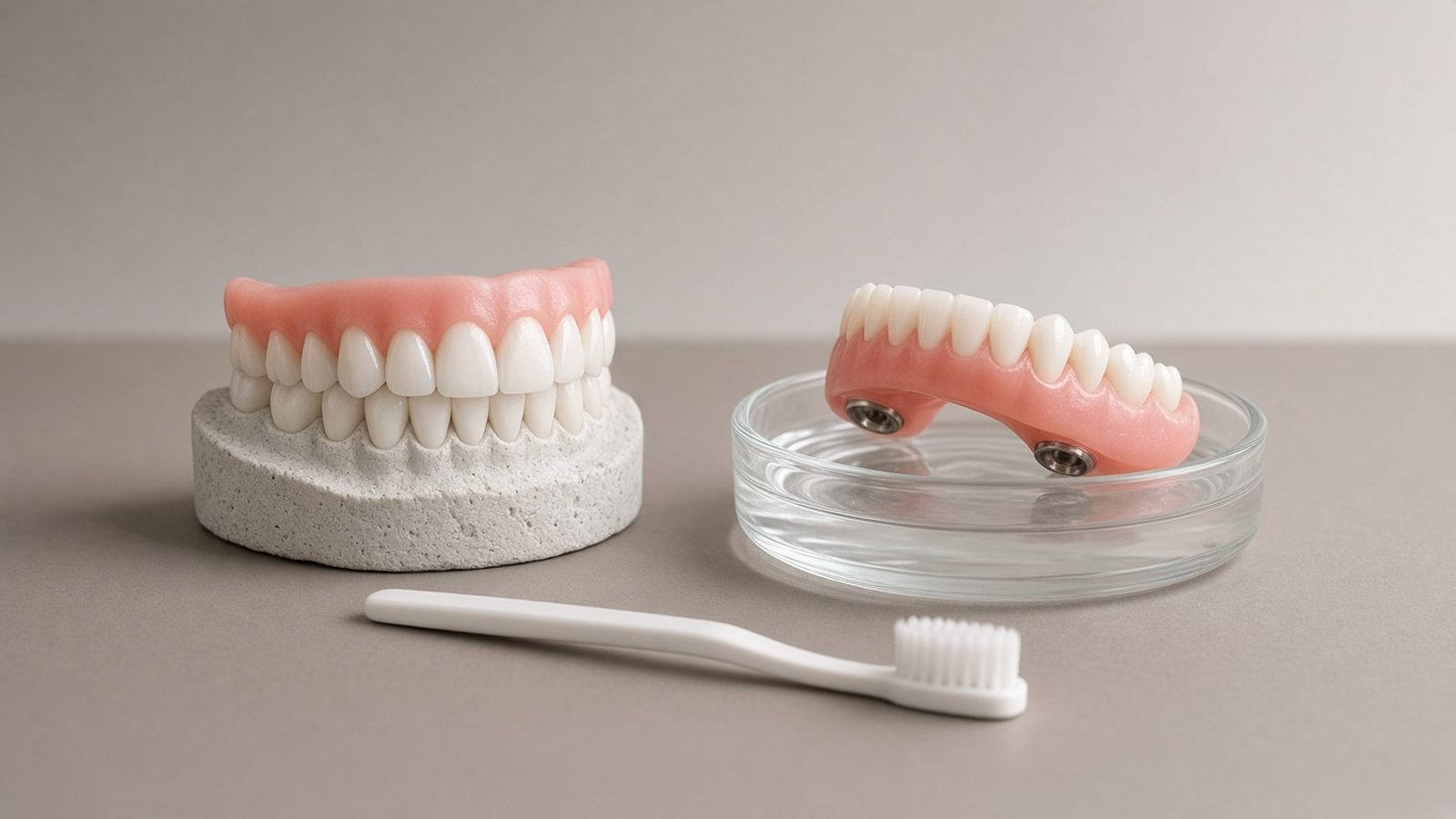
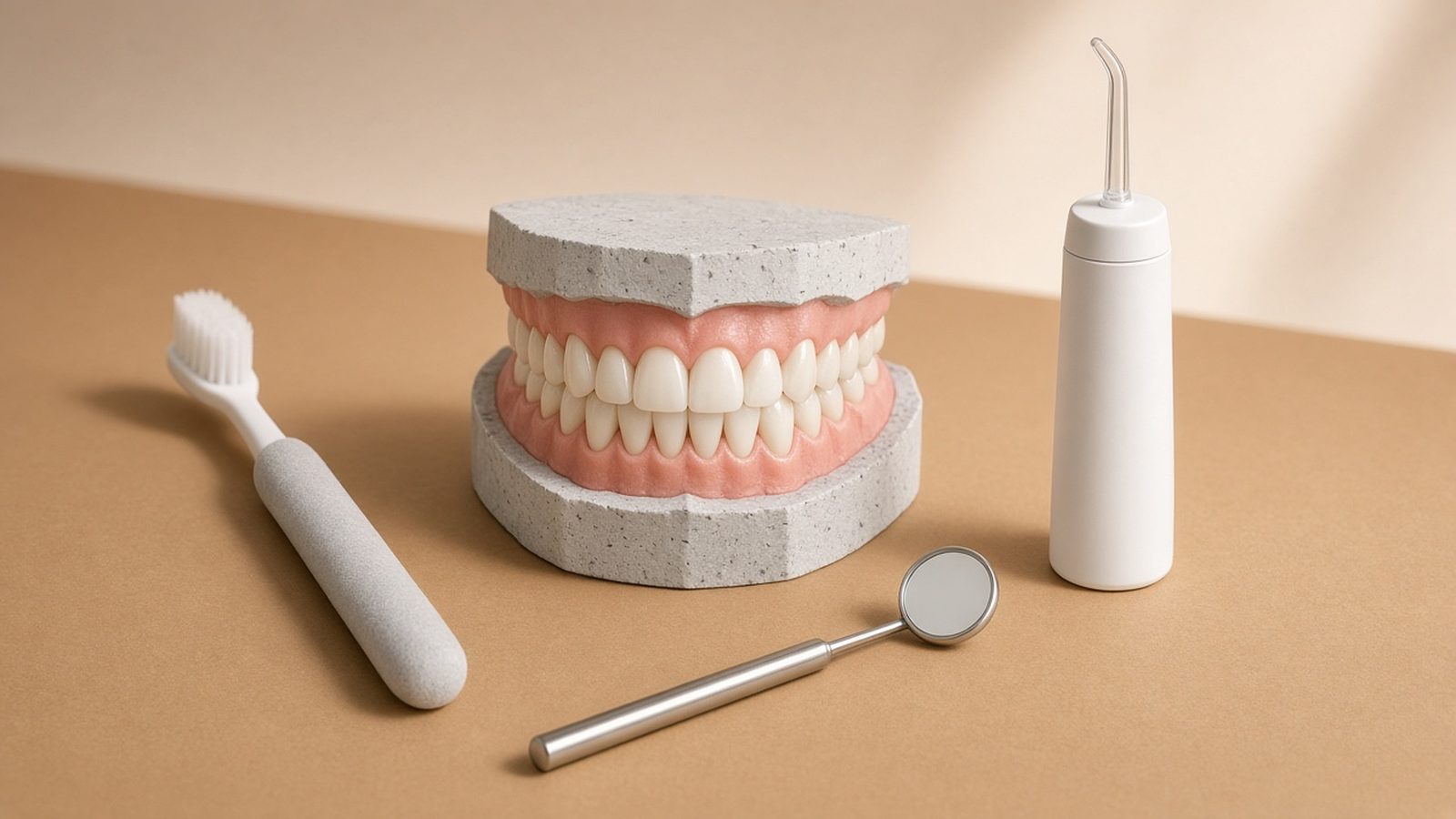
Can you clean it? Fixed full-arch teeth stay in your mouth, which removes the need to take out and put back a denture with sore fingers. But a fixed arch still needs daily cleaning underneath, and that takes some dexterity. Ask to see the cleaning tools before you decide. Many patients find a water flosser and thick-handled brushes easier than string floss. If a family member or caregiver helps with your daily routine, bring them to the consultation so they can learn the routine too.
Can you handle it? Snap-on implant overdentures are removable. For some people that makes cleaning easier, and for others the clips are hard to work with stiff hands. A traditional denture asks the least of surgery but the most of your gums and grip.
Both of our offices offer traditional dentures, snap-on implant overdentures and fixed full-arch teeth, so the choice can be made around you rather than around a single product. Our comparison of All-on-X, implant dentures and dentures walks through the trade-offs, and our guide to cleaning and maintaining full-arch teeth shows what daily care involves.
If your jaw joints are affected, mention it early. Limited opening, morning stiffness or jaw pain can change how long appointments should last, how impressions and scans are taken and which anesthesia option is most comfortable.
What is different about full-arch treatment with RA
A full-arch case usually means removing several teeth, cleaning out infection and placing implants in one planned surgery. For an RA patient, that concentrates the medicine-timing question into one date, which can make coordination simpler than a long series of separate extractions. It also means the plan has to account for:
- How much infection is present. Active abscesses and deep gum disease affect both the surgical plan and your rheumatologist's view of timing.
- Bone quality and volume. Long-term inflammation, steroids and tooth loss can all affect bone. Some patients need bone grafting first; our article on why bone grafting may be needed before dental implants explains when.
- Healing time between stages. Every patient at Regional Implant Centers leaves with same-day temporary teeth. Final arches are delivered in 1 to 4 months, depending on healing and progress, and typical cases take 4 to 5 total visits. Our article on temporary vs final teeth explains what changes between the two.
- Long-term bone around implants. Because the research points to more bone loss around implants in people with RA, regular professional maintenance matters more, not less.
Not every patient is a candidate for fixed teeth, and for some people a less extensive option is the better fit. A good team will tell you that directly.
How we plan these cases at Regional Implant Centers
Our RISE Protocol is built around a team rather than a single provider: a prosthodontist who plans the teeth and bite, an oral surgeon who plans and performs the surgery, an anesthesiologist focused on safety and monitoring, and lab technicians who build the teeth. For a patient with RA, that structure means:
- A medical history review that goes beyond a checkbox. Expect to be asked for your medicine list, recent flares, steroid history and your rheumatologist's contact details, and for permission to coordinate with your doctors when your history calls for it.
- 3D imaging before decisions. Both our Katy and Hutto offices have a mobile cone beam CT to study bone, infection sites, nerves and sinuses. Your $25 consultation includes a CBCT 3D scan.
- Specialist surgical planning. Our surgeons, including Dr. Enrique Tabarini, plan the extent and sequence of surgery around your health history. When bone is very limited, zygomatic and pterygoid implants are options performed by Dr. Tabarini, though they are not right for everyone.
- Anesthesia choices. Options include local anesthesia, IV sedation and general anesthesia, planned by an anesthesiologist. Surgery takes place in a very safe surgical facility held to the highest standards of care. If your jaw or neck joints are affected, tell the team early. Our anesthesia and patient comfort page explains more.
- Teeth designed close to the team. Our in-house dental lab is at our Katy office. Final arches are full monolithic zirconia or titanium-reinforced.
- Care after delivery. Regional Implant Centers provides a 1-year warranty plus extended maintenance packages for ongoing professional follow-up.
Traveling from San Antonio, New Braunfels, Schertz or Boerne
Regional Implant Centers does not have an office in San Antonio or the surrounding cities. Patients from the San Antonio area are seen at either of our two offices. Our Hutto office, at 201 E Wilco Hwy, Suite 203, is often the shorter drive up I-35 and also handles bone grafting and sinus procedures, including sinus lifts. Our Katy office, at 707 S Fry Rd, Suite 150, is a straight drive east on I-10 and is home to our in-house lab.
Travel takes more planning when your joints are part of the equation. Long drives can leave hips, knees and hands stiff, so build in stops and ask which visits must be in person. If a flare is likely around a scheduled visit, call ahead; rescheduling is better than pushing through a long appointment in pain. Our guide to full-mouth dental implants from San Antonio covers visit planning, and our Hutto and Katy location pages have maps. If you already have a plan from another office and want it reviewed, see our San Antonio second-opinion guide.
Insurance notes, without promises
Medical insurance may apply only to surgical services, such as extractions, bone grafting or alveoloplasty, when a plan includes oral surgery coverage. Implants, the prosthesis and temporary teeth are billed to the patient. Only PPO plans are relevant for our out-of-network oral surgery benefits, and Federal Employee Program (FEP) Blue Cross Blue Shield plans cannot be billed. A diagnosis such as rheumatoid arthritis does not by itself make dental treatment covered. If you have a PPO with oral surgery benefits, the surgical portion may be worth checking, but that is not a guarantee, so please verify. Your $25 consultation includes an insurance benefits check. Our article on medical insurance for oral surgery in full-arch treatment explains how surgical claims work, and financing options are available through independent third-party companies.
Questions to bring to your consultation
- Which of my teeth are infected, and how urgent is removing that infection given my medicines?
- Will you contact my rheumatologist, and what will you ask about each medicine?
- If a medicine is held, how will we choose the surgery date around my dosing schedule?
- What will healing look like for me, and which signs of infection should make me call right away?
- Based on my hands and jaw, would fixed teeth or an overdenture be easier for me to live with?
- Do I need bone grafting, and does my steroid history change that?
- Which anesthesia option fits my joints, airway and medical history?
- How often should I come back for maintenance after my final teeth are placed?
Frequently asked questions
Can I get dental implants if I have rheumatoid arthritis?
Often, yes. Systematic reviews report implant survival in people with RA that is broadly similar to the general population, although the studies are small and people with RA tended to lose more bone around implants over time. Your disease activity, medicines, steroid history, bone and ability to clean your teeth all shape the plan.
Do I have to stop Humira or another biologic before implant surgery?
Not necessarily, and never on your own. There is no dental-specific guideline. Rheumatology guidance for joint replacement suggests holding biologics and scheduling surgery after the next dose would have been due, but your rheumatologist and surgeon should decide together, weighing infection risk against the risk of a flare.
Should I keep taking methotrexate before dental surgery?
Many rheumatologists continue methotrexate through surgery. The 2022 American College of Rheumatology guideline for hip and knee replacement recommends continuing usual methotrexate dosing, but it was not written for oral surgery. Ask your rheumatologist to confirm for your situation.
Is it safer to wait until my arthritis is under control?
Sometimes timing around a flare makes sense, but leaving infected teeth in place indefinitely has its own risk, especially on immune-suppressing medicine. Your dental team and rheumatologist can decide together whether to treat now, after a flare settles, or before a medicine change.
Are fixed teeth or snap-on dentures better if my hands are stiff?
It depends on your hands and habits. Fixed teeth do not have to be removed, but they need daily cleaning underneath. Overdentures are removable, which helps some people and frustrates others. Ask to try the cleaning tools before choosing, and bring a caregiver if one helps you at home.
Plan your treatment with your rheumatologist in the loop
If you have rheumatoid arthritis and your teeth are failing, the best next step is a conversation that includes your medical history from the start, with your rheumatologist part of the plan.
Schedule your $25 consultation, which includes a CBCT 3D scan and an insurance benefits check, at /schedule-consultation or call (832) 632-7037, the same number for both offices. Learn more about the centers' leadership on Jeffry Tobon's team page.
Sources & Resources
- Goodman SM, Springer BD, Chen AF, et al. 2022 American College of Rheumatology/American Association of Hip and Knee Surgeons Guideline for the Perioperative Management of Antirheumatic Medication in Patients With Rheumatic Diseases Undergoing Elective Total Hip or Total Knee Arthroplasty. Arthritis & Rheumatology, 2022;74(9):1464-1473. https://doi.org/10.1002/art.42140 (full text: https://www.aahks.org/wp-content/uploads/2026/03/Periop-Management-of-Antirheumatic-Drugs.pdf)
- Hyldahl E, Gotfredsen K, Lynge Pedersen AM, Storgard Jensen S. Survival and Success of Dental Implants in Patients with Autoimmune Diseases: a Systematic Review. Journal of Oral and Maxillofacial Research, 2024;15(1):e1. https://www.ejomr.org/JOMR/archives/2024/1/e1/v15n1e1ht.htm
- Duttenhoefer F, Fuessinger MA, Beckmann Y, et al. Dental implants in immunocompromised patients: a systematic review and meta-analysis. International Journal of Implant Dentistry, 2019;5:43. https://doi.org/10.1186/s40729-019-0191-5
- Esimekara JFO, Perez A, Courvoisier DS, Scolozzi P. Dental implants in patients suffering from autoimmune diseases: A systematic critical review. Journal of Stomatology, Oral and Maxillofacial Surgery, 2022;123(5):e464-e473. https://doi.org/10.1016/j.jormas.2022.01.005
- Kobayashi T, Bartold PM. Periodontitis and periodontopathic bacteria as risk factors for rheumatoid arthritis: A review of the last 10 years. Japanese Dental Science Review, 2023;59:263-272. https://pmc.ncbi.nlm.nih.gov/articles/PMC10477376/
- Mills S, Ryan P, Gaffney K. Management of biologics in oral surgery. Journal of Oral Medicine and Oral Surgery, 2023;29(3):28. https://doi.org/10.1051/mbcb/2023025
Disclaimer
This article is general patient education. It is not a diagnosis, a treatment plan or medical advice, and it is not a promise that implants or any other treatment will work for every patient. Never stop, skip, delay or change a rheumatoid arthritis medicine, steroid or any prescribed medicine without talking to the doctor who prescribed it. Whether implants, an overdenture, fixed teeth or a denture are appropriate, and how surgery and anesthesia are planned, depends on an individual examination, imaging and medical review, and no surgery is free of risk. Insurance language here is general; please verify your own benefits. Financing is provided by independent third-party companies. Regional Implant Centers has offices in Katy and Hutto, Texas, and does not have offices in San Antonio or Dallas-Fort Worth.
Ready to Learn What Is Possible?
Schedule a consultation with Regional Implant Centers.
Schedule ConsultationFrequently Asked Questions
Can I get dental implants if I have rheumatoid arthritis?
Often, yes. Systematic reviews report implant survival in people with RA that is broadly similar to the general population, although the studies are small and people with RA tended to lose more bone around implants over time. Your disease activity, medicines, steroid history, bone and ability to clean your teeth all shape the plan.
Do I have to stop Humira or another biologic before implant surgery?
Not necessarily, and never on your own. There is no dental-specific guideline. Rheumatology guidance for joint replacement suggests holding biologics and scheduling surgery after the next dose would have been due, but your rheumatologist and surgeon should decide together, weighing infection risk against the risk of a flare.
Should I keep taking methotrexate before dental surgery?
Many rheumatologists continue methotrexate through surgery. The 2022 American College of Rheumatology guideline for hip and knee replacement recommends continuing usual methotrexate dosing, but it was not written for oral surgery. Ask your rheumatologist to confirm for your situation.
Is it safer to wait until my arthritis is under control?
Sometimes timing around a flare makes sense, but leaving infected teeth in place indefinitely has its own risk, especially on immune-suppressing medicine. Your dental team and rheumatologist can decide together whether to treat now, after a flare settles, or before a medicine change.
Are fixed teeth or snap-on dentures better if my hands are stiff?
It depends on your hands and habits. Fixed teeth do not have to be removed, but they need daily cleaning underneath. Overdentures are removable, which helps some people and frustrates others. Ask to try the cleaning tools before choosing, and bring a caregiver if one helps you at home.
This content is educational and not a substitute for a consultation.