Advanced Implant Technology
Robotic Dental Implant Surgery for Full-Arch Treatment: What the Evidence Shows for Dallas-Fort Worth Patients
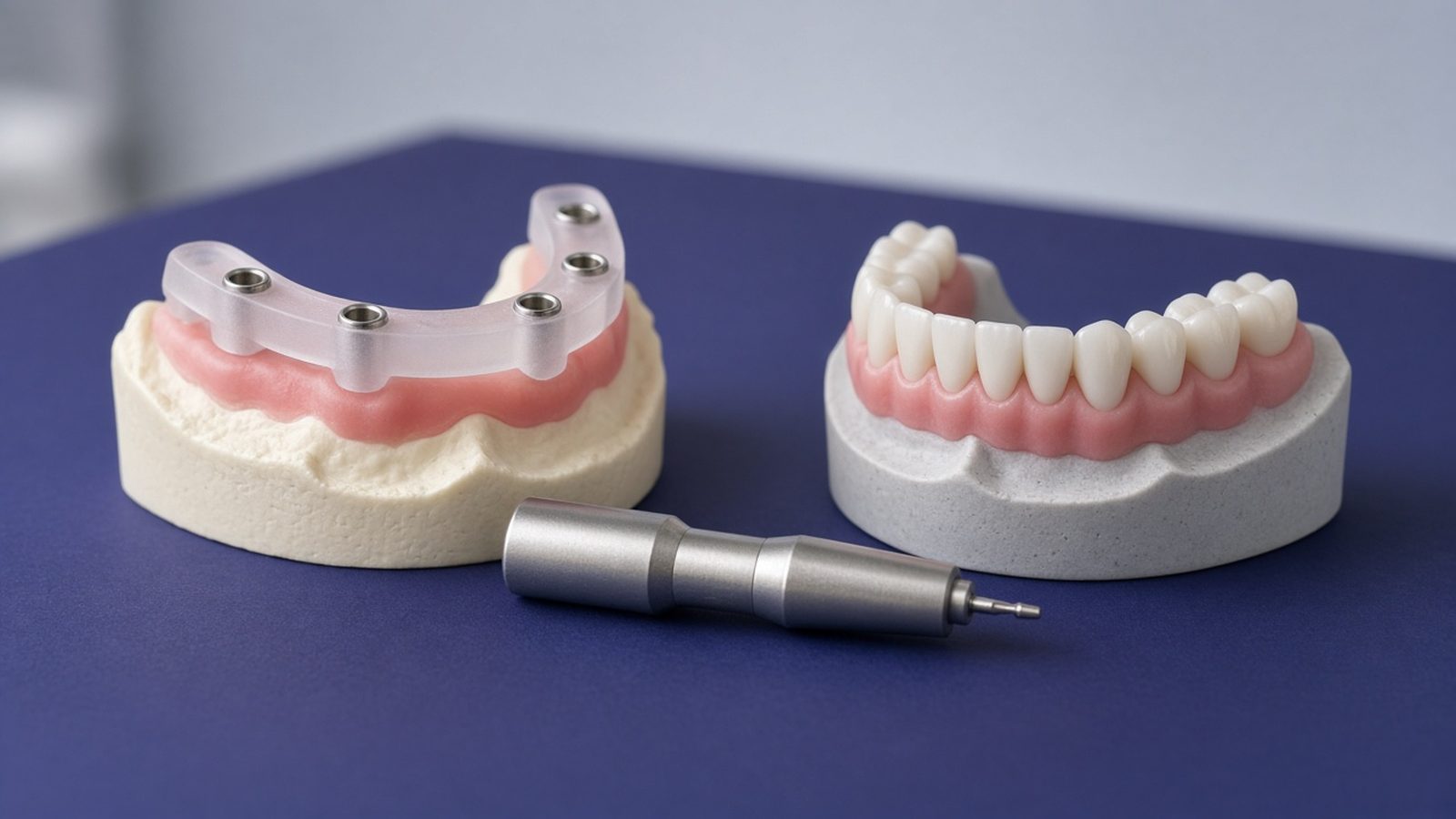
Robotic systems place implants close to the digital plan, but full-arch evidence is still thin. Here is what studies show and what to ask any office.
If you have been reading about full-arch implants in Dallas, Fort Worth, Plano, Frisco, McKinney or Arlington, you have probably seen robotic dental implant surgery advertised as more precise, less invasive or faster to heal. It is a fair question: when you are about to commit to a whole arch of new teeth, you want every advantage you can get.
This guide explains what robotic implant systems actually do, how researchers measure their accuracy, what the clinical studies show so far, what is known about robots in full-arch cases specifically, and which questions help you compare offices fairly. It is written for patients who may travel to our Hutto or Katy offices. Regional Implant Centers does not have a Dallas-Fort Worth office. For the wider picture on surgical guides and navigation, see our companion article on guided implant surgery.
The short answer
Robotic systems help hold the drill to a digital plan, and studies show they place implants within about 0.7 mm and under 2 degrees of that plan on average. That is more accurate than freehand placement and similar to or somewhat better than surgical guides. What the studies do not show yet is that robots lead to longer-lasting implants or better full-arch results.
Most robotic research is recent, short-term and focused on single teeth. Several trials found robotic surgery took longer than the alternative, and one found patients reported more discomfort during the procedure. Full-arch evidence is limited to small case series. Accuracy matters, but in full-arch care it is one part of a larger chain: diagnosis, bone, the design of your future teeth, the surgical and anesthesia team, the lab work and long-term maintenance. A robot can help with one link in that chain. It does not replace the others.
What "robotic" means in implant surgery
"Robotic" covers a few different technologies. Some guide the surgeon's hand, and some do the drilling themselves under supervision.
Every computer-assisted implant method starts the same way: a 3D cone beam CT (CBCT) scan and a digital plan that sets where each implant should go. The methods differ in how that plan is carried into the mouth.
| Method | How the plan is followed | Main trade-offs |
|---|---|---|
| Freehand | The surgeon drills by eye and feel, using the plan and landmarks | Most dependent on the surgeon; largest average deviations in studies |
| Static guide | A printed template fits over the teeth, gums or bone and steers the drill | Accurate and simple once made; needs room to open the mouth and a stable fit |
| Dynamic navigation | Cameras track the drill and show its position on a screen in real time | No template; learning curve; the surgeon still steers by hand |
| Robot-assisted (haptic) | A robotic arm holds or limits the drill so it stays on the planned path while the surgeon operates | Extra setup and registration time; equipment cost; limited long-term data |
| Task-autonomous robot | The robot performs the drilling steps under the surgeon's supervision | Studied mostly in hospital settings outside the U.S.; trained operators and backup needed |
In the U.S., the robotic implant system with the longest regulatory history was first cleared by the FDA in December 2016 under the classification "dental stereotaxic instrument." That kind of clearance means the FDA found the device substantially equivalent to existing devices for its intended use. It is not a finding that robotic surgery produces better outcomes than other methods.
Many task-autonomous robot studies come from hospitals in China, using systems that work differently from the haptic type more often marketed to U.S. patients, so it helps to know which kind of robot a study or ad describes.
How accuracy is measured, and why a millimeter matters
Researchers compare where each implant was planned on the first CBCT scan with where it actually ended up on a scan taken after surgery.
Three numbers usually come out of that comparison:
- Platform (entry) deviation: how far the top of the implant landed from its planned spot, in millimeters.
- Apex (tip) deviation: how far the bottom of the implant landed from its planned spot.
- Angular deviation: how many degrees the implant's angle differs from the plan.
These numbers matter most near the nerve canal in the lower jaw, the sinus floor and thin outer walls of bone. In full-arch work, the position and angle of each implant also decide where the screw access holes come out under the bridge, which affects how the final teeth are designed. Our DFW article on numbness after dental implants explains why nerve position is planned so carefully.
One caution: these are surrogate measures. A 2024 scoping review in Clinical Oral Implants Research noted that accuracy is mainly assessed through these deviation numbers and called for linking accuracy levels to specific clinical outcomes. In other words, a smaller deviation is a good sign, but researchers have not yet shown how many tenths of a millimeter translate into a real difference for patients.
What the research shows so far
Systematic reviews agree that robots land implants close to the plan. They also agree that the evidence base is young and that better trials are needed.
Here is what the larger reviews report:
- Wu and colleagues, 2024 (Clinical Oral Implants Research). Eight clinical studies, 109 patients and 242 implants. Average deviations were 0.68 mm at the platform, 0.67 mm at the apex and 1.69 degrees in angle. Accuracy was not significantly different between partly toothless and fully toothless patients, and no adverse events were reported. The authors concluded that both the systems and the research need further development.
- Luo and colleagues, 2025 (BMC Oral Health). Sixteen clinical studies and 908 implants. Average deviations were 0.69 mm at the platform, 0.72 mm at the apex and 1.62 degrees. The authors called the accuracy high but said large, multi-center randomized trials are still needed to compare robots with other techniques.
- Pozzi and colleagues, 2025 (International Journal of Oral and Maxillofacial Implants). Six clinical studies of task-autonomous robots, 299 implants, including 197 implants in 27 complete-arch cases. Average deviations were about 0.6 mm and 1.2 to 1.4 degrees, and the authors reported better accuracy than static and dynamic computer-assisted methods. They also wrote that clinical practicality "remains cumbersome," with well-trained operators needed and a technical expert providing backup control.
- Alqutaibi and colleagues, 2026 (The Journal of Prosthetic Dentistry). Thirty-six clinical studies from 2020 to 2026. Robots were consistently accurate, complications were infrequent and generally minor, and short-term implant survival was high. Operative time commonly increased because of registration and setup, and follow-up was mostly short. The authors listed workflow complexity, cost and limited long-term data as limits on routine use.
For comparison, our guided implant surgery article summarizes large reviews of static guides and dynamic navigation, which also improve on freehand placement. In short, robots sit at the accurate end of a range of computer-assisted methods, and every method still calls for a safety margin around nerves and sinuses.
Head-to-head trials: robot versus freehand, and robot versus a printed guide
The few randomized trials so far found robots more accurate, with longer surgery times. They studied single missing teeth, not full arches.
Two trials are worth knowing about:
- Robot versus freehand (Chen and colleagues, 2025). Twenty-four patients with one missing tooth were randomly assigned to robot-assisted or freehand placement. The robotic group averaged 0.70 mm at the platform and 1.09 degrees, compared with 1.24 mm and 7.43 degrees freehand. Complications were similar in both groups, and every implant in both groups was still in place at 6 months. The robotic procedure took longer.
- Robot versus static guide (Luo and colleagues, 2026). Thirty-six patients needing one back-tooth implant were randomly assigned to a robot or a printed static guide. The robot was more accurate at the entry point (0.70 mm versus 1.02 mm), but surgery took about twice as long (about 50 minutes versus 24 minutes), and patients reported more discomfort during the procedure. The authors concluded that the choice should balance accuracy with comfort, efficiency and resources.
Neither trial followed patients for years or involved full-arch bridges, but both show the trade-off: more precision, at the cost of time and setup.
What we know about robots in full-arch cases
Full-arch robotic research consists mostly of small case series in people who were already toothless. The early numbers are encouraging, but no study has compared long-term full-arch results against other methods.
Two recent examples:
- A 2026 case series in Dental Journal treated six toothless patients with 36 implants using a task-autonomous robot without opening the gums (a flapless approach). Average deviations were 0.45 mm at the top, 0.47 mm at the tip and 1.30 degrees. Patients reported low pain and swelling and high satisfaction. The authors said larger controlled studies are required.
- A 2026 retrospective series in the Journal of Dentistry followed 15 toothless patients, 23 jaws and 128 implants placed with a robotic arm combined with navigation. Average deviations were about 0.7 mm and 1.16 degrees, average operating time was about 88 minutes per jaw, and all implants survived during short-term follow-up. The authors called for a randomized trial to confirm the findings.
There are good reasons full-arch cases are harder to study. Many people seeking full-arch treatment still have failing teeth that must come out on surgery day. Bone often needs to be smoothed or leveled so the bridge has room, and sockets may need grafting. Implants in the back of the upper jaw are often angled to avoid the sinus, and some patients need a sinus lift or, with severe bone loss, zygomatic or pterygoid implants. Each of those steps depends on judgment made during surgery, and the published robotic full-arch studies mostly describe simpler starting points.
What a robot does not change
A robot can help an implant land where it was planned. It cannot make a weak plan good, and it does not change your bone, your health or your bite.
The parts of full-arch treatment that usually decide how well it works long term include:
- Diagnosis. Hidden infections, gum disease, bone volume and sinus anatomy have to be found on the CBCT and exam first.
- The plan for your teeth. Where your new teeth need to sit for your bite, lip support, speech and smile should come before where the implants go. Our article on digital smile design explains that process.
- Bone and grafting decisions. No device creates bone that is not there.
- Medical safety. Your health history, medicines and anesthesia plan matter regardless of how the drill is held.
- The fit of the final bridge. How implant positions are recorded after surgery and how the lab builds the bridge affect comfort and long-term stress on the parts. Our photogrammetry guide covers that step.
- Maintenance. Cleanings, checkups and home care protect implants for years, which no surgical method can do for you.
For an overview of what long-term full-arch studies do show, see what full-arch implant research actually shows. And if your concern is a past implant that failed, All-on-4 revision for DFW patients explains how failed cases are evaluated.
Reading robotic implant ads with a clear head
Most claims in robotic implant marketing are possible benefits, not guarantees. It is fair to ask how each one applies to your case.
Common phrases and what to ask about them:
- "Minimally invasive" or "no incisions." Flapless surgery can be done with robots, guides or navigation when the bone and gums allow it. In full-arch cases with extractions or bone leveling, the gums are often opened anyway. Ask whether your plan is flapless and why.
- "Faster recovery." Recovery depends on extractions, grafting, the number of implants, your health and how you follow aftercare. Ask what recovery the office expects for your specific plan.
- "More precise." The studies support better placement accuracy on average. Ask how the office checks accuracy and what happens if the plan has to change during surgery.
None of this makes robotic surgery a poor choice. It is one of several reasonable tools, and the team using it matters at least as much.
Questions to ask any office about how implants will be placed
Good answers are specific to your mouth and your plan, and they explain the trade-offs as well as the benefits.
- Which method will be used to place my implants: freehand, a printed guide, navigation or a robot, and why is that the right choice for my bone and mouth opening?
- Who plans the final teeth, and is the implant plan built around that design?
- How will you check where the implants actually ended up?
- If my plan includes extractions, bone leveling or grafting, how does that change the placement method?
- What happens if the plan needs to change during surgery?
- Will I leave with temporary teeth the same day, and what will the final bridge be made of?
- What warranty and maintenance plan come with the final teeth?
Our second opinion guide has more questions for comparing full-arch proposals side by side.
How our team plans implant positions
At Regional Implant Centers, implant positions are planned around the teeth you will end up with, using 3D imaging and one shared digital plan. Guided planning is used when appropriate rather than as a one-size-fits-all rule.
Our RISE Protocol brings oral surgeons, prosthodontists, anesthesiologists and in-house lab specialists together under one roof. For a patient comparing placement methods, that means:
- 3D imaging at both offices. Hutto and Katy both have mobile cone beam CT, which shows bone volume, nerve pathways and sinus position and can capture updated scans during surgery when appropriate. The FDA notes that CBCT gives more radiation than standard dental X-rays, so it should be used when the information is needed.
- One coordinated plan. Our SegMark Workflow combines CBCT imaging, intraoral scans, bite records and facial references so the surgery is planned to serve the final teeth.
- Precise records for the bridge. Photogrammetry records implant positions after placement, and our in-house lab at Katy helps refine tooth shape, shade and lip support.
- Anesthesia options. We offer local anesthesia, IV sedation and general anesthesia, with an anesthesiologist involved when sedation is used. Surgery takes place in a very safe surgical facility with the highest standards of care. Learn more about anesthesia and patient comfort.
Every patient leaves with same-day temporary teeth. Final arches, either full monolithic zirconia or titanium-reinforced, are delivered in about 1 to 4 months depending on healing, and a typical case takes 4 to 5 total visits. When bone is thin, RIC does bone grafting and sinus lifts, and for severe upper-jaw bone loss, zygomatic and pterygoid implants are performed by Dr. Enrique Tabarini. Final teeth come with a 1-year warranty, and extended maintenance packages are available. Not everyone is a candidate for fixed teeth, and for some people a traditional denture or snap-on overdenture is the better fit; both offices offer all three.
This article does not describe any office's equipment, including ours, as better than another's. If you want to know exactly how your implants would be placed, ask at your consultation, and we will explain the method and the reasons for it.
Coming from Dallas-Fort Worth to Hutto or Katy
For most DFW travelers, Hutto, just northeast of Austin, is the closer office. Katy, west of Houston, is home to our in-house lab.
Our Hutto office is at 201 E Wilco Hwy, Suite 203, Hutto, TX 78634, and our Katy office is at 707 S Fry Rd, Suite 150, Katy, TX 77450. Both are open Monday through Thursday, 8 AM to 5 PM, with Fridays reserved for surgery. Both offices evaluate traditional dentures, snap-on overdentures and fixed full-arch teeth, and Hutto offers bone grafting and sinus lifts when clinically appropriate.
For trip planning, start with full-mouth dental implants from Dallas-Fort Worth. If your upper jaw has severe bone loss, our DFW guide to zygomatic implant surgery and recovery explains that path. Bring any scans, proposals and medicine lists you have.
Insurance notes, without promises
When medical insurance applies, it typically covers surgical professional services such as extractions, bone grafting and alveoloplasty. Implants, temporary teeth and the final prosthesis are billed to the patient. Please verify your own benefits.
Only PPO plans are relevant for RIC's out-of-network oral surgery benefits, and Federal Employee Program (FEP) Blue Cross Blue Shield plans cannot be billed. If you have a PPO plan with oral surgery coverage, the surgical portion may be worth checking; that is not a guarantee, so please verify. The placement method, robotic or otherwise, does not by itself change what a plan covers. Our DFW article on whether insurance covers All-on-4 explains how claims work, our guide to budgeting for full-arch implants from DFW covers travel and payment timing, and financing options are available. This article does not list treatment prices beyond the $25 consultation.
Frequently asked questions
Are robotic dental implants more accurate?
On average, yes. Reviews of clinical studies report robotic placement within about 0.7 mm and under 2 degrees of the plan, which is more accurate than freehand placement and similar to or somewhat better than printed guides. Whether that difference improves long-term results has not been shown yet.
Is robotic implant surgery better for All-on-4 or full-arch cases?
The evidence is not there yet to say so. Full-arch robotic studies are small case series, mostly in people who were already toothless, with short follow-up. Full-arch results depend heavily on diagnosis, bone, the design of the final teeth and maintenance.
Does robotic implant surgery hurt less or heal faster?
Not necessarily. One case series reported low pain, but a randomized trial comparing a robot with a printed guide found longer surgery and more discomfort during the procedure with the robot. Recovery depends mostly on extractions, grafting and your health.
Is robotic dental implant surgery FDA-approved?
The robotic implant system with the longest U.S. history was cleared through the FDA 510(k) process, which compares a device with existing ones for its intended use. Clearance allows a device to be marketed; it is not a finding that it produces better outcomes than other methods.
How do I start if I live in Dallas-Fort Worth?
Book a $25 consultation, which includes a CBCT 3D scan and an insurance benefits check, at our Hutto or Katy office. Bring any scans, proposals and medicine lists, and ask how your implants would be placed and why.
Talk with our team about your plan
If robotic implant ads have you wondering what matters most, a careful exam and a 3D scan are a good place to start.
Schedule your $25 consultation, which includes a CBCT 3D scan and an insurance benefits check, at /schedule-consultation or call (832) 632-7037, the same number for both offices. Learn more about how the centers are led on Jeffry Tobon's team page.
Sources & Resources
- U.S. Food and Drug Administration. 510(k) Premarket Notification K161399, Neocis Guidance System (Dental Stereotaxic Instrument), decision date December 22, 2016. https://www.accessdata.fda.gov/scripts/cdrh/cfdocs/cfpmn/pmn.cfm?ID=K161399
- U.S. Food and Drug Administration. Dental Cone-beam Computed Tomography. https://www.fda.gov/radiation-emitting-products/medical-x-ray-imaging/dental-cone-beam-computed-tomography
- Wu XY, Shi JY, Qiao SC, Tonetti MS, Lai HC. Accuracy of robotic surgery for dental implant placement: a systematic review and meta-analysis. Clinical Oral Implants Research, 2024. https://pubmed.ncbi.nlm.nih.gov/38517053/
- Luo Z, Li A, Unkovskiy A, et al. Accuracy of robotic computer-assisted implant surgery in clinical studies: a systematic review and meta-analysis. BMC Oral Health, 2025. https://pmc.ncbi.nlm.nih.gov/articles/PMC11992838/
- Pozzi A, Carosi P, Lorenzi C, et al. In vivo accuracy of autonomous dental implant robotic surgery: systematic review and meta-analysis. International Journal of Oral and Maxillofacial Implants, 2025. https://pubmed.ncbi.nlm.nih.gov/40178998/
- Alqutaibi AY, Shahadah S, Bakkari A, et al. Robot-assisted dental implant surgery: a systematic review of available clinical evidence. The Journal of Prosthetic Dentistry, 2026. https://pubmed.ncbi.nlm.nih.gov/42303484/
- Chen J, Wang Y, Bai Y, et al. Accuracy, safety, and efficiency in robotic-assisted vs. freehand dental implant surgery: a 6-month follow-up randomized controlled trial. Clinical Oral Implants Research, 2025. https://pubmed.ncbi.nlm.nih.gov/39899324/
- Luo Z, Zhou W, Wang M, et al. Accuracy, efficiency, and patient- and surgeon-reported outcomes of static versus robotic computer-assisted implant surgery: a randomized clinical trial. Clinical Oral Implants Research, 2026. https://pmc.ncbi.nlm.nih.gov/articles/PMC13446231/
- Gao BX, Tresguerres F, Monasterio Sebastian N, et al. Clinical accuracy and patient experience following robotic-assisted full-arch implant rehabilitation: a case series. Dental Journal, 2026. https://pmc.ncbi.nlm.nih.gov/articles/PMC13512193/
- Li M, Wang J, Balmer M, et al. Accuracy and feasibility of robot-assisted implant surgery in edentulous patients: a retrospective case series. Journal of Dentistry, 2026. https://pubmed.ncbi.nlm.nih.gov/42612962/
- Pimkhaokham A, Chow J, Pozzi A, et al. Computer-assisted and robotic implant surgery: assessing the outcome measures of accuracy and educational implications. Clinical Oral Implants Research, 2024. https://pubmed.ncbi.nlm.nih.gov/37994685/
Disclaimer
This article is for education only. It is not a diagnosis, a treatment plan or a promise that any treatment or technology will work for every patient. Not every patient is a candidate for full-arch implants. Only a clinical examination, appropriate imaging and a review of your health history can determine what fits your situation. Regional Implant Centers does not have an office in Dallas-Fort Worth; patients travel to our Hutto or Katy offices. Insurance language here is general; please verify your own benefits.
Ready to Learn What Is Possible?
Schedule a consultation with Regional Implant Centers.
Schedule ConsultationFrequently Asked Questions
Are robotic dental implants more accurate?
On average, yes. Reviews of clinical studies report robotic placement within about 0.7 mm and under 2 degrees of the plan, which is more accurate than freehand placement and similar to or somewhat better than printed guides. Whether that difference improves long-term results has not been shown yet.
Is robotic implant surgery better for All-on-4 or full-arch cases?
The evidence is not there yet to say so. Full-arch robotic studies are small case series, mostly in people who were already toothless, with short follow-up. Full-arch results depend heavily on diagnosis, bone, the design of the final teeth and maintenance.
Does robotic implant surgery hurt less or heal faster?
Not necessarily. One case series reported low pain, but a randomized trial comparing a robot with a printed guide found longer surgery and more discomfort during the procedure with the robot. Recovery depends mostly on extractions, grafting and your health.
Is robotic dental implant surgery FDA-approved?
The robotic implant system with the longest U.S. history was cleared through the FDA 510(k) process, which compares a device with existing ones for its intended use. Clearance allows a device to be marketed; it is not a finding that it produces better outcomes than other methods.
How do I start if I live in Dallas-Fort Worth?
Book a $25 consultation, which includes a CBCT 3D scan and an insurance benefits check, at our Hutto or Katy office. Bring any scans, proposals and medicine lists, and ask how your implants would be placed and why.
This content is educational and not a substitute for a consultation.