Smoking, Vaping & Dental Implants
Teeth Damaged by Years of Smoking? Full-Arch Implant Options for Houston-Area Smokers
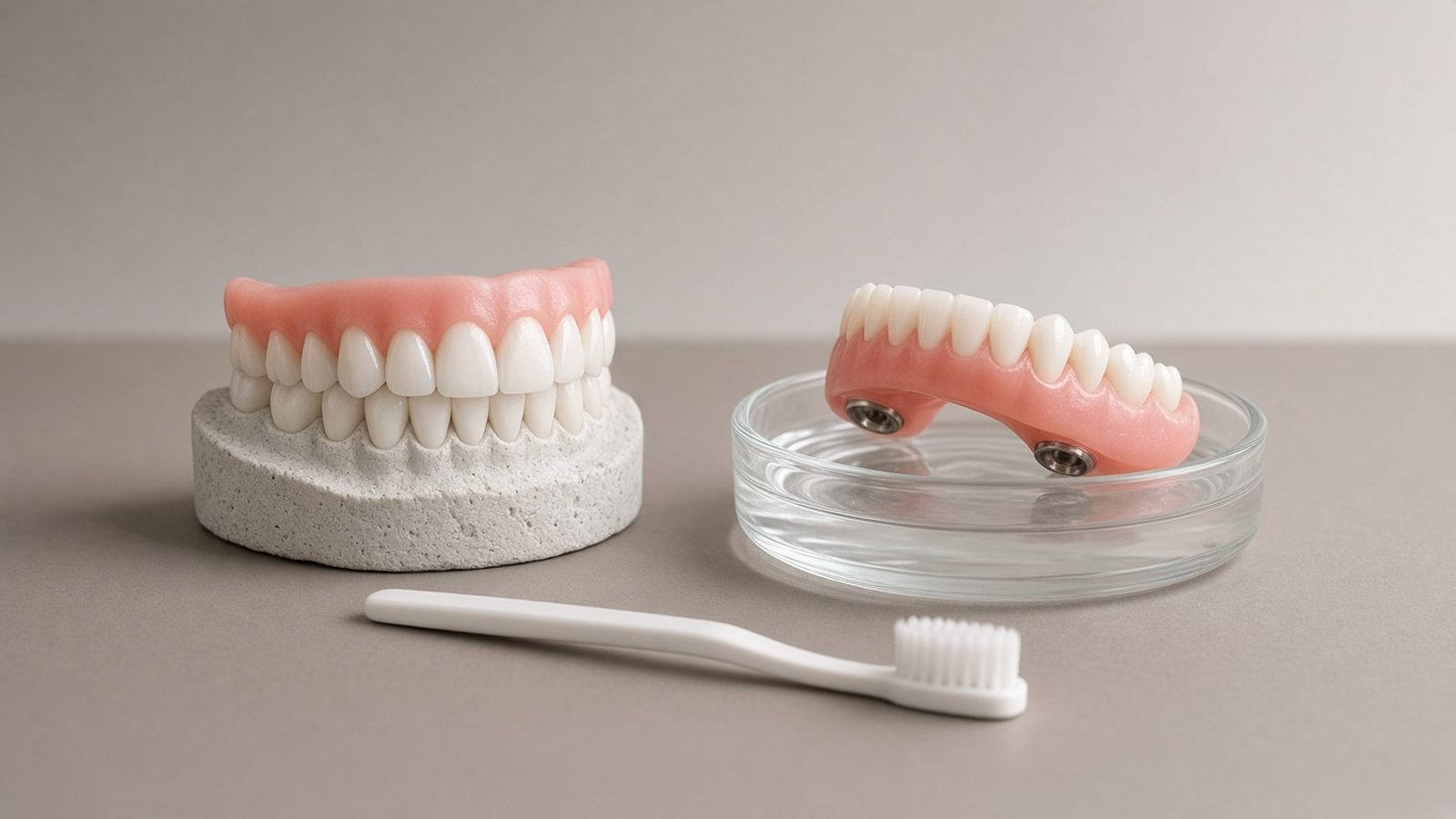
A Houston-area guide for long-time smokers with failing teeth: what smoking does to gums and implants, what to check first, and fixed vs snap-on options.
Some of the people who call our Katy office start the conversation with an apology. They have smoked for twenty or thirty years, their teeth are stained and loose, a few have already been pulled, and they expect to be told it is too late or that they did this to themselves. Neither is a useful place to start. Smoker's teeth that are failing are a medical problem with real treatment options, and full-arch implants are one of them, along with implant overdentures and well-made dentures.
This guide is for long-time smokers in Houston, Katy, Cypress, Sugar Land, Richmond, Fulshear and the Memorial area who are starting to think about full-arch treatment. It explains what years of smoking do to teeth and gums, why the damage often hides until teeth are loose, what a careful exam should look for before anyone talks about implants, how smoking affects anesthesia and healing, and how to think about fixed teeth versus a removable option if you are not sure you can quit. It does not repeat our quit-timing guide; for that, see our article on smoking and dental implants.
The short answer
A long smoking history does not automatically rule out full-arch implants, but it changes the plan. Expect a closer look at your gums, bone, mouth lining and lungs, an honest talk about quitting, and a real comparison of fixed teeth with removable options.
- Smoking is one of the strongest known risk factors for severe gum disease, which is a leading reason adults lose teeth. The CDC says smokers have about twice the risk of gum disease compared with nonsmokers.
- Smoking can hide gum disease. Gums that are starved of blood flow tend to bleed less, so the usual warning sign is muted while the bone underneath keeps breaking down.
- Implants in smokers fail more often than implants in nonsmokers. A 2021 meta-analysis of more than 150,000 implants found about 2.4 times the odds of failure in smokers.
- Before any surgery, a smoker's mouth deserves a careful oral cancer check, a 3D look at the bone and a review of heart and lung health with the anesthesia team.
- Fixed full-arch teeth, snap-on implant overdentures and traditional dentures are all offered at our Katy and Hutto offices. The right choice depends on your exam, your health, how you clean and whether you plan to keep smoking.
- Quitting helps at every stage, even late. It does not have to happen before your first consultation.
What years of smoking do to teeth and gums
Smoking damages the tissues that hold teeth in place. Over years, that usually shows up as gum disease, receding gums, bone loss and loose teeth, with staining and bad breath on top.
The CDC calls smoking an important cause of severe gum disease in the United States. Its summary for patients makes three points that match what we see. Smokers have about twice the risk of gum disease of nonsmokers. The more you smoke, and the longer you smoke, the higher the risk. And gum disease treatment may not work as well for people who keep smoking.
Gum disease starts as bacteria and hardened tartar along the gumline. In a smoker, the immune response to that buildup is weaker and the tissues heal more slowly. Over time the gums pull away from the teeth, pockets form, and the bone around the roots breaks down. Teeth start to drift, feel loose or ache when you chew. Eventually they need to come out.
A large German study of more than 23,000 adults, published in the Journal of Dental Research in 2015, put numbers to what many smokers already feel. Heavy smokers, at 15 or more cigarettes a day, had more than three times the odds of tooth loss in men and more than twice the odds in women under 50, compared with people who never smoked. The same study had a hopeful finding: after people quit, their risk of tooth loss kept falling and approached that of never-smokers after about 10 to 20 years.
Smokers also tend to notice staining on teeth and older dental work, receding gums with exposed roots that decay more easily, bad breath that brushing does not fix and slower healing after extractions. None of this is a moral failing. Nicotine is highly addictive, and many people started smoking as teenagers. Knowing how the damage happened simply tells your team what to look for and what to protect once new teeth are in.
Why smoker's gum disease often hides until teeth are loose
Bleeding gums are the classic warning sign of gum disease, and smoking suppresses that bleeding. Many smokers have advanced disease with gums that look fairly calm.
In 2004, Dietrich and colleagues looked at gum bleeding at more than 140,000 tooth sites in over 12,000 people from a national U.S. health survey. Smoking had a strong, dose-dependent effect: the more someone smoked, the less their gums bled. In heavier smokers, healthy gum sites were about half as likely to bleed as in never-smokers, and diseased sites lost much of the bleeding signal that would normally flag them. Former smokers showed the smallest effect.
Researchers think smoking narrows small blood vessels and blunts the gums' inflammatory response: less visible inflammation, more tissue destruction. Bleeding often increases within a few weeks of quitting, which can feel alarming but usually means the gums are reacting normally again.
What this means in practice:
- Do not judge your gum health by bleeding. If you smoke, pink, quiet gums are not proof that the bone under them is healthy.
- Loose teeth, shifting teeth and new gaps are the more reliable signs. So is a change in your bite or food packing between teeth that used to fit tightly.
- A 3D scan and gum measurements tell the real story. Your team needs to see how much bone is left around each tooth and in the jaw, not just what the gums look like.
If you want more on gum disease itself, our article on dental implants with gum disease walks through when loose teeth can be treated and when full-arch treatment becomes an option.
Is it too late to save my teeth?
Sometimes teeth that look bad can be saved, and sometimes teeth that look fine cannot. Only an exam with imaging can tell you which teeth have enough bone and healthy roots to keep.
Stains and chips look dramatic but are often cosmetic. Bone loss around the roots decides whether a tooth has a future. Some long-time smokers have a few strong teeth worth keeping with gum treatment and a partial denture or a few implants. Others have lost so much support that keeping them would mean years of repairs on teeth likely to fail anyway.
A good team should be willing to tell you either one. Questions worth asking:
- Which of my teeth have enough bone to keep, and for how long?
- If I keep some teeth now, what is the plan when they fail?
- Is full-arch treatment the right fit, or is it more than I need right now?
If you already have a recommendation from another office and want a second look, our second opinion guide for Houston patients explains what to bring and what to ask.
The exam a long-time smoker should expect before any implant plan
Before full-arch treatment, a smoker's exam should cover four things: an oral cancer check, a 3D look at the bone and sinuses, a gum and infection review, and a full health history that includes your lungs and heart.
An oral cancer check, every time
Tobacco use of any kind is a major risk factor for oral cancer. The National Institute of Dental and Craniofacial Research (NIDCR) says most cancers in the mouth are related to tobacco, alcohol or both, and that the risk is highest when people use both. Before anyone plans surgery in a smoker's mouth, the tongue, cheeks, floor of the mouth, palate, lips and neck should be checked.
The NIDCR lists signs worth reporting if they last more than two weeks, including a sore that does not heal, a white or red patch, a lump or thick area, trouble chewing or swallowing, numbness and a denture that suddenly fits poorly because of swelling. If anything looks unusual, the right next step is usually a closer look or a biopsy with the appropriate specialist before implant planning continues. That can feel like a delay. It is the correct order.
A 3D look at bone, sinuses and nerves
Long-term gum disease leaves uneven bone loss, and the upper jaw in particular can thin out under the sinuses. A cone beam CT (CBCT) scan shows bone height and width, sinus position and nerve paths in three dimensions. That is how a surgeon decides how many implants an arch may need, whether bone grafting or a sinus lift would be part of the plan and whether angled, zygomatic or pterygoid implants should be discussed. Both our offices have a mobile cone beam CT, and the scan is part of the $25 consultation.
Gum health and infection
Failing teeth in a smoker's mouth often come with infected gum pockets, abscesses or old root canal teeth with infection at the tips. These need to be found and planned for, because infection at the time of surgery affects healing. Our article on chronic tooth infections and dental implants explains how that is usually handled.
A full health history
Smoking rarely travels alone. Long-time smokers are more likely to have high blood pressure, heart disease, COPD or other lung problems, diabetes or poor circulation. Each of these affects surgery and healing, and some need a note from your physician before surgery. Bring a current list of medicines, inhalers and diagnoses. Our page on dental clearance and medical procedures explains how we coordinate with physicians when that is needed.
Smoking, your lungs and anesthesia
Smoking makes the heart and lungs work harder during and after anesthesia. Telling your anesthesia team exactly how much you smoke is one of the most important safety steps you can take.
The American Society of Anesthesiologists (ASA) explains that people who smoke are more likely to have breathing problems during or after surgery, are at higher risk of pneumonia and face a higher chance of heart problems around the time of surgery. Smoking also reduces blood flow, which slows wound healing. The ASA's advice is to quit as soon as possible before surgery, ideally a week or more ahead, and to talk with your anesthesiologist about how your smoking affects the anesthesia plan.
The ASA also points out something many smokers do not know: nicotine and carbon monoxide levels start dropping as soon as you stop, so even a short smoke-free stretch before surgery helps. A 2025 meta-analysis in the Journal of Clinical Anesthesia, pooling 55 studies of adults having surgery, found that stopping smoking at least two weeks before surgery was linked to fewer lung complications than continuing to smoke, with larger benefits at four and eight weeks. That research covered surgery in general, not dental implants specifically, but full-arch surgery is still surgery.
At Regional Implant Centers, anesthesia options include local anesthesia, IV sedation and general anesthesia. An anesthesiologist on our team plans and monitors anesthesia, and surgery happens in a very safe surgical facility with the highest standards of care. Your smoking history, any lung disease and your inhaler use all go into that plan. If you want to understand the differences between sedation levels, our guide to IV sedation vs general anesthesia for dental implants is a good place to start.
How smoking affects implants themselves
Implants placed in smokers fail more often, lose more bone around them over time and are more prone to gum-line inflammation. The risk is real but not absolute, and quitting lowers it.
A useful summary is a 2021 systematic review and meta-analysis by Mustapha and colleagues in Medicina. It pooled 292 publications covering more than 35,000 implants in smokers and more than 114,000 in nonsmokers. Implants in smokers had about 2.4 times the odds of failure, in both the upper and lower jaw, and showed a little more bone loss around the implant over time.
The Foundation for Oral Rehabilitation, an educational group focused on implant and full-arch treatment, summarizes the clinical side this way: smoking narrows blood vessels and slows wound healing, smokers have more gum disease, dry sockets and complications after implant surgery, and smokers should be strongly advised to quit, or at least stop for a period before and after surgery. Their guidance names at least six weeks before and eight weeks after surgery. Your surgeon may set a different window for your plan.
Two practical takeaways:
- Smoking does not change the work your implants have to do. A full arch of teeth is held by a small number of implants. Each implant that struggles matters more than it would in a single-tooth case.
- The years after treatment count as much as the surgery. Peri-implantitis is an infection around implants that slowly destroys bone. A 2017 World Workshop review by Schwarz and colleagues found strong evidence that a history of gum disease, poor plaque control and skipped maintenance raise the risk, and called the data on smoking specifically inconclusive. Long-time smokers often carry the first of those risks already, so daily cleaning and regular checkups matter. Our article on peri-implantitis treatment explains what it looks like and how it is managed.
Fixed teeth or a removable option if you still smoke
If you expect to keep smoking, the decision between fixed full-arch teeth and a removable implant overdenture deserves real thought. Neither is wrong, and both are offered at our Katy and Hutto offices.
Many smokers come in wanting fixed teeth, and for good reason: they stay in, feel more like natural teeth and do not cover the palate. But it is worth knowing that a 2018 textbook chapter on implants in smokers by Javed and Romanos recommends removable implant-supported teeth for heavy smokers. The thinking is simple. Implants under a removable denture are easier to see and clean, and if an implant has trouble, a removable design may be simpler to adjust.
Research on smokers with snap-on lower dentures is limited but encouraging. One small five-year study in the European Journal of Dentistry followed 29 smokers who received four mini implants (a narrower implant type, one of several overdenture designs) supporting a lower overdenture and reported stable bone levels after the first month and lasting improvement in quality-of-life scores. It was a small group in one center, so it is a reason to discuss the option, not proof that it is right for you.
Here is how the three options compare for a smoker:
| Fixed full-arch (All-on-X) | Snap-on implant overdenture | Traditional denture | |
|---|---|---|---|
| Stays in the mouth | Yes, removed only by the dental team | You take it out to clean | You take it out to clean |
| Cleaning around implants | Floss threaders, water flosser and professional cleanings around a bridge you cannot remove | Implants and attachments are fully visible once the denture is out | No implants to clean |
| If an implant has trouble | Can affect the whole bridge; may need repair or redesign | May be simpler to adjust | Not applicable |
| Bone under the teeth | Implants help preserve bone where they sit | Implants help preserve bone where they sit | Bone under a denture tends to keep shrinking |
| Staining from smoke | Final zirconia resists stain; temporaries stain more easily | Acrylic teeth and base can stain | Acrylic teeth and base can stain |
There is no rule that a smoker must choose removable teeth, and no rule that a smoker cannot have fixed teeth. What matters is an honest look at three questions: how much you smoke now, whether you plan to stop, and how well you can clean around implants every day. Our article on All-on-X vs implant dentures vs dentures goes deeper on the general comparison, and if you already wear a snap-on denture, our guide to switching from a snap-on denture to fixed teeth covers that path.
Will smoking stain my new teeth?
Temporary teeth made from acrylic-based material can stain from smoke within weeks. Final arches in monolithic zirconia resist staining much better, but the gums and implants under any bridge still feel the effects of smoking.
During healing, every patient wears temporary teeth. Those are usually made from acrylic-based material such as PMMA. Lab studies that expose provisional materials to cigarette smoke consistently find color change. A 2026 study in the International Journal of Prosthodontics found that smoke discolored conventional, milled and 3D-printed provisional materials, with milled material holding its color best and brushing reducing, but not fully reversing, the staining. In plain terms: if you smoke while wearing temporaries, expect them to darken, and brush them gently every day.
Final arches at Regional Implant Centers are made in full monolithic zirconia or titanium-reinforced zirconia. Zirconia is a dense ceramic, and stain resistance is one of the reasons it is used for final teeth. Our zirconia vs acrylic full-arch teeth article explains the material differences in more detail.
The part zirconia cannot fix is underneath. A bridge that looks clean can still sit over inflamed gum tissue if plaque and smoke are working on the implants below. That is why cleaning and maintenance matter more for smokers than for anyone else with full-arch teeth.
If you are thinking about quitting
You do not have to quit before your first consultation, and you do not have to do it alone. Most surgeons will ask you to stop for a window around surgery, and many patients use that window as a starting point to quit for good.
The ASA calls surgery a good time to quit, because people are already focused on their health and the recovery period interrupts the routine. Some practical options:
- Talk to your physician about quit medicines. Nicotine patches, gum and lozenges and prescription medicines are all used to help people stop. Your physician can tell you which fit your health, and your surgeon can tell you which fit your implant plan. Nicotine replacement still delivers nicotine, so ask about it specifically.
- Use free coaching. The Texas Tobacco Quitline at Yes Quit offers free, confidential help for Texas residents, including for e-cigarettes. The national line, 1-800-QUIT-NOW, routes you to your state's program.
- Plan for the hard moments. Many people smoke after meals, with coffee or in the car. Recovery already changes those routines, which can make it easier to break the link.
Our smoking and dental implants guide covers stop windows before and after surgery in detail, and our article on vaping, nicotine pouches and cannabis with dental implants covers the products people often switch to. Switching to a vape or a pouch is not the same as quitting, and your team will want to know about those too.
Caring for full-arch teeth when you have a smoking history
Smokers with full-arch teeth need the same daily cleaning as everyone else, done more carefully, and they benefit from professional maintenance visits that check the gums and implants, not just the teeth.
At home, that means:
- Brushing the bridge and gumline twice a day with a soft brush
- Cleaning under a fixed bridge every day with a water flosser or floss threaders
- Taking a removable overdenture out every night to clean it and the attachments
- Watching for bleeding, swelling, a bad taste, a loose feeling or a change in your bite, and calling instead of waiting
Maintenance visits let the team check the tissue around each implant and clean areas you cannot reach. After treatment, RIC gives a 1-year warranty plus extended maintenance packages. Our implant warranty and maintenance packages pages describe how that works, and smoking is one of the habits our written terms address, so read them before treatment and ask us anything that is unclear. Our article on All-on-4 cleaning and maintenance walks through a typical routine.
How we plan full-arch treatment for smokers at Regional Implant Centers
We plan the same way for every full-arch patient, with the RISE Protocol, and we adjust that plan to your smoking history, your gums, your bone and your health rather than treating smoking as a yes-or-no question.
- A team plan. Under the RISE Protocol, our oral surgeons, prosthodontist, anesthesiologist and lab technicians work from one plan. For a smoker, that plan includes the gum findings, the oral cancer check, the bone on CBCT and your medical history.
- Options on the table. Both our Katy and Hutto offices offer traditional dentures, snap-on implant overdentures and fixed full-arch (All-on-X) treatment, so the recommendation is not limited to one product.
- Bone and sinus work when needed. Long-term gum disease often leaves thin bone. We do bone grafting and sinus lifts, and for some patients with severe upper jaw bone loss, Dr. Enrique Tabarini offers zygomatic and pterygoid implants. Grafted cases ask the most of healing, which is one more reason a quit plan matters. Not every case can be treated, and your surgeon will tell you honestly what your scan shows.
- Anesthesia planned for your lungs and heart. Local anesthesia, IV sedation and general anesthesia are available, planned by an anesthesiologist who reviews your smoking history and medical conditions.
- Same-day teeth, then finals. Every patient leaves surgery with same-day temporary teeth. Final arches, in full monolithic zirconia or titanium-reinforced zirconia, are delivered in about one to four months depending on healing and progress. Typical cases take four to five total visits.
- A lab in the building. Our in-house dental lab is at the Katy office, so the technicians who make your teeth can see you in person when shade, shape and lip support need refining. Read more on our in-house lab page.
For Houston-area patients
Our Katy office is at 707 S Fry Rd, Suite 150, in Katy. For patients in Cypress, Fulshear, Richmond and Sugar Land, and for those coming in from Memorial or inner-loop Houston, it is the closer of our two offices. You can read more about the office on our Katy location page or on our Katy full-mouth dental implants page. Our Hutto office, north of Austin, offers the same three types of care, but most Houston patients have no reason to make that drive.
A few tips for your first visit:
- Bring a list of every tobacco and nicotine product you use and roughly how much. Nobody at the consultation is there to judge you.
- Bring your medication list, including inhalers, and the names of your physicians.
Insurance and financing, briefly
Insurance may help with part of the surgical side of treatment, never the whole case, and coverage is never guaranteed.
At Regional Implant Centers, medical insurance is reviewed only for surgical professional services, such as extractions, bone grafting and alveoloplasty. Implants, temporary teeth and the final prosthesis are billed to you directly. Only PPO plans work for our out-of-network oral surgery benefits, and we cannot bill Federal Employee Program (FEP) Blue Cross Blue Shield plans. If your plan is a PPO with oral surgery coverage, some surgical services may be a possible match for medical benefits and are worth checking; please verify with your carrier before you rely on it. The insurance benefits check at your consultation is where we start. Our insurance experts and financing pages explain the details, and financing is provided by independent third-party companies.
Questions to bring to your consultation
- Which of my teeth, if any, are worth keeping?
- What did my oral cancer check show, and is anything worth a closer look?
- What does my CBCT show about my bone and sinuses, and would I need grafting?
- How does my smoking history change your recommendation between fixed teeth and an overdenture?
- How long do you want me off tobacco and nicotine before and after surgery?
- Which anesthesia option fits my lungs and heart, and what do you need from my physician?
- How does smoking affect the warranty and maintenance terms for my plan?
Frequently asked questions
Can a heavy smoker get All-on-4 or full-arch implants?
Sometimes, yes. Smoking raises the risk of implant failure and gum-line infection, but it is not an automatic no. The decision depends on your bone, gum health, medical history and whether you are willing to stop for a period around surgery. Some heavy smokers are better served by a snap-on implant overdenture, which is easier to clean around. A consultation with a 3D scan is the only way to know.
Why didn't my gums bleed if I had gum disease?
Smoking suppresses gum bleeding. A large U.S. study found that the more people smoked, the less their gums bled, even where gum disease was present. That is why many smokers are surprised to learn they have advanced bone loss. Loose or shifting teeth and a 3D scan are better guides than bleeding.
Will smoking stain zirconia implant teeth?
Final teeth in monolithic zirconia resist staining far better than acrylic. Temporary teeth, which are usually acrylic-based, can darken from smoke within weeks. Even with zirconia, smoking still affects the gums and implants under the bridge, so cleaning and maintenance matter.
Is a snap-on denture better than fixed teeth for smokers?
Not always, but it is worth discussing. A removable overdenture lets you see and clean the implants completely, and if one implant has trouble it is often easier to adjust. Fixed teeth feel more like natural teeth and stay in. Both are offered at our Katy and Hutto offices, and the right choice depends on your exam and habits.
Do I have to quit smoking before my first consultation?
No. Come in as you are, and tell us honestly what you use. Your surgeon will explain how long to stay off tobacco and nicotine around surgery for your plan. Many patients use that window as a starting point to quit for good, with help from their physician or the Texas Tobacco Quitline.
Start with an honest look at your mouth
If years of smoking have left you with failing teeth, the first step is not a promise to quit or a decision about implants. It is an exam that shows what you are working with. Schedule a consultation at our Katy office. The $25 consultation includes a CBCT 3D scan and an insurance benefits check, and you will leave knowing which teeth, if any, can be kept, what your bone looks like and which full-arch options make sense for you.
Schedule your consultation or call (832) 632-7037.
Related reading: Smoking and dental implants, Vaping, nicotine pouches and cannabis with dental implants, Dental implants with gum disease, Peri-implantitis treatment, Zirconia vs acrylic full-arch teeth, All-on-X vs implant dentures vs dentures, How long do dental implants last?, Loose dentures: options in Katy, Bone and tissue reconstruction, Anesthesia and patient comfort, Our doctors, Dr. Enrique Tabarini, Katy office, Hutto office and our medical disclaimer.
About the author: Jeffry Tobon, CDT, is President of Regional Implant Centers.
Sources & Resources
- Centers for Disease Control and Prevention. Smoking, Gum Disease, and Tooth Loss. Tips From Former Smokers.
- Dietrich T et al. The effect of cigarette smoking on gingival bleeding. Journal of Periodontology. 2004.
- Dietrich T et al. Smoking, Smoking Cessation, and Risk of Tooth Loss: The EPIC-Potsdam Study. Journal of Dental Research. 2015.
- Mustapha AD et al. Smoking and Dental Implants: A Systematic Review and Meta-Analysis. Medicina. 2021.
- Foundation for Oral Rehabilitation. Smoking: risk assessment in edentulous patients.
- National Institute of Dental and Craniofacial Research. Oral Cancer.
- American Society of Anesthesiologists. Smoking. Made for This Moment.
- Tang E et al. Impact of short duration smoking cessation on post-operative complications: A systematic review and meta-analysis. Journal of Clinical Anesthesia. 2025.
- Hussein MO, Alruthea MS. Marginal Bone Level Changes and Oral Health Impact Profile (14) Score of Smokers Treated by Mandibular Mini Implant Overdentures: A 5-Year Follow-up Study. European Journal of Dentistry. 2020.
- Turker Kader I et al. Color and Translucency Stability of Conventional, Milled, and 3D-Printed Provisional Restorative Materials After Cigarette Smoke Exposure and Brushing. International Journal of Prosthodontics. 2026.
- Schwarz F et al. Peri-implantitis. Journal of Periodontology (2017 World Workshop). 2018.
- Javed F, Romanos GE. Dental Implants in Patients who Habitually Smoke Tobacco. In: Evidence-based Implant Dentistry and Systemic Conditions. Wiley. 2018.
- Texas Tobacco Quitline. Yes Quit.
This article is general patient education and is not a diagnosis, treatment plan or anesthesia advice. Whether and when implant treatment is appropriate depends on an individual exam, imaging and the judgment of your surgical and anesthesia team. Do not start, stop or change a prescribed medicine, including a quit-smoking medicine, without talking to the clinician who prescribed it. Insurance coverage is never guaranteed; at Regional Implant Centers, medical insurance is reviewed only for surgical professional services, and implants, temporary teeth and the final prosthesis are billed to the patient. Only PPO plans work for our out-of-network oral surgery benefits, and we cannot bill Federal Employee Program (FEP) Blue Cross Blue Shield plans. Financing is provided by independent third-party companies. Implant treatment is not appropriate for every patient, outcomes vary, and no surgery or anesthesia is free of risk. Regional Implant Centers has offices in Katy and Hutto, Texas.
Ready to Learn What Is Possible?
Schedule a consultation with Regional Implant Centers.
Schedule ConsultationFrequently Asked Questions
Can a heavy smoker get All-on-4 or full-arch implants?
Sometimes, yes. Smoking raises the risk of implant failure and gum-line infection, but it is not an automatic no. The decision depends on your bone, gum health, medical history and whether you are willing to stop for a period around surgery. Some heavy smokers are better served by a snap-on implant overdenture, which is easier to clean around. A consultation with a 3D scan is the only way to know.
Why didn't my gums bleed if I had gum disease?
Smoking suppresses gum bleeding. A large U.S. study found that the more people smoked, the less their gums bled, even where gum disease was present. That is why many smokers are surprised to learn they have advanced bone loss. Loose or shifting teeth and a 3D scan are better guides than bleeding.
Will smoking stain zirconia implant teeth?
Final teeth in monolithic zirconia resist staining far better than acrylic. Temporary teeth, which are usually acrylic-based, can darken from smoke within weeks. Even with zirconia, smoking still affects the gums and implants under the bridge, so cleaning and maintenance matter.
Is a snap-on denture better than fixed teeth for smokers?
Not always, but it is worth discussing. A removable overdenture lets you see and clean the implants completely, and if one implant has trouble it is often easier to adjust. Fixed teeth feel more like natural teeth and stay in. Both are offered at our Katy and Hutto offices, and the right choice depends on your exam and habits.
Do I have to quit smoking before my first consultation?
No. Come in as you are, and tell us honestly what you use. Your surgeon will explain how long to stay off tobacco and nicotine around surgery for your plan. Many patients use that window as a starting point to quit for good, with help from their physician or the Texas Tobacco Quitline.
This content is educational and not a substitute for a consultation.