Oral Infections & Systemic Health
Hidden Tooth Infections Found on a 3D Scan: What They Mean for Full-Arch Implants in Austin and Hutto
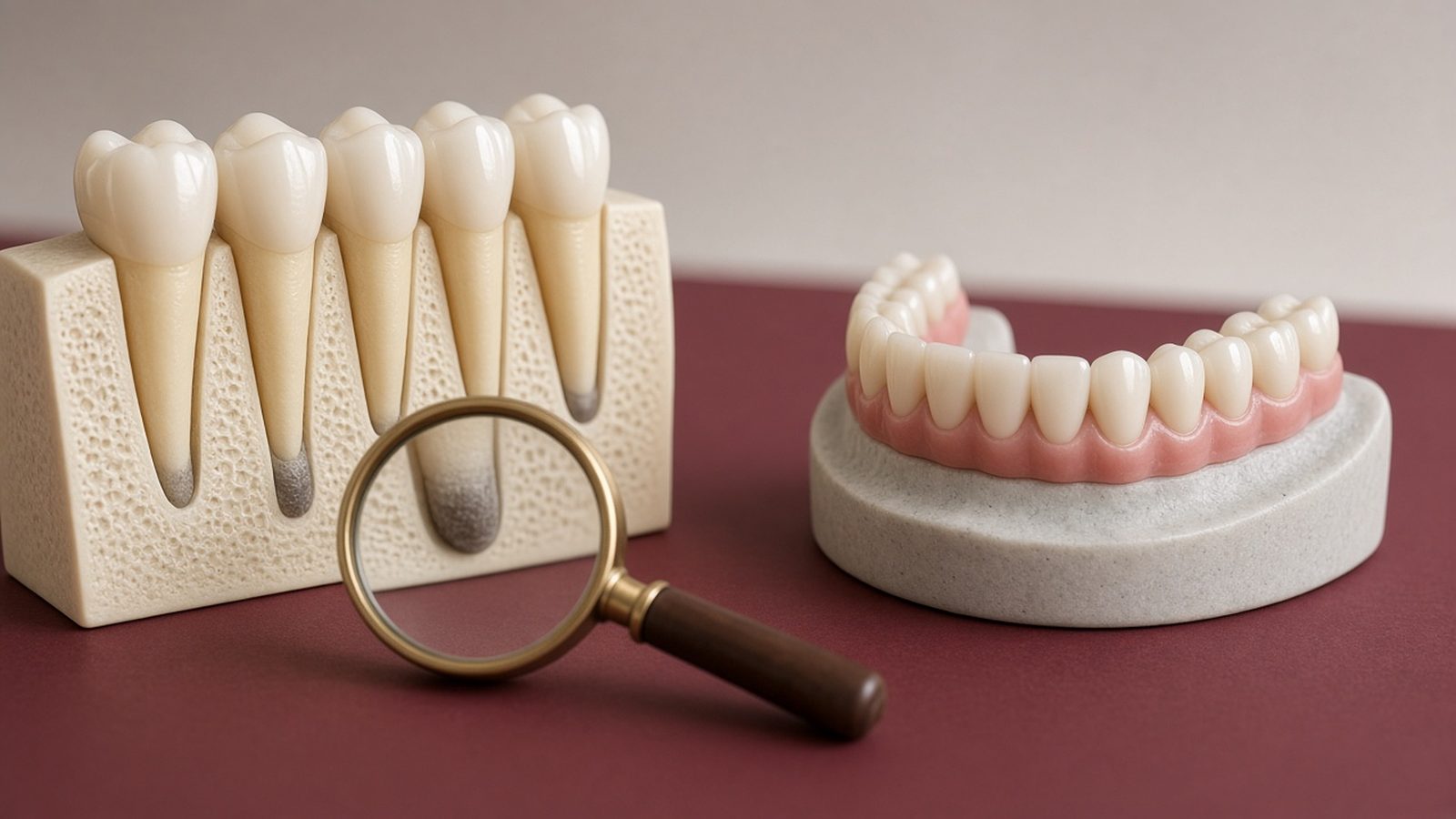
A 3D scan can find quiet infections at several teeth before full-arch implants. Here is what those findings mean and how they can change the plan for Austin-area patients.
You came in to talk about replacing failing teeth, maybe because a bridge keeps loosening or a denture is no longer an option you want. You feel mostly fine. Then the 3D scan comes back and the report mentions dark areas at the tips of several roots, an old root canal that "has not healed" and thickening in the sinus above an upper molar. If you live in Austin, Hutto, Round Rock, Pflugerville, Cedar Park, Georgetown or nearby, this guide explains what hidden tooth infections found on a CBCT scan usually mean for full-arch implants, why they matter even when nothing hurts, and how they can change the order and timing of treatment.
This is general education, not a diagnosis. If you have spreading facial swelling, fever or trouble swallowing, go to an emergency room first; our guide to a broken or abscessed tooth explains why. For how long-standing tooth infections relate to the rest of your health, see chronic tooth infections and dental implants. This article covers a narrower moment: the scan found more than you expected, and you want to know what happens next.
The short answer
A dark area at a root tip on a CBCT scan often points to apical periodontitis, a low-grade inflammation that is commonly linked to infection inside the tooth and frequently causes no pain. Finding more than one during full-arch planning is not unusual, and it often changes the details of the plan rather than whether treatment is possible.
What tends to change: which teeth are removed and how the sockets are cleaned, whether bone grafting or sinus care is needed, and whether implants go in on the same day as extractions or after a healing period. At Regional Implant Centers, every full-arch implant patient leaves surgery with same-day temporary teeth. Hidden infection can affect the sequence and timing around that surgery day, which your surgical team explains for your own case.
The consultation costs $25. It is not free, complimentary or no-cost, and it is the right place to go through your scan findings tooth by tooth.
Why "it doesn't hurt" is not the same as "it's healthy"
Many tooth infections settle into a quiet, chronic state. Pain fades because pressure drains or the nerve inside the tooth has died, but the inflammation around the root can keep wearing away bone.
MedlinePlus, the National Library of Medicine's consumer health site, notes that a toothache from an abscess may stop if pressure is relieved, yet the infection remains active and can keep spreading and destroying tissue. Teeth that have already had a root canal have no living nerve, so they may never hurt even when a problem develops around them.
How common is this? A 2021 systematic review in the International Endodontic Journal pooled 114 studies covering more than 34,000 people. It estimated that about half of adults worldwide have at least one tooth with apical periodontitis, and that about 39% of root-filled teeth showed it on imaging. The authors called it a frequently chronic, asymptomatic disease and cautioned that the studies varied widely in quality. Still, if you have several old root canals, crowns and large fillings, a scan finding more than one quiet problem would not be surprising.
Signs people sometimes notice, if anything:
- A small bump on the gum that drains and comes back
- A bad taste near one tooth, or bad breath that does not improve with brushing
- A tooth that feels tender when you bite, then settles
- Sinus pressure or congestion on one side that keeps returning
Many people notice none of these, which is why imaging matters before implant surgery.
What a CBCT scan can see that a flat X-ray may miss
A cone beam CT builds a three-dimensional picture of teeth, roots, bone and sinuses. It is generally better than a single flat dental X-ray at picking up bone changes around roots, which is why infections that never showed up before can appear during full-arch planning.
A flat dental X-ray squeezes three dimensions into two, so overlapping roots and bone can hide a small lesion. A 2023 systematic review and meta-analysis in the Polish Journal of Radiology pooled eight studies and found that CBCT correctly identified about 95% of teeth with apical periodontitis, compared with about 61% for digital periapical X-rays. The flat X-ray rarely produced false alarms, but it missed many real lesions. The review was small, but the direction is clear: 3D imaging tends to find more.
The U.S. Food and Drug Administration lists dental implant planning and root canal diagnosis among the uses of dental CBCT. The FDA also notes that CBCT usually delivers more radiation than conventional dental X-rays, and, along with the American Dental Association, recommends dental imaging only when it is needed for diagnosis or treatment.
What a CBCT cannot do on its own: it cannot see bacteria, only how bone has responded to inflammation. A dark area does not always mean active infection; some areas are healing, some are scar tissue and some are other conditions. Clinicians combine the scan with your symptoms, gum measurements, tooth testing and history.
Both of our offices have a mobile cone beam CT, which our team uses when 3D imaging is appropriate to study bone volume, nerve pathways, sinus position and jaw anatomy. It supports clinical judgment; it does not replace it.
The words on your scan report, in plain English
Scan reports use technical language. Knowing a few common terms makes your consultation easier.
| What the report may say | What it usually means | Why it matters for a full-arch plan |
|---|---|---|
| Periapical radiolucency or periapical lesion | A dark area at the root tip where bone has thinned | Often linked to infection inside the tooth; the site needs cleaning if the tooth is removed |
| Apical periodontitis | Inflammation around the root tip, usually from the pulp | May be silent; affects bone available at that spot |
| Persistent lesion on a root-filled tooth | An old root canal with a lesion that has not resolved | Retreatment or removal is weighed against the overall plan |
| Widened ligament space | A thicker-than-normal gap around the root | Can be an early sign of inflammation; read with your symptoms |
| Mucosal thickening of the maxillary sinus | Swollen sinus lining, often above upper back teeth | May be related to a dental source or to ordinary sinus disease |
| Bone loss around several teeth | Thinning from gum disease or old infections | Shapes implant positions, grafting and the timeline |
Ask your team to show you each finding on the screen; seeing it in 3D is usually clearer than a written report.
When upper teeth and the sinus are involved
The roots of upper back teeth often sit just below the maxillary sinus. Infection at those roots can inflame the sinus lining or cause a sinus infection, sometimes with little or no tooth pain.
This is called odontogenic sinusitis, meaning sinusitis that comes from a dental source. A 2022 state-of-the-art review in the World Journal of Otorhinolaryngology - Head and Neck Surgery describes it as more common than historically reported. The review notes that it usually affects one side, that patients often have no dental pain, and that radiologists reading sinus CT scans have missed the dental cause in 60% to 70% of cases in several studies. It also notes that oral antibiotics alone generally do not resolve it when there is a treatable dental problem, and that when both the dental source and the sinusitis are addressed, resolution can be expected in most cases. Some patients still need sinus surgery with an ear, nose and throat specialist.
Why this matters for full-arch planning:
- The sinus floor matters for implant placement. Upper implants, sinus lifts and alternatives such as pterygoid or zygomatic implants all depend on the bone and sinus anatomy above the back teeth.
- An inflamed sinus may change timing. Your team may want the dental source treated and the sinus settled before a sinus lift or graft. In some cases an ENT referral comes first.
- Your history helps. Mention one-sided sinus infections, sinus surgery or foul-smelling drainage.
Our Hutto office offers bone grafting and sinus work, including sinus lifts, when clinically appropriate. For patients with severe upper-jaw bone loss, Dr. Dan Holtzclaw and Dr. Enrique Tabarini perform zygomatic and pterygoid implants. Our guide to sinus lift vs. zygomatic vs. pterygoid implants explains those choices.
How hidden infection can change a full-arch plan
Finding several silent infections rarely ends the conversation. It usually adds steps: confirming which teeth are involved, cleaning infected sites thoroughly, rebuilding bone where needed and choosing appropriate timing for implants.
When most teeth on an arch are failing, the question shifts from saving each infected tooth to clearing infection and building a stable foundation. When only a few teeth have problems, root canal treatment or retreatment may still make more sense than a full arch. Our guide to failing crowns and bridges covers that save-or-replace question, and dental implants with gum disease covers advanced periodontitis and loose teeth.
Here is how scan findings commonly feed into a plan. This is a general pattern, not a description of any one patient's treatment:
- Confirm the findings. The scan is compared with an exam, gum measurements and your symptoms.
- Decide which teeth stay and which go. In a full-arch plan, teeth with persistent lesions, cracks or heavy bone loss are often among those removed.
- Plan the cleaning. The inflamed tissue in each socket has to be cleaned out so the area can heal.
- Account for missing bone. A long-standing lesion can leave a hollow in the jaw that affects implant position or calls for grafting. See why bone grafting may be needed before dental implants.
- Coordinate with your physicians when needed. See dental clearance before surgery.
- Set the timing. The surgeon weighs whether implants can go in on the same day as extractions or should wait for healing at some sites.
Our oral surgery team handles extractions, including full-mouth extractions when clinically appropriate, socket preservation, ridge augmentation, alveoloplasty and bone shaping, and the treatment of infection and severe disease. Treatment may be completed in one visit or staged over time, depending on the case.
Same-day implants or staged treatment after infection?
Research suggests implants can sometimes be placed into sockets that held infected teeth, after careful cleaning, but the evidence is mixed and comes mostly from smaller studies. That is why timing is decided case by case.
Two reviews show both sides of the evidence:
- A 2019 meta-analysis in Medicina Oral, Patologia Oral y Cirugia Bucal pooled eight comparative studies covering 935 implants. Immediate implants placed into infected sites failed about three times as often as immediate implants in non-infected sites, although measures of gum and bone health around surviving implants did not differ significantly. Even with that higher relative risk, most implants in both groups survived.
- A 2026 scoping review in the same journal mapped 24 clinical studies of implants placed right after removing infected teeth. Most reported favorable survival when the extraction was gentle, the socket was meticulously cleaned and the implant was firmly stable at placement. The authors concluded this may be feasible in carefully selected cases, but that the evidence is too varied to support a single standard protocol.
In plain terms, same-day placement tends to be favored when sockets can be cleaned thoroughly, healthy bone can hold an implant firmly and there is no active swelling. Waiting at some sites may be favored by acute swelling, large bone defects, an inflamed sinus above an upper implant site or health factors that slow healing. A full arch also gives the surgeon options, because implants can often be positioned in healthier bone away from the worst sites.
What this means for teeth on surgery day: at Regional Implant Centers, every full-arch implant patient leaves surgery with same-day temporary teeth. Those temporaries are for healing, not for final chewing. If your infection findings change the timing of any step, your team will explain the sequence before you schedule. Our article on teeth in a day: temporary vs. final teeth explains the difference, and the All-on-4 timeline for Austin and Hutto shows where infection treatment can add time before a surgery date is set.
Antibiotics have a role, but they do not remove the source; a course of pills may calm a flare-up without cleaning out an infected root or socket. Problems that develop around implants after treatment are a separate topic, covered in All-on-4 implant failure: save or replace?
What to bring and tell your team before the scan
The more your team knows about past dental work and sinus history, the easier it is to read a 3D scan accurately and avoid repeat imaging.
- A list of teeth that have had root canals, crowns, implants or extractions, with rough dates if you know them
- Any recent dental X-rays or CBCT scans from other offices; ask your current dentist to send the files
- Repeated sinus infections, especially on one side, and any sinus surgery
- Courses of antibiotics for tooth pain or swelling in the past year
- Your medicines, including blood thinners and bone medicines, and conditions such as diabetes or heart disease
- Smoking, vaping or nicotine pouch use; see vaping, nicotine pouches and dental implants
If you were told elsewhere that infection or bone loss rules out implants, see our guide for patients told they are not a candidate. Not every patient is a candidate, and an honest plan says so.
How our Hutto team evaluates hidden infection
Patients in the Austin area are seen at our Hutto office, where the team can image, diagnose and plan full-arch care that accounts for infection, bone and sinus findings together.
Our RISE Protocol brings the specialists together so the final teeth guide the surgical plan:
- Rehabilitation and imaging: a prosthodontist plans your bite and new teeth, while mobile CBCT and digital planning map bone, nerve, sinus and every root with a lesion.
- Surgery: surgeons handle extractions, socket cleaning, grafting, sinus work and implant placement. Anesthesia options include local anesthesia, IV sedation and general anesthesia, with an anesthesiologist caring for patients who are sedated. Surgery takes place in a very safe surgical facility with the highest standards of care. See anesthesia and patient comfort.
- Esthetics: final teeth are designed and finished with support from our in-house lab at the Katy office.
After healing, final arches are full monolithic zirconia or titanium-reinforced and are typically delivered one to four months after surgery, depending on healing and progress. A typical case takes about four to five total visits. Final teeth come with a 1-year warranty, and extended maintenance packages are available to help protect the implants and gums over time.
The Hutto office is at 201 E Wilco Hwy, Suite 203, Hutto, TX 78634, and serves patients from Austin, Round Rock, Pflugerville, Cedar Park, Georgetown and nearby communities. We do not have offices in those other cities. Hours are Monday through Thursday, 8 AM to 5 PM, with Fridays reserved for surgery. Our Katy office serves the Houston area. For a visit-by-visit picture, see full-mouth dental implants near Austin.
Insurance notes, without promises
When medical insurance applies, it typically involves surgical professional services such as extractions, bone grafting and alveoloplasty. Implants, temporary teeth and the prosthesis are billed to the patient. Please verify your own benefits.
Only PPO plans are relevant for RIC's out-of-network oral surgery benefits, and Federal Employee Program (FEP) Blue Cross Blue Shield plans cannot be billed. If you have a PPO with oral surgery coverage, it may be a possible match worth checking for some of the surgical work, such as removing infected teeth; that is not a guarantee, so please verify with your plan. Financing options are available, and our team can explain them at your visit. This article does not list treatment prices beyond the $25 consultation.
Questions to ask about your scan findings
Good questions turn a confusing scan report into a clear plan.
- Which teeth show lesions, and which of those do you think are active infections?
- Are any of my old root canals worth retreating, or does the full-arch plan replace them?
- Is my sinus involved, and do I need an ENT evaluation first?
- Can implants go in the same day as extractions, or should some sites heal first, and how does that change my timeline?
- Can you use the scans I already have, or do you need a new one?
FAQ: Hidden tooth infections and full-arch implants in Austin
Can a tooth be infected if it does not hurt?
Yes. Chronic infections at the root tip often cause little or no pain, especially in teeth that already had a root canal, because those teeth have no living nerve. Pain can also fade when pressure drains, even though the infection stays active. Imaging and an exam are usually how these quiet infections are found.
Does a dark spot on my CBCT always mean infection?
No. A dark area at a root tip often reflects inflammation linked to infection inside the tooth, but it can also be a healing area, scar tissue from earlier treatment or another condition. Your clinician reads the scan alongside your symptoms, gum measurements and tooth testing before deciding what it means and what to do.
Can I still get full-arch implants if my scan shows infections at several teeth?
Often, yes. Hidden infections usually change the details of the plan, such as which teeth are removed, how sockets are cleaned, whether grafting or sinus care is needed and when implants are placed. Not every patient is a candidate, and some cases need staged treatment or other specialists first. A specialist exam and 3D imaging decide what is possible.
Will hidden infection stop me from getting same-day teeth?
At Regional Implant Centers, every full-arch implant patient leaves surgery with same-day temporary teeth. What infection findings can change is the sequence and timing around surgery, such as treating a sinus problem or letting certain sites heal first. Your surgical team explains the plan for your case before you schedule.
How do Austin-area patients get their scan findings reviewed at Regional Implant Centers?
Schedule a $25 consultation through the schedule consultation page or call (832) 632-7037. Consultations are never free, complimentary or no-cost. Austin-area patients are seen at our Hutto office, which has a mobile CBCT. Bring any recent X-rays or scans, a list of past root canals and crowns, your medicines and any sinus history.
Talk with our Hutto team about your scan
If a scan found more infection than you expected, it is worth a calm, specific conversation about what each finding means and how it fits a plan for new teeth.
Schedule your $25 consultation at /schedule-consultation, visit our Hutto office page, or call (832) 632-7037. Learn more about how the centers are led on Jeffry Tobon's team page.
Sources & Resources
- MedlinePlus (U.S. National Library of Medicine). Tooth abscess. https://medlineplus.gov/ency/article/001060.htm (toothache may stop when pressure is relieved, but infection remains active)
- Tiburcio-Machado CS, et al. The global prevalence of apical periodontitis: a systematic review and meta-analysis. International Endodontic Journal, 2021. https://pubmed.ncbi.nlm.nih.gov/33378579/ (about half of adults have at least one tooth with apical periodontitis; about 39% of root-filled teeth)
- Abesi F, et al. Diagnostic performance of cone-beam computed tomography for apical periodontitis: a systematic review and meta-analysis. Polish Journal of Radiology, 2023. https://pmc.ncbi.nlm.nih.gov/articles/PMC10867952/ (pooled sensitivity about 95% for CBCT vs about 61% for digital periapical radiography)
- U.S. Food and Drug Administration. Dental Cone-beam Computed Tomography. https://www.fda.gov/radiation-emitting-products/medical-x-ray-imaging/dental-cone-beam-computed-tomography (uses, 3D benefits, higher dose than conventional dental X-rays, image only when needed)
- Craig JR, et al. Odontogenic sinusitis: a state-of-the-art review. World Journal of Otorhinolaryngology - Head and Neck Surgery, 2022. https://pmc.ncbi.nlm.nih.gov/articles/PMC9126162/ (often no dental pain; dental cause missed on CT in 60% to 70% of cases; treat both dental source and sinus)
- de Oliveira-Neto OB, et al. Immediate dental implants placed into infected sites present a higher risk of failure than immediate dental implants placed into non-infected sites: systematic review and meta-analysis. Medicina Oral, Patologia Oral y Cirugia Bucal, 2019. https://pmc.ncbi.nlm.nih.gov/articles/PMC6667019/ (risk ratio about 3 for failure; 935 implants)
- Espada-Salgado, et al. Immediate implant placement in infected extraction sockets: a scoping review of case selection, decontamination protocols, clinical outcomes and complications. Medicina Oral, Patologia Oral y Cirugia Bucal, 2026. https://pmc.ncbi.nlm.nih.gov/articles/PMC13636454/ (may be feasible in selected cases with meticulous debridement and primary stability; no standard protocol)
Disclaimer
This article is for education only. It is not a diagnosis, a treatment plan or a promise that any treatment will work for every patient. Not every patient is a candidate for full-arch implants or for implants placed on the same day as extractions. Only a clinical examination and appropriate imaging can determine what your scan findings mean and which treatment fits your health and anatomy. If you have spreading swelling, fever, or trouble breathing or swallowing, seek emergency care. Insurance language here is general; please verify your own benefits.
Ready to Learn What Is Possible?
Schedule a consultation with Regional Implant Centers.
Schedule ConsultationFrequently Asked Questions
Can a tooth be infected if it does not hurt?
Yes. Chronic infections at the root tip often cause little or no pain, especially in teeth that already had a root canal, because those teeth have no living nerve. Pain can also fade when pressure drains, even though the infection stays active. Imaging and an exam are usually how these quiet infections are found.
Does a dark spot on my CBCT always mean infection?
No. A dark area at a root tip often reflects inflammation linked to infection inside the tooth, but it can also be a healing area, scar tissue from earlier treatment or another condition. Your clinician reads the scan alongside your symptoms, gum measurements and tooth testing before deciding what it means and what to do.
Can I still get full-arch implants if my scan shows infections at several teeth?
Often, yes. Hidden infections usually change the details of the plan, such as which teeth are removed, how sockets are cleaned, whether grafting or sinus care is needed and when implants are placed. Not every patient is a candidate, and some cases need staged treatment or other specialists first. A specialist exam and 3D imaging decide what is possible.
Will hidden infection stop me from getting same-day teeth?
At Regional Implant Centers, every full-arch implant patient leaves surgery with same-day temporary teeth. What infection findings can change is the sequence and timing around surgery, such as treating a sinus problem or letting certain sites heal first. Your surgical team explains the plan for your case before you schedule.
How do Austin-area patients get their scan findings reviewed at Regional Implant Centers?
Schedule a $25 consultation through the schedule consultation page or call (832) 632-7037. Consultations are never free, complimentary or no-cost. Austin-area patients are seen at our Hutto office, which has a mobile CBCT. Bring any recent X-rays or scans, a list of past root canals and crowns, your medicines and any sinus history.
This content is educational and not a substitute for a consultation.