Digital Planning
Guided Implant Surgery: What Houston Patients Should Know Before Full-Arch Treatment
What a surgical guide does, what studies show about guided vs freehand implants, the limits in full-arch cases, and what Houston patients should ask.
Guided implant surgery is now a selling point in a lot of Houston dental ads, usually described as a "GPS for your implants" that puts every implant exactly where it was planned. If you live in Houston, Katy, Cypress, Sugar Land, Richmond, Fulshear, Spring or Tomball and are comparing offices for full-arch or multiple implants, it helps to know what a surgical guide really does, what the research shows it improves, and where its limits are. This article explains guided surgery from the patient's side of the chair. It is general education, not a diagnosis, and it does not mean any one technique is right for you.
The short answer
Guided implant surgery uses a 3D scan and a digital plan to transfer planned implant positions into the mouth, usually through a custom-made guide. Studies show it places implants closer to the plan than freehand surgery does, but they have not shown that guided implants last longer or have fewer complications overall.
That distinction matters when you read ads. Accuracy is a real benefit, especially when bone is thin, nerves or sinuses are close, or several implants have to line up under one bridge. But a guide is only as good as the plan behind it, and it does not replace the surgeon's judgment once the gums are open and the bone can be seen and felt. The useful question is not "Do you use guided surgery?" but "How is my plan made, who checks it, and what happens if my bone does not match the scan?"
What a surgical guide actually is
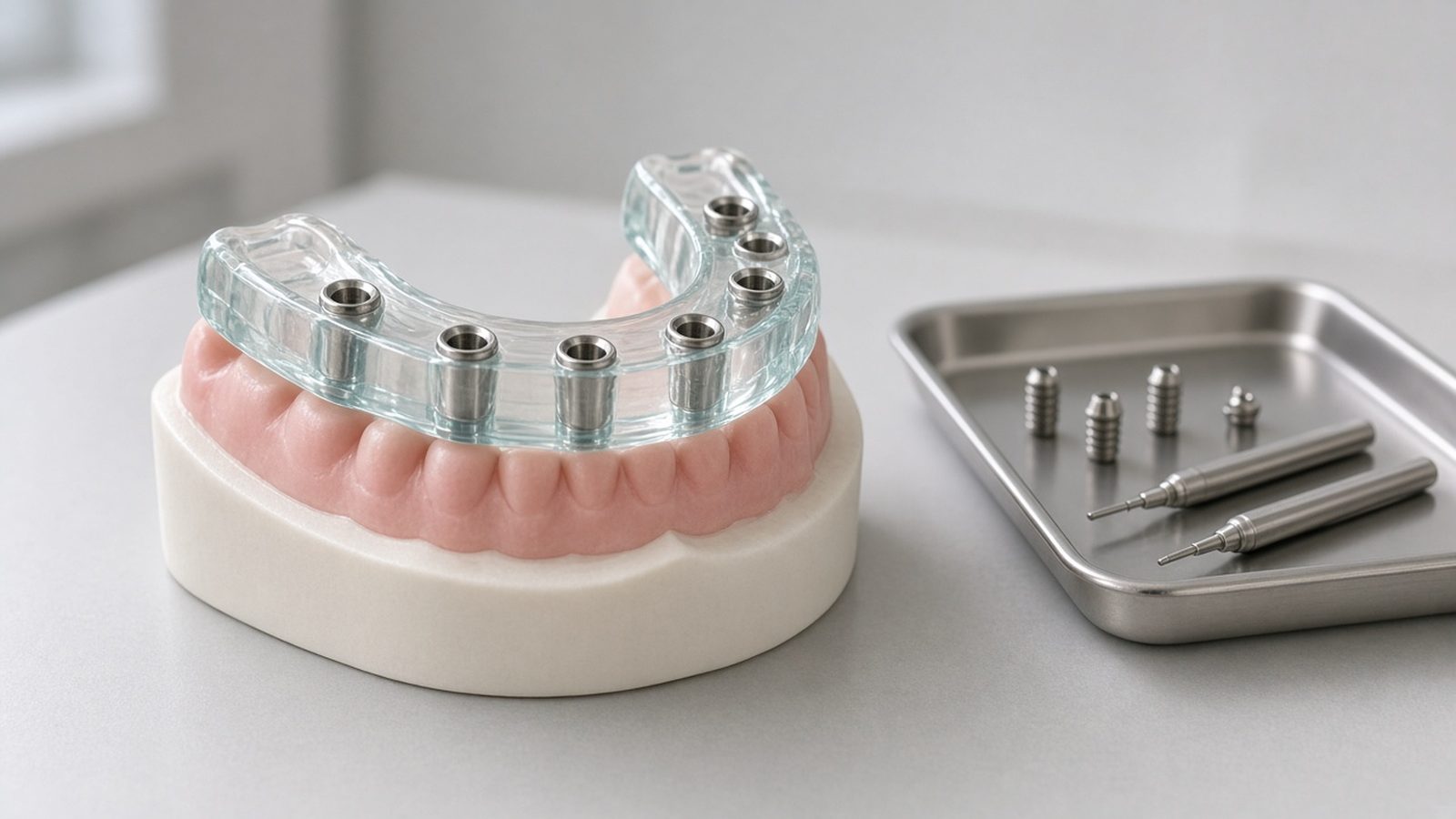
A surgical guide is a custom device, usually 3D-printed resin with small metal sleeves, that fits over the teeth, gums or bone and limits the drill to the planned position, angle and depth.
The guide is the last step in a chain, and each link affects the result:
- A 3D scan. A cone beam CT (CBCT) scan shows the bone, the nerve canal in the lower jaw and the sinuses in the upper jaw.
- A record of the mouth and bite. An intraoral scan or impression captures the teeth, gums and how the jaws meet.
- A design for the future teeth. In good planning, the teeth are designed first, so the implants can be placed where they will support those teeth rather than wherever bone happens to be thickest. Our article on why the final teeth should guide oral surgery planning explains the reasoning.
- A virtual plan. Software merges the scans, and the clinician places virtual implants, checking distance from the nerve, the sinus and neighboring roots.
- The guide. The plan is turned into a guide that carries the drill to each planned site.
Guides are described by what they rest on. A tooth-supported guide sits on remaining teeth and tends to be the most stable. A tissue-supported guide rests on the gums of a toothless jaw. A bone-supported guide sits directly on bone after the gums are lifted back. Guides for toothless jaws are often held in place with small anchor pins so they cannot shift during drilling.
There are also degrees of guidance. A pilot guide directs only the first, narrow drill, and the surgeon finishes the site freehand. A fully guided approach directs every drill, and sometimes the implant itself. Dynamic navigation uses no physical guide at all: cameras track the drill in real time against the 3D plan on a screen, a bit like a car's navigation display.
What the research says about accuracy
Large reviews agree that guided approaches land closer to the plan than freehand placement. They also show that no method is perfect, which is why planners leave a safety margin around nerves and sinuses.
A 2018 systematic review and meta-analysis by Tahmaseb and colleagues, prepared for the International Team for Implantology (ITI) consensus conference, pooled 20 clinical studies covering 2,238 implants in 471 patients placed with static guides. On average, the implants ended up about 1.2 mm from the planned entry point, about 1.4 mm from the planned tip, and about 3.5 degrees off the planned angle. The authors judged that clinically acceptable in most situations but said a safety margin of at least 2 mm should still be respected. They also found accuracy was significantly better in partly toothless mouths than in fully toothless ones.
A 2025 meta-analysis by Werny and colleagues in the International Journal of Implant Dentistry compared methods across 55 studies. Average angle errors were about 7.5 degrees freehand, 5.9 degrees with a pilot-drill guide, 3.7 degrees with dynamic navigation and 2.6 degrees with a fully guided static template, with similar ordering for distance errors. Fully guided static surgery was the most accurate at the entry point. The authors again recommended a 2 mm safety margin, because even guided implants can end up a millimeter or more from the plan at the tip.
To put those numbers in plain terms: a few degrees of tilt, multiplied along the length of an implant, can be the difference between an implant that sits comfortably inside the bone and one that comes close to a nerve canal, a sinus floor or a thin outer wall. It can also affect where the screw access holes come out under a full-arch bridge, which matters for how the teeth look and how easy they are to clean.
What guided surgery has not been shown to do
The evidence supports better accuracy. It does not yet show that guided implants survive longer, heal faster or have fewer complications than implants placed freehand by an experienced surgeon.
A 2022 critical review in Periodontology 2000 by Pimkhaokham and colleagues looked at 77 studies to see whether the extra accuracy turns into better results for patients. Current evidence did not show a difference in surgical complications, early healing, integration of the implant with bone, or long-term survival between guided and freehand placement. Evidence linking guided accuracy to better-looking results was limited. The review did note two indirect benefits: guided surgery can make flapless surgery (placing implants through the gums without lifting them back) and immediate teeth more predictable, and surgery time appeared to be shorter with guides in fully toothless patients, though not in single-tooth or partly toothless cases.
The ITI's 2018 consensus statement on digital technology reached a similar position. It called static guided surgery an additional tool for diagnosis, planning and surgery rather than a replacement for them, because CBCT measurements and intraoral scans are not precise enough on their own to deliver the accuracy the method seems to promise. It also cautioned that flapless guided surgery can place implants outside the band of firm gum tissue that helps protect them, so it has to be done with care.
So when an ad suggests that guided surgery "eliminates" freehand error, means "no grafting," or guarantees success, it is claiming more than the research supports. Guided surgery is a way to carry out a good plan more faithfully. It cannot make a poor plan good.
Why full-arch cases are different
Full-arch treatment is where digital planning can help the most, and also where a guide is hardest to keep perfectly still. Teeth may be removed, bone reshaped and implants angled, all in one visit.
Tahmaseb's review found guided accuracy was lower in fully toothless jaws, which makes sense. With no teeth to rest on, a guide sits on soft gum tissue or on bone, and both are less stable reference points than enamel. In a mouth with failing teeth, the teeth that anchored the scan may be removed on surgery day, so the plan has to account for what the jaw will look like after extractions and any bone smoothing.
Full-arch plans also tend to use angled implants toward the back of the jaw to avoid the sinus or the nerve and to spread support under the bridge. Those positions leave less room for error, which is why careful 3D planning is valuable here. Our article on All-on-4 versus All-on-6 explains why the number and spread of implants varies, and our guide to severe lower jaw bone loss covers how thin bone changes the plan.
Even with a careful plan, surgery can reveal bone that is softer, harder or shaped differently than the scan suggested. A surgeon may need to change an implant's length, angle or position, add grafting, or decide that immediate teeth are not safe that day. That is not a failure of planning. It is why a plan should be written with options, and why you should ask in advance what would trigger a change. Our article on what happens on full-arch surgery day walks through how those decisions are made in the chair.
Limits and trade-offs worth knowing
Guided surgery has practical limits: it needs room in the mouth, a guide that fits, extra planning time and, in rare cases, a backup plan if the guide cannot be used.
- Mouth opening. Guided drills are longer because they have to pass through the guide. In one study included in the Pimkhaokham review, 7 of 43 planned implants in the back of the mouth could not be placed with the guide because the patients could not open wide enough, and they were placed freehand instead.
- Fit and stability. The most commonly reported problem with guides is that they do not seat fully or rock slightly. A guide that does not fit has to be corrected or set aside.
- Breakage. Guide fracture during surgery has been reported but is uncommon. In one full-arch study, it happened in about 1 in 65 patients and the guide was repaired during the operation.
- Time and planning work. A 2021 systematic review by Graf and colleagues found that the diagnostic and planning steps for computer-assisted surgery take more time and cost more than conventional planning, and that time was the main driver of those costs.
- Flapless is not always better. Placing implants through the gums without lifting them can mean less swelling for some people, but the ITI consensus cautions that it can put implants outside the firm gum tissue, and it limits what the surgeon can see.
None of these is a reason to avoid guided surgery. They are reasons the surgeon should be comfortable working both with and without a guide.
Where the CBCT scan fits, and the radiation question
Every guided plan starts with a CBCT scan. It gives information a flat X-ray cannot, and it also uses more radiation than standard dental X-rays, so it should be taken when it is needed and not repeated without reason.
The FDA notes that dental CBCT is used for implant planning and gives three-dimensional information that can help diagnosis and treatment planning. It also says CBCT doses are generally lower than other CT exams but typically higher than conventional dental X-rays, and that the FDA and the American Dental Association recommend dental X-ray exams, including CBCT, only when necessary. The FDA encourages patients to talk with their provider about why a scan is needed and to keep a record of their imaging history.
That record is practical as well as protective. If you had a CBCT at another office recently, bring the files. Whether an earlier scan can be used for planning depends on its quality, its field of view and whether anything has changed since, and that is the planning team's call.
How our team plans implant positions
At Regional Implant Centers, implant positions are planned around the teeth you will end up with. 3D imaging, digital planning and our surgical team work from one shared plan, and guided planning is used when appropriate rather than as a one-size-fits-all rule.
Our RISE Protocol sets the order of work. A prosthodontist maps out your bite, facial support, speech and the long-term plan for your new teeth before surgery begins. At our Katy office, that includes Dr. Polyxeni Konti, our prosthodontist. Our digital planning team then uses 3D cone beam CT imaging, which helps guide implant position, angulation, depth and spacing around the final prosthetic design. Our SegMark Workflow aligns CBCT imaging, intraoral scans, bite information, facial references and restorative goals into one coordinated digital plan, which supports clearer surgical guides and plans and gives the surgeon, restorative doctor, digital planner and lab one shared reference point.
On surgery day, a dedicated anesthesia provider focuses on your safety, comfort and monitoring while the surgeon focuses on the surgery. When treatment becomes more complex, our team can capture updated scans with mobile CBCT during the procedure to support more informed decisions, including checking implant positions. After the implants are placed, photogrammetry records their exact 3D positions so the restorative and lab teams can design a full-arch prosthesis that fits passively. Our in-house dental lab is at our Katy office, where technicians can see you in person while they refine tooth shape, shade, lip support and smile line.
For patients with very limited upper bone, our surgeons Dr. Dan Holtzclaw and Dr. Enrique Tabarini also perform zygomatic and pterygoid implants. These are specialized techniques that are not right for everyone, and our article on sinus lift versus zygomatic implants explains how they compare.
None of this technology guarantees a result, and it does not replace clinical judgment. Its value is that the people responsible for each phase can see the same information before anything irreversible happens.
Questions to ask any Houston office about guided surgery
Good answers are specific to your case. Be cautious of answers that promise perfect placement, guaranteed success or no grafting before anyone has studied your scan.
Whether you are talking with our team or another practice, these questions tend to reveal how carefully a case is planned:
- Who designs my future teeth, and is that design done before the implant positions are chosen?
- Will my plan use a guide, dynamic navigation or freehand placement, and why is that the right approach for my bone and mouth opening?
- If a guide is used, what does it rest on: teeth, gums or bone? How is it held still?
- Who reviews the digital plan, and can I see it with the nerve and sinus marked?
- What happens if the guide does not fit or my bone differs from the scan? Who decides, and will I be told before I leave?
- Will implant positions be checked during or after surgery, and how?
- Are planning, imaging and any guide fees included in my written estimate?
If you already have a plan from another office and want to compare, our article on getting a second opinion before full-arch surgery explains what records to request. For how a plan's line items can differ, see our guide to full-mouth dental implant cost factors in Houston. Our seed article on digital planning before dental implant surgery gives a shorter overview of the imaging tools.
Coming to our Katy office from around Houston
Our Houston-area office is in Katy, on the west side of the metro. You can start with a phone consultation and decide whether to come in after that.
Our Katy office is at 707 S Fry Rd, Suite 150, Katy, TX 77450. Its posted hours are Monday through Thursday 8 to 5, with Fridays for surgeries only. Patients come from Katy, Cypress, Sugar Land, Fulshear, Richmond and across West Houston, and our article for Sugar Land, Fulshear and Cypress patients covers what those visits look like. Our Katy full-mouth dental implants page explains the full-arch options offered there. Both our Katy and Hutto offices offer traditional dentures, snap-on implant overdentures and fixed full-arch teeth, so a fixed bridge is not the only path.
If sedation is part of your plan, arrange for a responsible adult to drive you home after surgery. Our anesthesia and comfort page explains the options your doctor may discuss.
How insurance and financing fit in
Medical insurance may help with some surgical parts of a plan, but at our office it does not pay for implants, temporary teeth or final teeth, and coverage is never guaranteed.
At Regional Implant Centers, we bill medical insurance only for surgical professional services, such as extractions, bone grafting and alveoloplasty (smoothing and reshaping the bone). Implants, temporary teeth and the final prosthesis are billed to the patient separately. Only PPO plans work for out-of-network oral surgery benefits. If you have a PPO medical plan with oral surgery coverage, it is worth checking, but please verify your benefits with our team before treatment. We cannot bill Federal Employee Program (FEP) Blue Cross Blue Shield plans. Our Insurance Advantage team reviews dental and medical benefits, and our insurance disclaimer explains that a benefit estimate or preauthorization is not a guarantee of payment. If you have a Blue Cross Blue Shield PPO, our article on BCBS PPO coverage for full-arch implant surgery in Houston goes into more detail.
Financing is available through independent third-party companies listed on our financing page, including Cherry, Proceed, CareCredit and Sunbit. Approval, rates and terms are set by each lender, not by Regional Implant Centers.
After treatment, Regional Implant Centers does not offer a traditional implant warranty. Our implant warranty page explains which events are not covered, including neglect, poor oral hygiene and smoking. Our Maintenance Package must begin within 30 days of final prosthesis delivery, and its terms explain what can void coverage. Read both before treatment.
Frequently asked questions
Is guided implant surgery better than freehand?
It is more accurate on average. Large reviews show guided implants land closer to the planned position and angle than freehand implants. Studies have not shown that guided implants last longer or have fewer complications overall, and an experienced surgeon may choose freehand placement when a guide will not fit or the bone differs from the scan.
Does guided implant surgery hurt less?
It may, for some patients. The ITI consensus reported benefits for pain and discomfort with guided surgery, largely because guides make it easier to place implants without lifting the gums. A broader review did not find a difference in early healing. How you feel afterward also depends on how much surgery is done, any extractions or grafting, and the anesthesia plan.
Can a surgical guide be used for All-on-4 or full-arch implants?
Yes. Guides for toothless jaws rest on the gums or the bone and are often held with small pins. Accuracy in fully toothless jaws is somewhat lower than when a guide rests on teeth, so careful planning, a safety margin around nerves and sinuses, and a surgeon ready to adjust are still important.
Does guided surgery mean I will not need a bone graft?
No. Digital planning can sometimes find a position or angle that uses the available bone well, but whether you need grafting depends on how much bone you have and where the implants have to go to support your teeth. That is decided from your CBCT scan and exam, not by the guide.
Is a CBCT scan safe?
A dental CBCT uses more radiation than standard dental X-rays and less than most other CT scans. The FDA and the American Dental Association recommend taking it only when it is needed for diagnosis or treatment. Ask why a scan is recommended, and bring any recent scans from other offices.
Talk with our team about planning your implants
If you live in Houston, Katy, Cypress, Sugar Land, Richmond, Fulshear, Spring or Tomball and want to understand how your implants would be planned, we can start with a conversation. Bring any scans or treatment plans you already have, and ask us the same questions listed above. If you come in, you will have a clinical exam, 3D imaging when indicated, and a written plan with estimated insurance benefits, financing options and your expected out-of-pocket investment before anything begins. Qualified patients receive a complimentary consultation, CBCT scan and insurance benefits evaluation. Schedule a consultation at our Katy office, by phone or in person, or call (832) 632-7037. If our Hutto office near Austin is more convenient, you can book there instead.
Sources & Resources
- Tahmaseb A, Wu V, Wismeijer D, Coucke W, Evans C. The accuracy of static computer-aided implant surgery: A systematic review and meta-analysis. Clinical Oral Implants Research, 2018.
- Werny JG, Frank K, Fan S, Sagheb K, et al. Freehand vs. computer-aided implant surgery: a systematic review and meta-analysis, part 1: accuracy of planned and placed implant position. International Journal of Implant Dentistry, 2025.
- Pimkhaokham A, Jiaranuchart S, Kaboosaya B, et al. Can computer-assisted implant surgery improve clinical outcomes and reduce the frequency and intensity of complications in implant dentistry? A critical review. Periodontology 2000, 2022.
- Wismeijer D, Joda T, Flugge T, Fokas G, Tahmaseb A, et al. Group 5 ITI Consensus Report: Digital technologies. Clinical Oral Implants Research, 2018.
- Graf T, Keul C, Wismeijer D, Guth JF. Time and costs related to computer-assisted versus non-computer-assisted implant planning and surgery. A systematic review. Clinical Oral Implants Research, 2021.
- U.S. Food and Drug Administration. Dental Cone-beam Computed Tomography
This article is general patient education and is not a diagnosis or treatment plan. Whether guided surgery, freehand placement or another approach is appropriate depends on an individual clinical evaluation and imaging. Insurance coverage is never guaranteed, and financing is provided by independent third-party companies. Regional Implant Centers has offices in Katy and Hutto, Texas. Outcomes vary, and implant treatment is not appropriate for every patient.
Ready to Learn What Is Possible?
Schedule a consultation with Regional Implant Centers.
Schedule ConsultationFrequently Asked Questions
Is guided implant surgery better than freehand?
It is more accurate on average. Large reviews show guided implants land closer to the planned position and angle than freehand implants. Studies have not shown that guided implants last longer or have fewer complications overall, and an experienced surgeon may choose freehand placement when a guide will not fit or the bone differs from the scan.
Does guided implant surgery hurt less?
It may, for some patients. The ITI consensus reported benefits for pain and discomfort with guided surgery, largely because guides make it easier to place implants without lifting the gums. A broader review did not find a difference in early healing. How you feel afterward also depends on how much surgery is done, any extractions or grafting, and the anesthesia plan.
Can a surgical guide be used for All-on-4 or full-arch implants?
Yes. Guides for toothless jaws rest on the gums or the bone and are often held with small pins. Accuracy in fully toothless jaws is somewhat lower than when a guide rests on teeth, so careful planning, a safety margin around nerves and sinuses, and a surgeon ready to adjust are still important.
Does guided surgery mean I will not need a bone graft?
No. Digital planning can sometimes find a position or angle that uses the available bone well, but whether you need grafting depends on how much bone you have and where the implants have to go to support your teeth. That is decided from your CBCT scan and exam, not by the guide.
Is a CBCT scan safe?
A dental CBCT uses more radiation than standard dental X-rays and less than most other CT scans. The FDA and the American Dental Association recommend taking it only when it is needed for diagnosis or treatment. Ask why a scan is recommended, and bring any recent scans from other offices.
This content is educational and not a substitute for a consultation.