Heart Disease & Oral Health
Gum Disease and Heart Disease: What San Antonio Patients Should Know Before Full-Arch Implants
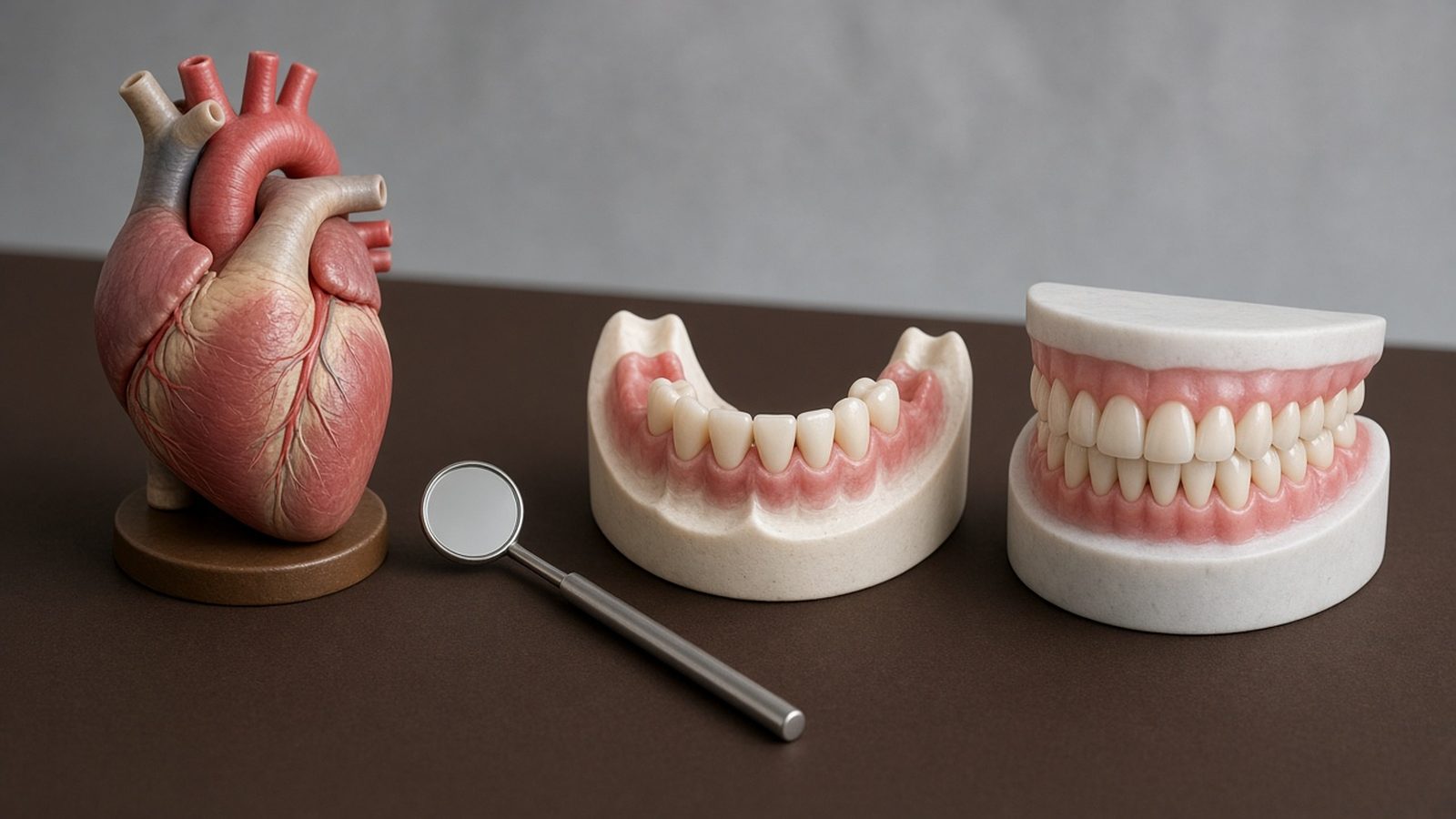
Gum disease and heart disease often travel together. Here is what the association means - and does not mean - before San Antonio patients plan full-arch implants.
If you live in San Antonio, New Braunfels, Schertz, Boerne or a nearby community, and you have both stubborn gum disease and a heart history, the questions often arrive together. Does periodontitis "cause" heart disease? Will treating my gums protect my heart? Can I still get full-arch dental implants if I have coronary disease, a stent or atrial fibrillation? This guide is for that intersection. It is written for patients who may travel to our Hutto or Katy offices. Regional Implant Centers does not have an office in San Antonio, New Braunfels, Schertz or Boerne.
This is not a redo of our Houston guide on dental implants with heart disease, which focuses on blood thinners, stents, antibiotics and cardiology clearance for surgery day. It is also not a redo of chronic tooth infections and implants (abscesses and failing roots) or advanced gum disease and full-arch options for Austin (save-versus-extract decisions). Here the focus is the gum-heart association itself, what the evidence does and does not support, and how that should shape a full-arch plan when you are traveling in from the San Antonio area.
The short answer
Periodontal disease and heart disease are associated in many studies, but association is not the same as proof that gum disease causes heart attacks - or that treating gums will prevent one. What is clear is that active gum infection raises surgical and implant risks, shares risk factors with cardiovascular disease, and should be controlled as part of any honest full-arch plan.
At Regional Implant Centers the consultation costs $25. It is not free, complimentary or no-cost. Bring your cardiologist's contact information, a current medicine list and any recent dental X-rays or periodontal charting.
What the gum-heart association actually means
Researchers have found links between periodontitis and atherosclerotic cardiovascular disease. Professional groups urge caution about claiming cause-and-effect or promising that gum treatment protects the heart.
The American Dental Association's oral-systemic health review states that periodontal disease has been associated with several conditions, including heart disease and diabetes, while "finding direct causality remains elusive." The ADA also notes that periodontal and systemic diseases share common risk factors such as smoking and poor diet, and that implying periodontal treatment alone will reduce systemic disease risk "would be incorrect and misleading" without stronger interventional evidence.
The American Academy of Periodontology similarly explains that studies show a link between periodontal disease and other systemic diseases, that a causal relationship has not been conclusively established, and that inflammation is one of the leading hypotheses for the heart-disease association. The AAP also notes that periodontal disease can exacerbate existing heart conditions and that patients at risk for infective endocarditis may need antibiotics before certain dental procedures - a decision made with your cardiologist, not from a blog article.
In plain language for a San Antonio-area patient: if a clinic advertises that full-arch implants will "cure" or "prevent" heart disease by removing infected teeth, that oversells the science. If your cardiologist asks you to get oral infection under control before elective surgery, or your dental team wants a cardiology note before a long implant case, that is responsible coordination - not scare marketing.
How common gum disease is - and why that matters for full-arch planning
Periodontitis is common in U.S. adults, is a leading cause of tooth loss, and is more common in people who also carry cardiovascular risk factors.
CDC gum-disease facts report that nearly half (about 42%) of adults aged 30 years and older have periodontitis, and that severe periodontitis affects about 8% of adults. CDC also notes that periodontitis involves infection and inflammation of the gums and bone around teeth, that it can be managed and slowed with professional treatment, and that poor oral hygiene, diabetes and smoking are associated with serious gum disease.
NIDCR summaries of the same NHANES data put overall periodontitis at about 42.2% of dentate adults 30 and older (about 7.8% severe; about 34.4% nonsevere), with higher prevalence among current smokers (about 62%), adults who report diabetes (about 60%), and people with more missing teeth. Cleveland Clinic patient education likewise describes periodontal disease as inflammation and infection of the tissues that support teeth, notes that almost half of U.S. adults have some form of gum disease, and lists heart disease among associated health issues while emphasizing that early gum disease can be managed and that advanced bone loss is not fully reversible.
Those numbers matter for full-arch patients because many people who eventually need an arch of implants did not lose teeth from one accident. They lost them after years of bleeding gums, deepening pockets, drifting teeth and "one more extraction." If you also have hypertension, coronary disease, a prior stent or atrial fibrillation, you are looking at two chronic inflammatory or vascular stories that share lifestyle and medical risk factors - not a mysterious one-way infection from the mouth to the heart.
Shared risk factors you should name out loud
Smoking, diabetes, age, diet and incomplete oral hygiene show up on both the periodontal chart and the cardiology problem list.
ADA oral-systemic materials emphasize comorbidities: people who smoke face higher risk for gum disease and for heart disease and stroke. CDC links smoking and diabetes with more serious gum disease. NIDCR data show current smokers and adults with diabetes have substantially higher periodontitis prevalence than nonsmokers and people without diabetes.
For travel-in patients from San Antonio, that means a useful consult does not treat gum disease as a "mouth-only" problem and heart disease as a "chest-only" problem. It asks:
- Are you still smoking, vaping or using nicotine pouches? (See our related smoking and dental implants guide for San Antonio.)
- Is blood sugar controlled enough for elective oral surgery and healing? (Companion: diabetes and tooth loss.)
- Which cardiac medicines affect bleeding, anesthesia planning or infection risk?
- Has active periodontal infection already destroyed so much bone that tooth-by-tooth salvage is no longer realistic?
Answering those questions honestly shapes whether the next step is periodontal therapy to keep remaining teeth, a staged extraction and temporary plan, a snap-on overdenture or a fixed full-arch bridge.
Why active gum infection still matters before implants - even without a "heart cure" claim
You do not need to prove that periodontitis causes heart attacks to justify cleaning up oral infection before placing implants.
FDA patient information on dental implants lists risks that include local infection in the bone and gums supporting the implant, implant looseness or loss, and difficulty cleaning around implants. It also notes that untreated periodontal disease is among the concerns clinicians discuss, and that overall health affects candidacy and healing. AAOMS explains that implants fuse to bone through osseointegration over months and that implant-supported restorations can be more stable than conventional partials and dentures when the foundation is sound.
Cleveland Clinic's periodontal overview describes how untreated disease progresses from reversible gingivitis to bone loss, pocketing, mobility and tooth loss. Once structural support is gone, the disease is managed rather than fully reversed. That progression is exactly how many full-arch candidates arrive: after years of "deep cleanings," antibiotics and failing bridges.
For implant planning, active periodontitis raises peri-implant risk later. History of periodontitis is a known risk context for inflammation around implants; that is why our related posts on gum disease and full-arch options and peri-implantitis treatment stress maintenance after teeth are replaced. Controlling infection before surgery, designing a cleansable prosthesis and enrolling in maintenance are mouth-health reasons - not a substitute for cardiology care.
What this means if you already have heart disease
Heart disease does not automatically rule out full-arch implants. It does require coordinated planning with your cardiologist and a clear oral-infection plan.
Use this article for the gum-heart evidence and the infection-control logic. Use the Houston heart disease and implants article for the medication and timing details: blood thinners, stent waiting windows, endocarditis antibiotic questions, blood-pressure concerns and what a cardiology clearance letter should cover. Do not stop or change cardiac medicines based on a website. Those decisions belong to your physicians.
Regional Implant Centers can also support physician-directed dental clearance when a cardiologist, transplant team or other medical team requests oral evaluation before a medical procedure. That is a different visit goal from planning your own full-arch reconstruction; see our posts on conditions that may require dental clearance and how clearance communication with physicians works.
When failing gums push the plan toward dentures, snap-ons or fixed full-arch teeth
When teeth are mobile, bone is lost across the arch, and remaining abutments cannot carry another bridge or partial, the conversation shifts from saving every tooth to choosing a stable prosthetic end point.
Both of our offices discuss:
- Traditional dentures - removable, no implants required; fit and chewing depend on gums and bone.
- Snap-on implant overdentures - implants for retention; still removable for cleaning.
- Fixed full-arch implant teeth (All-on-X) - implant-supported bridge that stays in place for daily wear; implant count is individualized.
A side-by-side comparison lives at All-on-X vs implant dentures vs traditional dentures. For patients who still have some savable teeth, the Austin gum-disease guide covers when full-arch becomes the clearer option. For San Antonio travel logistics (which office is closer, trip count, escort rules for sedation), start with traveling from San Antonio for full-mouth implants. If you already hold a local All-on-4 plan you distrust, see second opinion for San Antonio full-arch patients.
Bone loss from long-standing periodontitis can limit conventional implant sites. Hutto offers bone grafting and sinus lifts when clinically appropriate. Complex upper-jaw cases may involve zygomatic or pterygoid approaches by Dr. Enrique Tabarini when grafting and tilted conventional implants are not enough. Prior graft failures have a dedicated travel-in guide: failed bone graft implant options.
What a travel-in evaluation at Hutto or Katy should include
A useful visit maps infection status, bone volume, cardiac coordination needs and the prosthetic end point - before anyone books surgery day.
Expect discussion of:
- Periodontal charting or recent records: pocket depths, mobility, bleeding, furcation involvement.
- Which teeth have a fair prognosis versus short-term abutments only.
- Mobile CBCT when the team determines 3D views of bone, nerves and sinuses are appropriate (mobile cone beam CT; both offices have mobile CBCT capability).
- Medical history focused on cardiac diagnoses, stents or surgeries, blood thinners, blood pressure control, sleep apnea and smoking.
- Whether cardiology clearance or medication guidance is needed before extractions and implant placement.
- Hygiene access under a future fixed bridge versus a removable overdenture.
- A written plan that separates infection control / extractions, same-day temporary teeth, healing and final arches.
Our RISE Protocol describes how a prosthodontist, imaging and planning team, oral surgeon and anesthesiologist, and lab technicians divide roles. Final arches for many cases involve the Katy in-house lab; the lab is at Katy, not claimed as a San Antonio facility.
How treatment usually unfolds if you choose implants
Every Regional Implant Centers full-arch implant patient leaves surgery with same-day temporary teeth. Final arches are full monolithic zirconia or titanium-reinforced zirconia, typically delivered in one to four months depending on healing and progress, across about four to five total visits in many cases.
A typical sequence:
- $25 consultation and imaging as indicated.
- Medical coordination (cardiology notes, medicine plan) when needed.
- Collaborative restorative and surgical planning.
- Surgery day with temporary teeth when immediate loading is appropriate.
- Healing follow-ups while implants integrate.
- Final prosthesis delivery and maintenance enrollment.
Anesthesia options include local anesthesia, IV sedation and general anesthesia, with an anesthesiologist focused on safety and monitoring in a very safe surgical facility with the highest standards of care. Which staffing model applies on your surgery day is confirmed at scheduling; see also anesthesia and patient comfort.
After finals, ask about the 1-year warranty and extended maintenance packages. Patients with a periodontitis history often need disciplined home care and professional maintenance to protect implants - the same inflammation biology that damaged natural teeth can affect peri-implant tissues if hygiene is neglected.
Insurance notes without overpromises
Medical insurance, when it applies at all, is typically limited to surgical professional services such as extractions, bone grafting and alveoloplasty. Implants, temporary teeth and the prosthesis are generally billed to the patient. Only PPO plans are relevant for RIC's out-of-network oral surgery benefits pathway, and Federal Employee Program (FEP) Blue Cross Blue Shield plans cannot be billed. Please verify your own benefits.
There can be a strong chance or possible match worth checking for portions of the surgical professional services on some PPO plans. That is probability language, not a guarantee. Bring plan cards and recent EOBs if you have them. This article does not list treatment prices beyond the $25 consultation.
Ten questions to bring to your consult
Write the answers down. If the plan cannot explain both the mouth infection story and the heart coordination story, it is incomplete.
- How advanced is my periodontitis, and which teeth still have a fair prognosis?
- If we place implants, how will past gum disease change my maintenance schedule?
- Looking at my CBCT, where is bone adequate, thin or complicated by the sinus?
- Do I need active infection controlled or teeth removed before implant placement - and in what sequence?
- What does my cardiologist need to approve or document before surgery day?
- Between a conventional denture, a snap-on overdenture and a fixed full-arch bridge, which fits my bone, hygiene ability, heart status and goals?
- Will I leave surgery with temporary teeth, and what soft-food window should I expect?
- What material will my final arch be (monolithic zirconia or titanium-reinforced), and roughly when would finals be delivered?
- Who designs the teeth, who places the implants, and who manages anesthesia?
- For surgical professional services, what is worth checking with my PPO, and what should I assume is patient-billed? Please verify.
FAQ: Gum disease, heart disease and full-arch implants for San Antonio-area patients
Does gum disease cause heart disease?
Studies show an association between periodontitis and atherosclerotic cardiovascular disease, but major dental organizations caution that association is not the same as proven causation. Shared risk factors such as smoking and diabetes can partly explain the overlap. Treating gums is important for oral health and surgical readiness; it should not be sold as proven heart-attack prevention.
If I replace my failing teeth with implants, will that protect my heart?
Removing chronically infected teeth can reduce an oral infection burden and create a cleaner foundation for chewing, but implants are not a cardiovascular treatment. Continue your cardiology care, medicines and lifestyle plan. Ask both teams how oral infection control fits into your overall health goals without overstating what dentistry can deliver.
Can I get full-arch implants if I have heart disease and advanced gum disease?
Often yes, when cardiac status is stable enough for elective oral surgery, medicines are coordinated, and the mouth infection plan is clear. Heart disease alone does not automatically rule out implants. Uncontrolled medical conditions, active heavy infection or inability to maintain hygiene can change timing or prosthetic choice. Individual evaluation is required.
Should I see a periodontist locally in San Antonio before traveling to Hutto or Katy?
If you still hope to keep many teeth, local periodontal therapy and a written prognosis can be valuable first. If you already know most remaining teeth are terminal, a full-arch consult that includes periodontal assessment, CBCT and prosthetic planning may be the more efficient next step. Bring recent periodontal charting either way.
How do San Antonio-area patients start at Regional Implant Centers?
Book a $25 consultation through the main schedule consultation page (Houston and Austin booking paths are also available for office preference). Call (832) 632-7037 with questions - the same number for both offices. Bring medicine lists, cardiologist contact information, and any CBCT or periodontal records. Consultations are never free, complimentary or no-cost. We do not have a San Antonio office; travel is to Hutto and/or Katy.
Talk with the team
If gum disease and heart disease are both part of your story, get a plan that respects the science: association without overclaiming, infection control without delay tactics, and a prosthetic path you can maintain for years. Regional Implant Centers evaluates traditional dentures, snap-on overdentures and fixed full-arch options with specialist collaboration, mobile CBCT when appropriate, and a clear temporary-to-final sequence.
Schedule your $25 consultation at /schedule-consultation, review Hutto and Katy, or call (832) 632-7037. Leadership context for how the centers are organized is on Jeffry Tobon's team page.
Sources & Resources
- American Dental Association (ADA). Oral-Systemic Health. https://www.ada.org/resources/ada-library/oral-health-topics/oral-systemic-health (periodontal disease associated with heart disease and diabetes; causality elusive; shared risk factors; caution against implying periodontal treatment alone prevents systemic disease)
- U.S. Centers for Disease Control and Prevention (CDC). Gum Disease Facts. https://www.cdc.gov/oral-health/data-research/facts-stats/fast-facts-gum-disease.html (about 42% of adults 30+ have periodontitis; about 8% severe; leading cause of tooth loss; links with hygiene, diabetes, smoking)
- National Institute of Dental and Craniofacial Research (NIDCR). Periodontal Disease in Adults (Age 30 or Older). https://www.nidcr.nih.gov/research/data-statistics/periodontal-disease/adults (NHANES 2009-2014: 42.2% total periodontitis; higher rates in smokers and adults with diabetes; prevalence rises with missing teeth)
- American Academy of Periodontology (AAP). Gum Disease and Other Diseases. https://www.perio.org/for-patients/gum-disease-information/gum-disease-and-other-diseases/ (links with heart disease and other conditions; causal relationship not conclusively established; inflammation hypothesis; endocarditis antibiotic note with physician)
- Cleveland Clinic. Periodontal Disease (Gum Disease). https://my.clevelandclinic.org/health/diseases/21482-gum-periodontal-disease (infection/inflammation of supporting tissues; almost half of U.S. adults; progression from gingivitis to bone loss and tooth loss; associated health issues including heart disease)
- U.S. Food and Drug Administration (FDA). Dental Implants: What You Should Know. https://www.fda.gov/medical-devices/dental-devices/dental-implants-what-you-should-know (overall health affects candidacy; risks include local infection, implant looseness, untreated periodontal disease concerns; healing may take months)
- American Association of Oral and Maxillofacial Surgeons (AAOMS). Dental Implant Surgery. https://myoms.org/what-we-do/dental-implant-surgery/ (osseointegration usually takes several months; implant-supported restorations contrasted with conventional removable dentures)
Disclaimer
This article is for education only. It is not a diagnosis, treatment plan, cardiology advice or promise that any specific option will work for every patient. Do not stop or change heart medicines based on this page. Only a clinical examination, appropriate imaging and coordination with your physicians can determine whether teeth can be saved, whether implants are appropriate, and which prosthesis fits your health and anatomy. Insurance language here is general; please verify your own benefits.
Ready to Learn What Is Possible?
Schedule a consultation with Regional Implant Centers.
Schedule ConsultationFrequently Asked Questions
Does gum disease cause heart disease?
Studies show an association between periodontitis and atherosclerotic cardiovascular disease, but major dental organizations caution that association is not the same as proven causation. Shared risk factors such as smoking and diabetes can partly explain the overlap. Treating gums is important for oral health and surgical readiness; it should not be sold as proven heart-attack prevention.
If I replace my failing teeth with implants, will that protect my heart?
Removing chronically infected teeth can reduce an oral infection burden and create a cleaner foundation for chewing, but implants are not a cardiovascular treatment. Continue your cardiology care, medicines and lifestyle plan. Ask both teams how oral infection control fits into your overall health goals without overstating what dentistry can deliver.
Can I get full-arch implants if I have heart disease and advanced gum disease?
Often yes, when cardiac status is stable enough for elective oral surgery, medicines are coordinated, and the mouth infection plan is clear. Heart disease alone does not automatically rule out implants. Uncontrolled medical conditions, active heavy infection or inability to maintain hygiene can change timing or prosthetic choice. Individual evaluation is required.
Should I see a periodontist locally in San Antonio before traveling to Hutto or Katy?
If you still hope to keep many teeth, local periodontal therapy and a written prognosis can be valuable first. If you already know most remaining teeth are terminal, a full-arch consult that includes periodontal assessment, CBCT and prosthetic planning may be the more efficient next step. Bring recent periodontal charting either way.
How do San Antonio-area patients start at Regional Implant Centers?
Book a $25 consultation through the main schedule consultation page. Call (832) 632-7037 with questions. Bring medicine lists, cardiologist contact information, and any CBCT or periodontal records. Consultations are never free, complimentary or no-cost. We do not have a San Antonio office; travel is to Hutto and/or Katy.
This content is educational and not a substitute for a consultation.