Nutrition & Oral Health
Eating After Tooth Loss: How Dentures, Snap-On Implants and Fixed Teeth Change Your Diet for Dallas-Fort Worth Patients
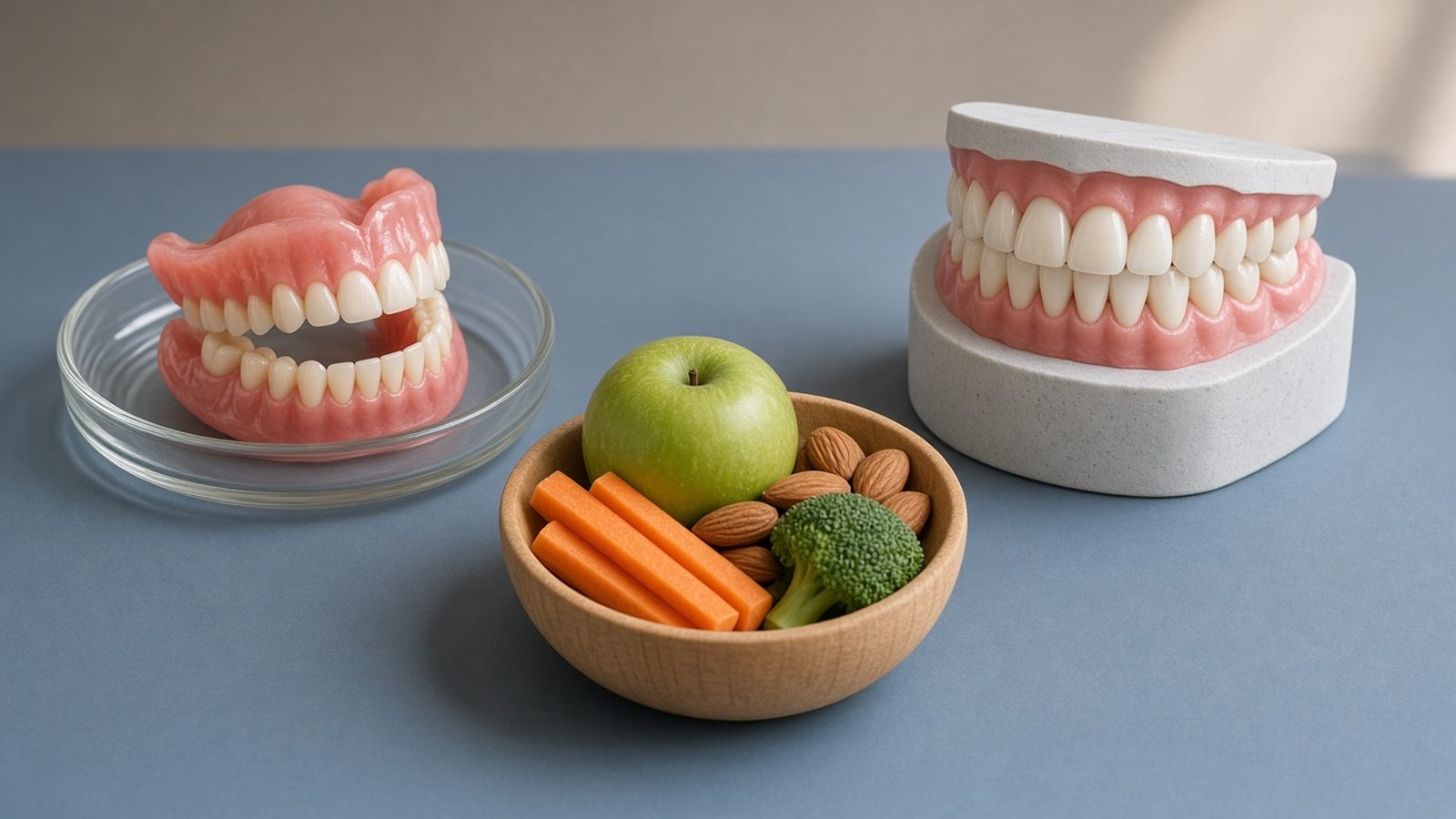
Failing teeth quietly change what you eat. Here is how dentures, snap-on implants and fixed full-arch teeth compare for long-term eating for Dallas-Fort Worth patients.
If you live in Dallas, Fort Worth, Plano, Frisco, McKinney, Irving, Arlington or a nearby community and your teeth have been failing for a while, your grocery list has probably changed without much fanfare. The crunchy salad gave way to soup. Steak became ground beef. Apples got sliced thin or skipped. This guide looks at that slow shift, how traditional dentures, snap-on implant overdentures and fixed full-arch teeth each change eating for years afterward, and what the research does and does not say about nutrition after tooth replacement. It is written for patients who may travel to our Hutto or Katy offices. Regional Implant Centers does not have a Dallas-Fort Worth office.
This is not a surgery-week menu. For that, see All-on-4 recovery: what to eat, week by week and protein and nutrition around full-arch surgery. This article is about the long run: the years when failing teeth narrow your diet, and the years after treatment, when new teeth make more foods possible but do not choose them for you.
The short answer
Losing teeth is linked with a narrower diet and a higher risk of poor nutrition, especially in older adults, although the research quality is mixed. Implant-supported teeth usually chew better than conventional dentures, but studies show better chewing does not automatically lead to better nutrition. The best results come from pairing a stable prosthesis with a deliberate plan to bring back the foods you gave up.
At Regional Implant Centers the consultation costs $25. It is not free, complimentary or no-cost. If you can, come with a short list of foods you avoid today and why. That list says more about your needs than most X-rays.
How tooth loss quietly reshapes what you eat
As teeth are lost or loosen, most people drift toward softer, easier foods. Over years, that can mean fewer raw vegetables, less fruit and less fiber, even when total calories stay about the same.
Tooth loss is common. National Institute of Dental and Craniofacial Research (NIDCR) survey data show that about 15% of U.S. adults 65 and older have no natural teeth left, with higher rates among seniors 75 and older and current smokers. Many more have lost enough back teeth that tough food takes real effort.
Does that matter for nutrition? A 2024 overview of systematic reviews in BMC Oral Health concluded that tooth loss is associated with poorer nutritional status, particularly in older adults, and that partially or fully toothless people were more likely to be malnourished or at risk of malnutrition in some pooled analyses. The authors were also candid that the underlying studies vary widely in method and that confidence in the evidence is low.
A separate meta-analysis of community-dwelling older adults found that compromised oral factors, including denture status, chewing ability and number of teeth, were associated with lower daily intake of energy, protein, fat, carbohydrate and vitamin C. The average gaps were modest, roughly 5 grams of protein and 13 milligrams of vitamin C a day, and drawn from few studies, but small daily gaps add up over years.
What this looks like in an ordinary DFW kitchen:
- Raw vegetables get replaced by cooked, canned or blended ones.
- Whole fruit becomes juice, applesauce or nothing.
- Tough meats become ground meat, deli slices or soft casseroles.
- Nuts and seeds disappear because fragments hurt under loose teeth or a denture.
None of those swaps is unhealthy alone. The problem is the pattern: a diet losing variety, fiber and produce because chewing, not preference, is deciding.
Why "I can still eat" is not the same as eating well
Many people with failing teeth or loose dentures still eat three meals a day and maintain their weight. The quieter problem is food variety and quality, which can slip for years without anyone noticing.
When patients say, "I can eat fine," the useful follow-up is: fine compared with what? Often the honest answer is fine compared with five years ago, after a long list of foods was dropped. Weight is not a good guide either; people who rely on soft, processed foods can gain weight while eating too little produce and fiber.
A 2024 Swedish case-control study in Frontiers in Nutrition shows how stubborn these habits can be. Researchers compared 25 older adults who had worn fixed implant bridges on both jaws for at least a year with 25 people of similar age who still had nearly all their natural teeth. Both groups looked well nourished on one screening tool, but the implant group scored worse on a second nutrition-risk questionnaire, ate fewer meals, ate a smaller variety of foods and ate significantly less fruit. The authors suggested these patients may have kept long-standing eating habits after treatment, and that diet counseling may be needed alongside new teeth.
It is a small study and does not prove fixed teeth cause poor nutrition. The practical point stands: new teeth are a chance to rebuild your diet, not a guarantee.
How each option changes everyday eating
Traditional dentures, snap-on implant overdentures and fixed full-arch teeth sit on a spectrum of stability. More stability generally makes biting and grinding firm foods easier, but each option has trade-offs in cost, care and fit.
Both of our offices offer all three options. Here is how they tend to compare at the table, in general terms. Individual results depend on bone, bite, the opposing arch, prosthesis design and how long you have worn removable teeth.
| Everyday eating question | Traditional denture | Snap-on implant overdenture | Fixed full-arch teeth (All-on-X) |
|---|---|---|---|
| What holds it in place | Suction, gum and bone support, sometimes adhesive | Implants with snap attachments; still removable | Screwed to implants; stays in for daily wear |
| Biting into firm foods with front teeth | Often difficult; front biting can tip the denture | Usually easier; depends on implant number and design | Generally closest to natural biting once finals are in |
| Grinding tough or fibrous foods | Limited; many people cut food small or switch textures | Improved for many wearers | Generally the strongest chewing of the three |
| Small seeds and nut fragments | Can slip under the denture and hurt | Less movement, but still a removable base | No removable base pressing on gums; food under the bridge is a cleaning task |
| Upper palate coverage | Full upper dentures typically cover the palate | Some designs reduce coverage; ask your team | No palate coverage |
| Long-term fit | Relines and adjustments as bone and gums change | Attachments wear and need periodic service | Professional maintenance and hygiene around implants |
A few points behind that table:
- Traditional dentures rest on your gums and, for upper dentures, your palate. Cleveland Clinic notes it can take weeks or sometimes months to get used to new dentures and that the jawbone gradually shrinks after tooth loss, which is why relines are part of denture life. For some people, a well-made denture is enough.
- Snap-on implant overdentures add implants for retention. Cleveland Clinic describes implant-supported dentures as offering more stability for chewing and speaking than dentures that rest on the gums. You still remove a snap-on for cleaning. Our guide to moving from a snap-on denture to fixed teeth covers when people upgrade.
- Fixed full-arch teeth stay in place and are cleaned in the mouth. For a side-by-side look at all three, see All-on-X vs implant dentures vs traditional dentures. If your current dentures are already loose and sore, options for loose dentures is a good companion read.
If your teeth are failing now rather than already gone, immediate dentures or All-on-4 when your teeth must come out walks DFW patients through that earlier decision.
What the research says about implants and nutrition
The evidence consistently shows better chewing and higher satisfaction with implant-supported teeth. The evidence on actual nutrient intake and nutrition markers is mixed, which is why food habits deserve attention after treatment.
A systematic review published in BMC Oral Health in January 2026 pulled together 18 studies of older adults who received implant-supported prostheses. Its conclusions are a useful reality check:
- Implants generally improved chewing efficiency and patient satisfaction. In one study, maximum bite force with implant overdentures rose from about 47 newtons to about 104 newtons over a year.
- Edentulous patients most reliably gained the ability to eat harder and more fibrous foods and a wider variety of foods. One study reported vegetable intake rising from 2.5 to 3.3 servings after a lower implant prosthesis.
- Changes in total calories, nutrient intake, body measurements and blood nutrition markers were inconsistent. Several studies found no significant nutrient differences between implant and conventional denture groups despite better chewing.
- The authors recommended dietary counseling and long-term monitoring of nutrition as part of implant rehabilitation.
Put plainly, new teeth widen the menu. They do not walk you down the produce aisle. That is a reason to plan the eating part on purpose, not a reason to avoid implants.
A food check you can do before your consultation
Spend a week noticing which foods you avoid and why. That short list helps your team match the prosthesis to your goals and gives you a target for rebuilding your diet afterward.
Try this before you book or before your visit:
- List five foods you used to eat and now avoid. Note whether it is because of pain, looseness, embarrassment or effort.
- Note how you handle raw vegetables, whole fruit, steak or brisket, crusty bread and nuts.
- Write down whether you use denture adhesive, cut food very small or chew on one side.
- Count roughly how many servings of fruit and vegetables you ate on two ordinary days.
- Note any medical diet you follow, such as diabetic, heart-healthy, low-sodium or soft-texture diets ordered by a physician.
Bring the list. Someone who misses brisket and corn on the cob has different priorities from someone who just wants a denture that stops rubbing. Both are reasonable.
Planning the eating timeline: before, during and after treatment
With full-arch implants, eating happens in stages: the period of failing teeth, a soft-food healing window on same-day temporary teeth, and then a gradual return to firmer foods once final teeth are delivered and your team clears you.
Every Regional Implant Centers full-arch implant patient leaves surgery with same-day temporary teeth. Those temporaries are meant for healing, not for testing limits. Expect a soft-food window while implants integrate with bone; your surgical team sets the specifics based on your case. The week-by-week detail lives in our recovery and eating guide, and the difference between temporary and final teeth is covered in teeth in a day: temporary vs final teeth.
Final arches are typically delivered in one to four months depending on healing and progress, across about four to five total visits in typical cases. After finals and your team's go-ahead, many people reintroduce firmer foods gradually. A practical order:
- Start with tender proteins and cooked vegetables you have been missing.
- Add raw vegetables and whole fruit cut into pieces, then work toward biting.
- Bring back crusty bread, tougher meats and nuts as comfort allows.
- Keep avoiding the habits that damage any teeth: chewing ice, cracking shells, biting hard candy and opening packages with your teeth.
If rebuilding variety is hard, ask your physician about a registered dietitian, especially if you manage diabetes, heart disease or kidney disease.
Designing the teeth with eating in mind
The prosthesis itself affects how confidently you eat: material, bite design, cleanability and maintenance all matter over the long run.
Final full-arch teeth at Regional Implant Centers are full monolithic zirconia or titanium-reinforced. Our zirconia vs acrylic full-arch teeth article explains why material choice matters for chewing forces and wear. Many final arches are designed and finished in our Katy in-house lab, which lets the restorative and lab teams adjust shape and bite closely. The lab is located at Katy only.
Ask how the bite will be balanced, how you will clean under the bridge, and whether a night guard makes sense if you clench or grind.
After finals, RIC provides a 1-year warranty, and extended maintenance packages are available. Regular maintenance protects the implants and gums that make comfortable chewing possible; see All-on-4 cleaning and maintenance for daily care.
What a travel-in evaluation from Dallas-Fort Worth looks like
A useful first visit connects your eating goals to bone, bite and health findings, then lays out a realistic plan and trip schedule before any surgery date is set.
For most DFW travelers, Hutto, just northeast of Austin, is the closer office; Katy, west of Houston, is home to our in-house lab. Either office can evaluate traditional dentures, snap-on overdentures and fixed full-arch teeth. Hutto also offers bone grafting and sinus lifts when clinically appropriate. For complex upper-jaw cases with severe bone loss, zygomatic and pterygoid approaches are performed by Dr. Dan Holtzclaw and Dr. Enrique Tabarini; our DFW guide to zygomatic implant surgery and recovery explains that path.
At the evaluation, expect:
- A review of your teeth or dentures and the foods you struggle with.
- Mobile cone beam CT imaging when 3D views are needed; both offices have mobile CBCT.
- A medical history, including medicines and any physician-ordered diet.
- Which option fits your bone, hygiene ability, goals and budget.
- Anesthesia options: local anesthesia, IV sedation and general anesthesia, with care from an anesthesiologist when sedation is used. Surgery takes place in a very safe surgical facility with the highest standards of care. More on anesthesia and patient comfort.
Our RISE Protocol describes how the prosthodontist, imaging and planning team, surgeon, anesthesiologist and lab work together so the final teeth guide the surgical plan. For trip logistics, start with full-mouth dental implants from Dallas-Fort Worth, and for travel costs and payment timing, see budgeting for full-arch implants from DFW. If bone loss is a concern, do you need a bone graft for All-on-4? covers grafting questions.
When health conditions shape both diet and treatment
Diabetes, heart disease, digestive problems and some medicines affect both what you should eat and how dental treatment is planned. Your physician and dental team should be working from the same picture.
People with diabetes often juggle gum disease and diet rules at once; see diabetes and tooth loss. Dry mouth from medicines can make chewing harder with any prosthesis. Unplanned weight loss or trouble swallowing needs a physician's evaluation; new teeth alone will not fix it. If decay drove your tooth loss, see severe tooth decay and dental implants for DFW patients.
Insurance notes without overpromises
Medical insurance, when it applies, is typically limited to surgical professional services such as extractions, bone grafting and alveoloplasty. Implants, temporary teeth and the prosthesis are generally billed to the patient. Please verify your own benefits.
Only PPO plans are relevant for RIC's out-of-network oral surgery benefits pathway, and Federal Employee Program (FEP) Blue Cross Blue Shield plans cannot be billed. Some PPO plans may be a possible match worth checking for portions of the surgical services; that is not a guarantee, so please verify. Our DFW guide does insurance cover All-on-4? goes deeper. This article does not list treatment prices beyond the $25 consultation.
Questions to bring to your consultation
Ask questions that tie the prosthesis to the way you actually eat. A good plan should explain both.
- Based on my bone and bite, which option will let me eat the foods on my list?
- What will I be able to eat on my same-day temporary teeth, and for how long?
- When will my final arch likely be delivered, and is it zirconia or titanium-reinforced?
- Do my medical conditions or medicines change the plan or the timeline?
- Which office makes more sense for me, and how many trips should I plan from DFW?
- What maintenance is included, and what comes after the 1-year warranty?
- What is worth checking with my PPO for surgical services, and what should I assume is patient-billed? Please verify.
FAQ: Eating with dentures and implants for Dallas-Fort Worth patients
Does losing teeth really affect nutrition?
Research links tooth loss with poorer nutritional status and lower intake of some nutrients, especially in older adults, but the evidence is mixed in quality and does not prove that tooth loss alone causes poor nutrition. In practice, many people with failing teeth shift toward softer, more processed foods and eat less raw produce and fiber over time.
Can I eat steak and raw vegetables with fixed full-arch implant teeth?
After healing and once final teeth are delivered and your team clears you, many people with fixed full-arch teeth eat firmer foods, including tender meats and raw vegetables cut into pieces. Results vary with bone, bite and prosthesis design. Avoid ice, hard candy, shells and opening packages with your teeth.
Is a snap-on implant denture enough for normal eating?
For many people, a snap-on overdenture is much more stable than a traditional denture and makes chewing easier. It is still removable, and how well it handles firm foods depends on implant number, design and the opposing arch. Your team can explain where a snap-on fits compared with fixed teeth for your goals.
Will new teeth automatically improve my diet?
Not automatically. Studies show implant-supported teeth usually improve chewing, but nutrient intake does not always change unless eating habits change too. Plan to reintroduce the foods you dropped, and consider asking your physician about a registered dietitian if you have diabetes, heart disease or other diet-related conditions.
How do Dallas-Fort Worth patients start at Regional Implant Centers?
Book a $25 consultation through schedule consultation or call (832) 632-7037, the same number for both offices. Consultations are never free, complimentary or no-cost. We do not have a Dallas-Fort Worth office; patients travel to Hutto or Katy. Bring your medicine list, any recent X-rays or CBCT scans and your list of foods you avoid.
Talk with the team
If failing teeth or loose dentures have slowly taken foods off your plate, it is worth an honest conversation about what a traditional denture, a snap-on overdenture or fixed full-arch teeth could change for you, and what they will not change on their own. Regional Implant Centers plans each case with specialists, mobile CBCT when appropriate, same-day temporary teeth for every full-arch implant patient, and a clear path to final arches and maintenance.
Schedule your $25 consultation at /schedule-consultation, review our Hutto and Katy offices, or call (832) 632-7037. Learn more about how the centers are led on Jeffry Tobon's team page.
Sources & Resources
- National Institute of Dental and Craniofacial Research (NIDCR). Tooth Loss in Seniors (Age 65 and Over). https://www.nidcr.nih.gov/research/data-statistics/tooth-loss/seniors (about 15% of seniors 65+ have no natural teeth)
- Association of tooth loss and nutritional status in adults: an overview of systematic reviews. BMC Oral Health, 2024. https://pmc.ncbi.nlm.nih.gov/articles/PMC11267674/ (association with poorer nutritional status; low confidence in evidence)
- The Association of Oral Processing Factors and Nutrient Intake in Community-Dwelling Older Adults: A Systematic Review and Meta-Analysis. https://pmc.ncbi.nlm.nih.gov/articles/PMC11819486/ (compromised oral factors linked with lower energy, protein and vitamin C intake)
- Homsi G, Trulsson M, Grigoriadis A, Kumar A. Nutritional status and dietary habits in older adults with fixed implant dental prostheses: a case-control study. Frontiers in Nutrition, 2024. https://www.frontiersin.org/journals/nutrition/articles/10.3389/fnut.2024.1373372/full (fewer meals, less variety and less fruit in the fixed implant group)
- Sivasuntharam I, et al. Effects of dental implants on dietary and nutritional outcomes in older adults: a systematic review. BMC Oral Health, 2026. https://link.springer.com/article/10.1186/s12903-026-07708-w (better chewing; inconsistent nutrition outcomes; counseling recommended)
- Cleveland Clinic. Dentures. https://my.clevelandclinic.org/health/treatments/10900-dentures (adjustment period; jawbone shrinkage; relines)
- Cleveland Clinic. Implant-Supported Dentures. https://my.clevelandclinic.org/health/treatments/24303-implant-supported-dentures (stability for chewing; removable and fixed options)
Disclaimer
This article is for education only. It is not a diagnosis, treatment plan, nutrition prescription or promise that any option will work for every patient. Talk with your physician or a registered dietitian before making major diet changes, especially if you manage diabetes, heart disease, kidney disease or swallowing problems. Only a clinical examination and appropriate imaging can determine which tooth replacement option fits your health and anatomy. Insurance language here is general; please verify your own benefits.
Ready to Learn What Is Possible?
Schedule a consultation with Regional Implant Centers.
Schedule ConsultationFrequently Asked Questions
Does losing teeth really affect nutrition?
Research links tooth loss with poorer nutritional status and lower intake of some nutrients, especially in older adults, but the evidence is mixed in quality and does not prove that tooth loss alone causes poor nutrition. In practice, many people with failing teeth shift toward softer, more processed foods and eat less raw produce and fiber over time.
Can I eat steak and raw vegetables with fixed full-arch implant teeth?
After healing and once final teeth are delivered and your team clears you, many people with fixed full-arch teeth eat firmer foods, including tender meats and raw vegetables cut into pieces. Results vary with bone, bite and prosthesis design. Avoid ice, hard candy, shells and opening packages with your teeth.
Is a snap-on implant denture enough for normal eating?
For many people, a snap-on overdenture is much more stable than a traditional denture and makes chewing easier. It is still removable, and how well it handles firm foods depends on implant number, design and the opposing arch. Your team can explain where a snap-on fits compared with fixed teeth for your goals.
Will new teeth automatically improve my diet?
Not automatically. Studies show implant-supported teeth usually improve chewing, but nutrient intake does not always change unless eating habits change too. Plan to reintroduce the foods you dropped, and consider asking your physician about a registered dietitian if you have diabetes, heart disease or other diet-related conditions.
How do Dallas-Fort Worth patients start at Regional Implant Centers?
Book a $25 consultation through schedule consultation or call (832) 632-7037, the same number for both offices. Consultations are never free, complimentary or no-cost. We do not have a Dallas-Fort Worth office; patients travel to Hutto or Katy. Bring your medicine list, any recent X-rays or CBCT scans and your list of foods you avoid.
This content is educational and not a substitute for a consultation.