Patient Comfort
Dental Anxiety and Full-Arch Implants: A Guide for Houston and Katy Patients Who Have Put Off the Dentist
A guide for Houston and Katy patients who have put off the dentist out of fear: which visits are awake, what sedation does and what helps with the fear.
If you live in Houston, Katy, Cypress, Sugar Land, Richmond, Fulshear or the Memorial area and fear has kept you away from the dentist for years, you may now be facing teeth that are loose, broken, infected or missing, and a word you never expected to hear: implants. Dental anxiety and full-arch implants come up together more often than most people realize. The fear is usually what let the problems grow, and the size of the treatment can make the fear worse. This guide is for that situation. It explains why the cycle happens, which parts of full-arch treatment are done awake and which are done under sedation, what research says actually helps with dental fear, and how to make the first call without having to explain every lost year.
It is not a guide to choosing between IV sedation and general anesthesia. That decision has its own article: IV sedation or general anesthesia for full-arch implants. This one covers the whole path, from the phone call to the maintenance visits years later.
The short answer
Dental fear is common, it is treatable, and it is not a character flaw. For full-arch implant treatment, anxiety matters at every visit, not only on surgery day. The surgery itself is done under local anesthesia, IV sedation or general anesthesia, with an anesthesiologist on the team. The consultation, scans, try-ins and follow-up visits are usually done awake, and those are often where anxious patients need the most support. Tell the team about your fear on the first call, ask what each visit involves, agree on a stop signal, and consider working on the fear itself, because implant teeth need regular maintenance for as long as you have them.
You are not the only one
Fear of the dentist is common among adults, and a smaller group has fear strong enough to keep them away for years.
A 2021 systematic review and meta-analysis in the Journal of Dentistry pooled population studies covering 72,577 adults. It estimated that about 15.3% of adults have dental fear and anxiety, 12.4% have high dental fear and about 3.3% have severe dental fear. Fear was more common among women and younger adults, and the numbers varied with the questionnaire used. Cleveland Clinic gives higher U.S. figures for any fear of dental treatment and notes that about 3% of adults in industrialized countries may avoid the dentist entirely.
Cleveland Clinic separates dental anxiety, where people worry but still go, from dentophobia, a recognized specific phobia in which the fear is out of proportion to the situation and people avoid care even when they are in pain. Either way, the numbers say the same thing: dental teams are used to hearing from nervous patients.
How fear and failing teeth feed each other
Avoiding the dentist tends to make dental problems bigger, and bigger problems make the next visit more frightening. Researchers call this the vicious cycle of dental fear.
An Australian study of 6,112 adults, published in BMC Oral Health, tested that idea. People with higher dental fear visited less often, expected to wait longer before their next visit, rated their oral health worse and were more likely to see a dentist only for a problem or for pain. Among people who were very afraid of the dentist, 29.2% had the full pattern of delayed visits, poor oral health and symptom-driven care, compared with 11.6% of people with no dental fear.
Embarrassment is part of the loop. Cleveland Clinic lists feeling embarrassed about how your teeth look or how your breath smells as one of the causes of dental fear, along with feeling helpless in the chair, past painful or traumatic experiences, and a family history of anxiety. The longer the gap since your last visit, the harder that first call can feel.
If a long-standing infection or a tooth that keeps flaring up is part of your story, our article on chronic tooth infections and dental implants explains why those problems rarely settle on their own.
Name what you are actually afraid of
"Dental anxiety" covers many different fears. Naming yours makes it easier for a team to help with the right thing.
Cleveland Clinic lists the fears people with dentophobia most often describe. Here is how each one tends to show up in full-arch treatment, and what is worth asking about.
| What you fear | Where it can come up | What to ask about |
|---|---|---|
| Needles, or numbing that does not work | Surgery day, and any visit that needs numbing | When the IV or numbing happens, and how the team checks you are numb before starting |
| Gagging or choking | Impressions, scans, try-ins | Whether scans or photogrammetry can replace impression putty for some steps, and breaks between steps |
| Sounds and smells | Any visit in a treatment room | Headphones, music, and a heads-up before anything loud |
| Losing control, lying back with your mouth open | Exams and records visits | A stop signal, being told each step before it happens |
| Being judged | The first visit | Telling the team up front that it has been years and you feel embarrassed |
| Bad news | The consultation and scan review | Seeing the 3D images yourself and having time to think before deciding |
| Pain after surgery | Recovery | What the plan is for pain and swelling, and who to call after hours |
| Cost surprises | The written plan | A written, line-by-line plan and how insurance and financing apply |
For some patients the fear is mostly about the surgery. For others, surgery under sedation sounds easier than a 20-minute exam awake. Both are common, and the plan should match the person.
Where full-arch treatment can help an anxious patient, and where it cannot
Full-arch treatment can replace years of separate visits with a planned series of appointments and one main surgery under sedation. It is still major treatment, though, and it does not remove the need for regular care afterward.
People who have avoided the dentist often imagine a long run of separate fillings, root canals and extractions, each one a new appointment to dread. When teeth across a whole arch cannot be kept, full-arch treatment replaces that with a planned sequence. At Regional Implant Centers, a typical case takes 4 to 5 total visits. The extractions, any bone reshaping and the implants happen in one surgery, and every patient leaves that day with temporary teeth. The final arch is delivered about 1 to 4 months later, depending on healing. Our article on temporary vs final teeth after a teeth-in-a-day procedure explains that step.
There are limits worth saying plainly:
- Fear is not a reason to remove teeth that can be kept. If some of your teeth can be saved, an honest plan will say so. If you are unsure whether a full-arch recommendation is right, a second opinion before surgery is reasonable. Our guide to getting a second opinion before full-arch surgery covers what to ask.
- It is still surgery. It needs a medical history review, imaging, and health that is stable enough for the anesthesia plan. Not every patient is a candidate.
- The care does not end at delivery. Implant teeth need professional cleanings and checkups for as long as you have them. Our article on All-on-4 cleaning and maintenance explains what that involves. If the fear stays untouched, those visits can slip, and that is when problems around implants are more likely to be missed.
The visits you are awake for
Most of the visits in full-arch treatment are done awake. Knowing what each one involves takes away much of the fear of the unknown.
The exact sequence varies by case, but these are the kinds of visits involved:
- The consultation. A conversation about your health history, what bothers you about your teeth and what you hope for, followed by an exam. You can ask to talk before anyone looks in your mouth.
- 3D imaging. A cone beam CT (CBCT) scan shows the jawbone, nerves and sinuses in three dimensions. You stand or sit still for a short scan, and nothing goes on your teeth. Both our Katy and Hutto offices have a mobile CBCT.
- Records for planning. Photos, a bite record and a digital scan of your mouth or current denture. If impression trays make you gag, say so. For many patients, digital scanning replaces some or all of the putty trays. Our article on photogrammetry and intraoral scanning explains how those records are taken.
- Surgery day. This is the visit done under local anesthesia, IV sedation or general anesthesia. Our article on what happens on full-arch surgery day at our Katy office walks through it.
- Follow-up and try-in visits. Checks on healing, adjustments to the temporary teeth, and a try-in of the design for the final arch. Our article on how the final teeth are designed shows what a try-in is for.
- Delivery of the final arch. The temporary bridge comes off and the final one goes on. Usually no surgery is involved.
- Maintenance visits. Cleanings and checks, on a schedule set for you.
Before each visit, ask three questions: what will happen, how long it will take, and whether anything will be done that might hurt. Knowing the answers in advance is one of the simplest ways to lower anticipatory anxiety.
What sedation does, and what it does not do
Sedation and anesthesia keep you comfortable and safe during surgery. They are not a treatment for dental fear itself.
The American Dental Association explains that the approach to sedation or anesthesia is chosen around the type of procedure, your overall health, any allergies and your anxiety level, and that more complex treatment may require deeper sedation or, on occasion, general anesthesia. For full-arch surgery at Regional Implant Centers, the options are local anesthesia, IV sedation and general anesthesia, and an anesthesiologist handles anesthesia and monitoring so the surgeon can focus on the surgery. Surgery happens in a very safe surgical facility with the highest standards of care. Which option fits you depends on your health history, the length and complexity of the surgery and your own preference, and it is decided with you before surgery day. For the differences between the options, see IV sedation or general anesthesia for full-arch implants, and for what is watched during surgery, see anesthesia monitoring for dental implant surgery.
A 2024 systematic review and meta-analysis in the Journal of Anxiety Disorders, covering 173 randomized trials in adults, helps explain the difference between getting through one procedure and easing the fear long term. For anxiety during oral surgery, it found moderate-certainty evidence for hypnosis and low-certainty evidence for anti-anxiety medication (benzodiazepines). Those approaches help with the moment. The longer-lasting fear and avoidance responded to something else, covered in the next section.
In practice, that means sedation can make the biggest visit much easier, but you will still be awake for the consultation, the records, the try-ins and every maintenance visit after that.
What helps with the fear itself
Cognitive behavioral therapy (CBT) has the strongest evidence for reducing long-standing dental fear. Simple steps in the chair, such as stop signals and clear explanations, also help.
The same 2024 review found moderate-certainty evidence that CBT reduces long-standing dental anxiety, and low-to-moderate-certainty evidence that psychotherapy, including CBT, helps people with dental phobia. Virtual reality exposure therapy was not supported. The authors concluded that dental anxieties are manageable and treatable. Cleveland Clinic describes exposure therapy, often combined with CBT, as one of the main treatments for fear of the dentist: you practice relaxation skills and then work up gradually, from images, to visiting an office without treatment, to a checkup.
If your fear is strong enough that you avoid care even when you are in pain, or if you have panic attacks or lose sleep before appointments, it is worth talking with your doctor or a psychologist. You can do that alongside planning implant treatment, not instead of it.
In the chair, the American Dental Association and Cleveland Clinic suggest similar steps:
- Say it early. Tell the person who books your appointment that you are nervous, and remind the team when you arrive. Share any bad experiences you have had.
- Agree on a stop signal. Raising a hand is the usual one. Knowing you can pause changes how the visit feels.
- Ask for a play-by-play, or ask for none. Some people want each step explained before it happens. Others would rather not know. Either is fine if the team knows which you prefer.
- Speak up if numbing is not working. Do not wait to be polite.
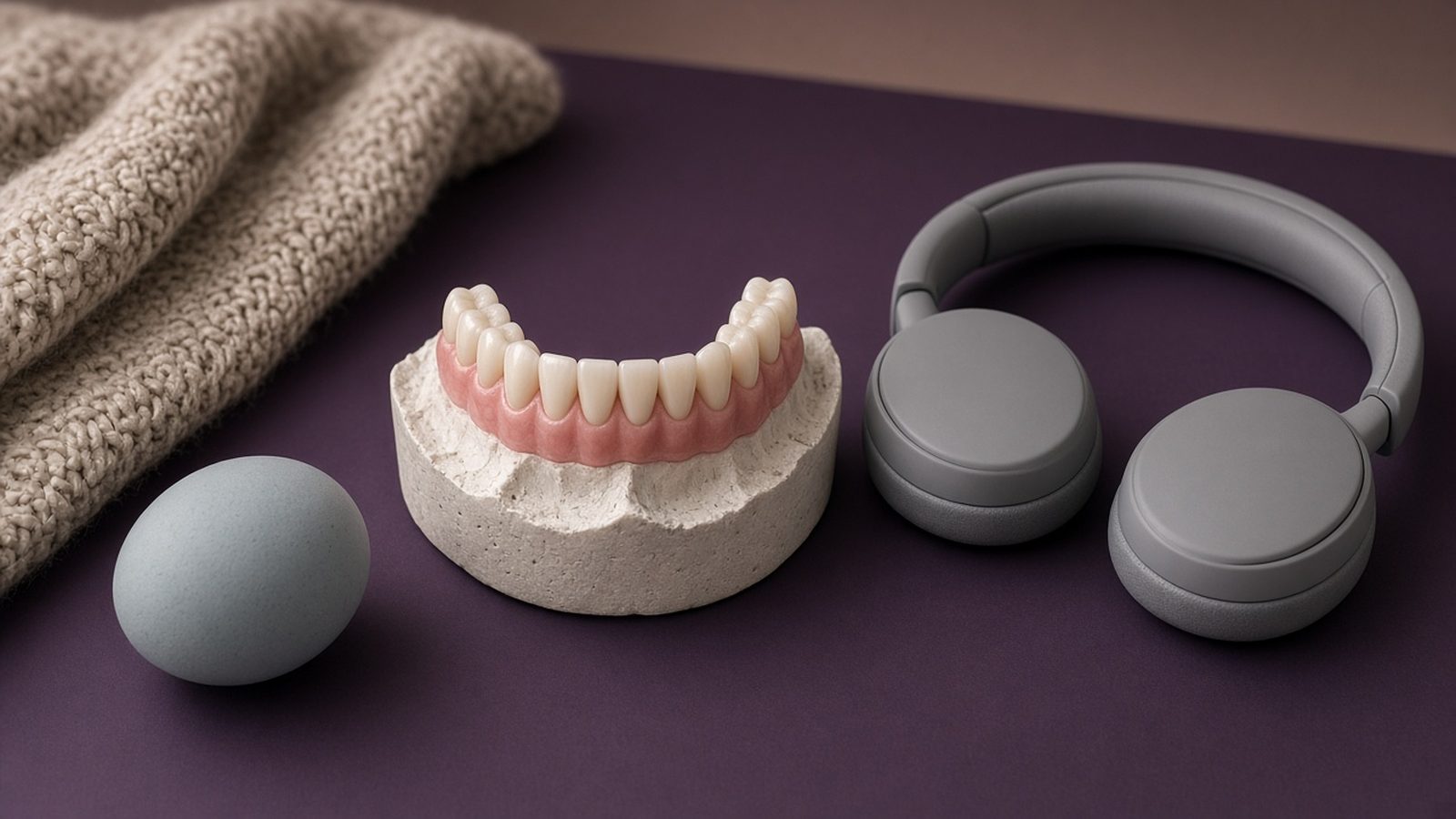
- Distract and breathe. Headphones with music or an audiobook, something to hold in your hands, slow counted breathing and relaxing one muscle group at a time.
- Bring someone, and book early. A support person in the waiting room, and a morning appointment so there is less time to dwell on it.
A qualitative review of patient experiences, published in 2024 in Community Dentistry and Oral Epidemiology, found the same themes from the patient side: trust in the team, information shared at the right time, and a sense of control and choice all helped patients feel less anxious.
Making the first call
You do not need to explain every year you stayed away. A short, honest sentence is enough to start.
Some people find it easier to write down what they want to say before they call. For example:
- "I have not been to a dentist in a long time, and I am nervous about it."
- "My teeth are in bad shape and I am embarrassed. I would like to understand my options."
- "I am afraid of needles and gagging. What will happen at the first visit?"
Useful things to ask on that call: how long the consultation takes, what happens at it, whether a scan is taken that day, whether you can bring someone with you, and whether you will be asked to decide anything that day. A consultation is for information. Agreeing to a consultation is not agreeing to treatment.
How our Katy team approaches nervous patients
Our team plans each stage with you before surgery, uses 3D imaging and digital records, offers local anesthesia, IV sedation and general anesthesia, and makes sure you leave surgery day with teeth.
At Regional Implant Centers, care follows our RISE Protocol. The prosthodontist plans your bite, facial support, speech and the long-term design of your teeth before surgery, the oral surgeon builds the foundation, an anesthesiologist focuses on your comfort and monitoring during surgery, and our lab team shapes the teeth. For patients who are anxious, that planning means fewer surprises: you can see your 3D scan, hear what the surgery involves and know what the temporary and final teeth will be before the day comes.
A few specifics about how we work:
- Both our Katy and Hutto offices have a mobile CBCT and offer traditional dentures, snap-on implant overdentures and fixed full-arch teeth (All-on-X). If fixed teeth are not the right fit for you, there are other options.
- Our surgical team includes Dr. Enrique Tabarini, an oral and maxillofacial surgeon, and Dr. Dan Holtzclaw. Bone grafting and sinus lifts are done when needed, and zygomatic and pterygoid implants are an option in some cases with severe upper bone loss. No one can promise that every case can be treated with fixed teeth.
- Anesthesia options are local anesthesia, IV sedation and general anesthesia, managed by an anesthesiologist. See our anesthesia and patient comfort page.
- Every patient leaves surgery day with temporary teeth.
- Final arches are full monolithic zirconia or titanium-reinforced, made with support from our in-house lab at the Katy office and delivered about 1 to 4 months after surgery.
- A typical case takes 4 to 5 total visits.
- We give a 1-year warranty, and extended maintenance packages are available.
None of this replaces an exam. Your plan, including the anesthesia plan, is set after your consultation, health history review and imaging.
Questions to ask at your consultation
- What will happen at each visit, and which visits involve sedation or anesthesia?
- How will you take records if I gag easily?
- Can we agree on a stop signal for every visit?
- Which anesthesia option do you suggest for my surgery, and why?
- Can any of my teeth be kept, and what are the alternatives to full-arch treatment for me?
- What will my temporary teeth be like, and when will the final arch be delivered?
- What happens if I feel pain or panic after I get home?
- How often will I need maintenance visits afterward, and what do they involve?
Insurance and financing
Some full-arch plans include surgical services that medical insurance may help with, but coverage is never guaranteed.
At Regional Implant Centers, medical insurance is billed only for surgical professional services, such as extractions, bone grafting and alveoloplasty. Implants, temporary teeth and the final prosthesis are billed to the patient separately. Out-of-network oral surgery benefits only work with PPO plans. If you have a PPO plan with oral surgery coverage, it is worth checking with our Insurance Advantage team, and please verify your benefits with your plan. For how medical insurance can apply, see medical insurance for the oral surgery parts of full-arch treatment. For what shapes the overall investment, see our full-mouth dental implant cost factors for Houston. Financing is available through third-party lenders, subject to approval.
Getting to our Katy office
Our Katy office serves patients from across west Houston and Fort Bend County.
Our Houston-area office is at 707 S Fry Rd, Ste 150, Katy, TX 77450, and patients come from Houston, Cypress, Sugar Land, Richmond, Fulshear and the Memorial area. If you are weighing the drive, our article on full-mouth dental implants for Sugar Land, Fulshear and Cypress patients covers what to expect. For more about the office and full-arch treatment there, see our Katy location page and full-mouth dental implants in Katy. Our second office is in Hutto, near Austin.
Frequently asked questions
Can I be sedated for full-arch implant surgery if I have dental anxiety?
Comfort planning is part of every full-arch surgery plan. At Regional Implant Centers the options are local anesthesia, IV sedation and general anesthesia, with an anesthesiologist handling anesthesia and monitoring. Whether sedation or general anesthesia fits you depends on your health history and the surgery, and it is decided with you before surgery day.
Will I be awake for any part of full-arch treatment?
Usually, yes. The consultation, 3D scan, records, try-ins, delivery of the final arch and maintenance visits are typically done awake. Knowing what each visit involves, agreeing on a stop signal and telling the team about your fear can make those visits easier.
I have not been to a dentist in years. Will I be judged?
Dental fear and long gaps between visits are common. One large review estimated that about 15% of adults have dental fear and anxiety. Tell the team when you call that it has been a while and that you are nervous. You do not need to explain every year.
Does sedation cure dental anxiety?
No. Sedation helps you through a procedure, but it does not treat long-standing fear. Cognitive behavioral therapy has the strongest research support for reducing long-term dental anxiety, and it can be done alongside implant planning.
Do I have to decide on treatment at the consultation?
No. A consultation is for information: an exam, imaging, your options and a written plan. You can take the plan home, ask questions and decide when you are ready.
Take the first step at your own pace
If fear has kept you from the dentist, the first step can be a short conversation. Consultations at Regional Implant Centers cost $25. To schedule a consultation, call (832) 632-7037 and let us know you are nervous, or book online for our Katy office. You can also start at our main scheduling page.
Sources & Resources
- Silveira ER, Cademartori MG, Schuch HS, Armfield JM, Demarco FF. Estimated prevalence of dental fear in adults: a systematic review and meta-analysis. Journal of Dentistry. 2021.
- Armfield JM, Stewart JF, Spencer AJ. The vicious cycle of dental fear: exploring the interplay between oral health, service utilization and dental fear. BMC Oral Health. 2007.
- Steenen SA, Linke F, van Westrhenen R, de Jongh A. Interventions to reduce adult state anxiety, dental trait anxiety, and dental phobia: a systematic review and meta-analyses of randomized controlled trials. Journal of Anxiety Disorders. 2024.
- Geddis-Regan A, Fisal ABA, Bird J, Fleischmann I, Mac Giolla Phadraig C. Experiences of dental behaviour support techniques: a qualitative systematic review. Community Dentistry and Oral Epidemiology. 2024.
- Cleveland Clinic. Dentophobia (fear of dentists).
- American Dental Association, MouthHealthy. Anxiety: 3 ways to stop fearing the dentist and Anesthesia and sedation.
This article is general patient education. It is not medical or dental advice, a diagnosis or a treatment plan. Your options can only be set after an exam and imaging. Not every patient is a candidate for dental implants or fixed full-arch teeth. If dental fear is affecting your sleep or daily life, talk with your doctor or a mental health professional. Insurance coverage varies by plan and is never guaranteed; please verify your benefits with your plan.
Ready to Learn What Is Possible?
Schedule a consultation with Regional Implant Centers.
Schedule ConsultationFrequently Asked Questions
Can I be sedated for full-arch implant surgery if I have dental anxiety?
Comfort planning is part of every full-arch surgery plan. At Regional Implant Centers the options are local anesthesia, IV sedation and general anesthesia, with an anesthesiologist handling anesthesia and monitoring. Whether sedation or general anesthesia fits you depends on your health history and the surgery, and it is decided with you before surgery day.
Will I be awake for any part of full-arch treatment?
Usually, yes. The consultation, 3D scan, records, try-ins, delivery of the final arch and maintenance visits are typically done awake. Knowing what each visit involves, agreeing on a stop signal and telling the team about your fear can make those visits easier.
I have not been to a dentist in years. Will I be judged?
Dental fear and long gaps between visits are common. One large review estimated that about 15% of adults have dental fear and anxiety. Tell the team when you call that it has been a while and that you are nervous. You do not need to explain every year.
Does sedation cure dental anxiety?
No. Sedation helps you through a procedure, but it does not treat long-standing fear. Cognitive behavioral therapy has the strongest research support for reducing long-term dental anxiety, and it can be done alongside implant planning.
Do I have to decide on treatment at the consultation?
No. A consultation is for information: an exam, imaging, your options and a written plan. You can take the plan home, ask questions and decide when you are ready.
This content is educational and not a substitute for a consultation.