Dentures vs Fixed Teeth
Immediate Dentures or All-on-4 When Your Teeth Must Come Out: A Guide for Dallas-Fort Worth Patients
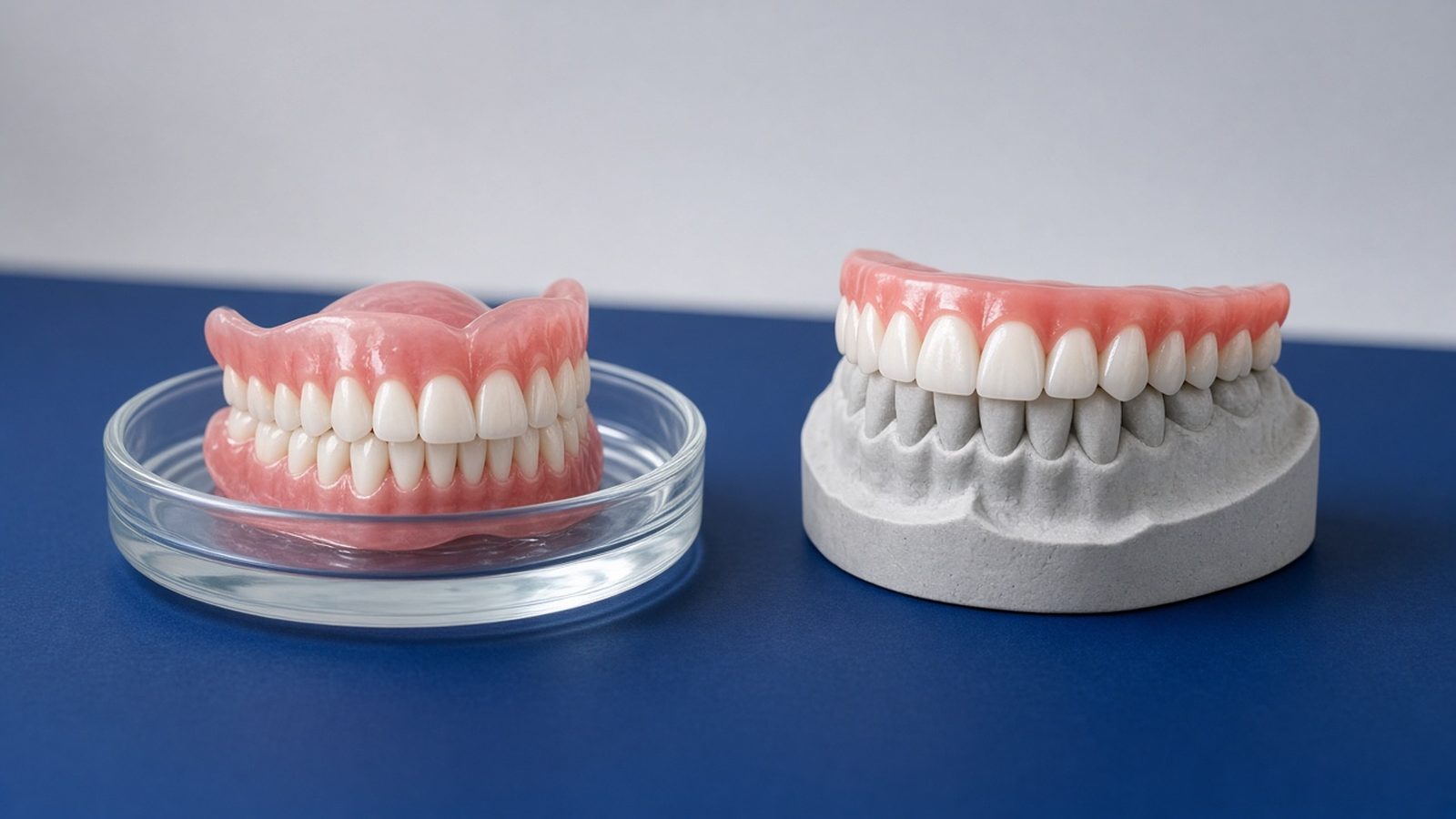
How immediate dentures and same-day All-on-4 teeth compare when your teeth must come out, plus a middle path, for Dallas-Fort Worth area patients.
If you live in Dallas, Fort Worth, Plano, Frisco, Arlington, Irving or McKinney and a dentist has told you that your remaining teeth cannot be saved, you are probably weighing two very different ways to leave the extraction appointment with teeth: an immediate denture or same-day fixed teeth on implants, such as All-on-4. Both are sometimes called "teeth in a day." They are not the same thing, they do not age the same way, and they lead to very different next few years. This guide compares immediate dentures vs All-on-4 for people who still have teeth today, explains what happens in each path after the extractions, and covers a third option many people overlook: starting with a denture and moving to implants later.
Regional Implant Centers does not have an office in the Dallas-Fort Worth area. DFW patients who choose implant treatment with us travel to our offices in Hutto, near Austin, or Katy, near Houston, so one of these paths can usually be handled close to home and the other involves several trips. If you are still deciding whether a drive makes sense, start with our article on full-mouth dental implants from Dallas-Fort Worth. If your teeth are failing from heavy decay, see our article on severe tooth decay and dental implants for DFW patients.
The short answer
An immediate denture is a removable plate of teeth placed the day your teeth are extracted. It rests on healing gums and needs adjustments and relines, then a definitive reline or a new denture once healing settles. Same-day fixed teeth with All-on-4 or All-on-X are a temporary bridge attached to implants placed in the same surgery; it stays in, and a final arch follows after healing. Dentures mean less surgery and a smaller upfront investment. Fixed teeth need enough bone and good enough health for implant surgery. A denture now and implants later is a third path. Which fits you can only be settled after an exam and a 3D scan.
Two kinds of "same-day teeth"
Both paths can give you teeth on extraction day. The difference is what holds them in place: your gums, or implants in your jawbone.
An immediate denture is made before your teeth come out, from impressions and bite records of your mouth as it is now, and it goes in right after the extractions. Cleveland Clinic describes a full denture as resting on the gums and relying on the palate or the lower jaw ridge for support, sometimes with adhesive. An upper denture usually covers the roof of the mouth.
With All-on-4 or All-on-X, the extractions, any bone reshaping and the implants happen in one surgery, and a temporary full-arch bridge is attached to the implants. Cleveland Clinic calls this an implant-supported or fixed denture and notes that only your dentist can remove it.
When an ad promises "teeth in one day," ask which one it means. Our article on same-day teeth versus final teeth explains why same-day implant teeth are still temporary.
What happens to your mouth after the teeth come out
Whichever path you choose, the jaw changes shape after extractions, quickly at first and then more slowly. That is why immediate dentures need relines and why final implant teeth are made later.
A systematic review of human studies by Tan and colleagues found that six months after extraction, the bony ridge had lost about 29 to 63 percent of its width and 11 to 22 percent of its height, with the fastest change in the first three to six months. The gums settle along with it.
For an immediate denture, the plate that fit on day one sits on a ridge that keeps shrinking. The FOR.org treatment guideline on immediate dentures says they need to be relined, or even remade, as healing and bone loss progress, and that a definitive reline is often done 6 to 9 months after extraction. For fixed implant teeth, the same change is why the first bridge is temporary: the final arch is made after the implants fuse with the bone and the gums settle.
Over the longer term, Cleveland Clinic notes that the jawbone gradually shrinks after tooth loss, which can change facial support. Dentures do not stop that process.
The immediate denture path, step by step
Expect records before extractions, extraction day, several adjustment visits in the first weeks, relines during healing, then a definitive reline or a new denture.
- Records before extractions. Impressions, bite measurements and tooth shade and shape are chosen while your teeth are still in place.
- Extraction day. The teeth come out and the denture goes in, acting like a bandage over the sockets.
- The first weeks. Expect sore spots and short adjustment visits. Cleveland Clinic notes that getting used to dentures can take weeks or months; FOR.org warns that chewing and speech may feel awkward for days or weeks.
- Healing months. Soft temporary liners help keep the fit reasonable while the ridge changes.
- Reline or replace. Once healing settles, the denture is relined with a long-lasting material or a new conventional denture is made.
- The long run. Cleveland Clinic puts the average life of a denture at about 7 to 10 years, with a reline every one to two years or whenever the fit changes.
One trade-off is easy to miss. Because your teeth are still in place when it is made, an immediate denture usually cannot be tried in first, so FOR.org notes the look and function can be less predictable than a conventional denture that goes through a trial fitting. A 2025 systematic review of immediate complete dentures concluded that results depend on a well-defined protocol, gentle surgery and regular follow-up to keep the bite height and patient satisfaction on track.
None of this makes an immediate denture a poor choice. It is a well-established way to avoid going without teeth; it is simply a removable appliance on a changing foundation.
The same-day fixed path, step by step
With All-on-4 or All-on-X, most of the work happens before and during one surgery, followed by healing months in temporary fixed teeth and then final teeth.
- Consultation and 3D scan. A cone beam CT scan shows the bone around your failing teeth, the sinuses and the lower-jaw nerve, and decides whether implants can go in on extraction day.
- Planning. Your teeth are designed first and the implants are planned around that design. Medical clearance, gum infection or a staged graft can add time.
- Surgery day. Extractions, planned bone reshaping, implants and a temporary fixed bridge, usually under sedation or general anesthesia.
- Healing. Soft foods first, follow-up checks and the temporary bridge while the implants fuse with the bone.
- Final teeth and upkeep. The final arch is attached once healing allows, followed by regular cleanings and checks; see our article on All-on-4 cleaning and maintenance.
Attaching teeth to implants the day they are placed is called immediate loading. A systematic review by Papaspyridakos and colleagues pooled 62 studies of fixed full-arch bridges, covering 2,695 patients and 13,653 implants. When cases were selected carefully and rough-surface implants were used, immediate loading gave implant and bridge survival similar to waiting, with estimated one-year implant survival above 99 percent for all approaches. The authors cautioned that many factors affect results, and most studies required firm implant stability at placement. Same-day fixed teeth are well studied, but they depend on a case that supports them. For a visit-by-visit view, see our article on how long All-on-4 takes.
Immediate dentures vs All-on-4 side by side
The biggest practical differences are whether the teeth come out at night, what holds them in place, how much surgery is involved and how much upkeep follows.
The table below compares the two paths in general terms. It is not a prediction for any one person.
| Question | Immediate denture | Same-day fixed teeth (All-on-4 or All-on-X) |
|---|---|---|
| What holds the teeth | Gums and palate, sometimes adhesive | Implants in the jawbone |
| Removable at home | Yes, taken out to clean and usually overnight | No, only the dental team removes it |
| Surgery | Extractions | Extractions, bone reshaping as needed and implant placement |
| Needs enough bone for implants | No | Yes, or an alternative such as grafting or other implant types |
| Roof of the mouth (upper) | Usually covered | Usually left open |
| Early fit changes | Relines and adjustments while the ridge shrinks | Temporary bridge worn while implants heal, then a final arch |
| Later upkeep | Relines every one to two years and replacement over time | Professional cleanings, checks and occasional repairs |
| Upfront investment | Lower | Higher |
| Where DFW patients can get it | Many local dentists | Specialty full-arch teams, including our Hutto and Katy offices |
Cost is part of almost every decision like this. Our article on the cost of dentures vs implants over time compares the long-run drivers without listing prices, and our article on budgeting for full-arch implants from DFW adds travel, time off and lodging.
The middle path: a denture now, implants later
Some people start with an immediate denture and add implants months later, either to snap the denture in place or to move to fixed teeth. It buys time, but it is not a free pause.
This can make sense when the teeth need to come out soon but you are not ready, medically or financially, for implant surgery, or when you want to see how you do with a denture first. FOR.org notes that people facing total extractions can choose anything from an immediate denture to several implant-supported options, and that a soft liner can let an immediate denture be worn over healing implant parts.
What you gain is time to heal, save or decide, a real trial of removable teeth and a simpler first surgery. What it can cost you:
- Bone. The ridge keeps changing. If months or years pass, the bone that could have held implants on extraction day may be thinner, and a graft or a different implant approach may come up. Our article on bone grafts for All-on-4 explains when that happens.
- Two phases of work. A denture phase and then an implant phase, with two surgeries instead of one and more visits overall.
If you go this way, ask whoever extracts your teeth to plan the extractions with future implants in mind, and whether a 3D scan beforehand would help.
Snap-on overdentures as the destination
A snap-on implant overdenture is a removable denture that clicks onto a few implants; Cleveland Clinic notes these typically offer more stability than traditional dentures. For the lower jaw, a meta-analysis of randomized trials by Emami and colleagues found people rated implant overdentures more satisfying than new conventional dentures at a clinically meaningful level, though the size of the benefit varied and the effect on quality-of-life scores was less certain.
If you later want fixed teeth instead, our article on moving from a snap-on denture to fixed teeth explains why overdenture implants are not always enough for a fixed bridge. For all three options side by side, see All-on-X vs implant dentures vs traditional dentures.
Upper and lower jaws often lead to different answers
Many people manage an upper denture better than a lower one, so the two arches sometimes end up with different plans.
An upper denture can use the broad roof of the mouth for suction. A lower denture rests on a narrower ridge with the tongue moving around it, which is why the lower jaw is where many people struggle and where the overdenture research above is strongest. Some people choose fixed teeth on one arch and a denture or overdenture on the other. Our article on upper vs lower full-arch implants covers those differences, and our article on loose dentures covers fixes for a denture that stops fitting.
Who tends to lean one way or the other
An immediate denture often fits when implant surgery is not advisable yet, when bone would make same-day implants unpredictable, or when removable teeth suit your life and budget. Fixed teeth tend to suit people who do not want removable teeth and who have the bone, health and readiness for implant surgery and upkeep.
A denture is usually the option you can start nearest home, and because early adjustments mean several short visits, a skilled local dentist or prosthodontist may be the most practical choice. People who lean toward fixed teeth often want teeth that do not move when they eat or speak, an open palate and no adhesive. Those are reasonable goals, not guarantees, and fixed teeth bring their own daily cleaning and professional maintenance. Not every patient is a candidate for implants or fixed full-arch teeth, and some candidates still prefer a denture.
Health matters to both paths. If you have heart disease or diabetes, or take blood thinners or bone medications, the surgeon may ask your physician for input first. Our article on dental clearance before surgery explains how that works.
What the choice means for trips from DFW
An immediate denture can usually be done near home. Fixed teeth with our team mean several trips to Hutto or Katy over a few months, so plan the travel along with the treatment.
From Dallas or Fort Worth, Hutto is roughly a three-hour drive down I-35 and Katy roughly four and a half to five hours. At Regional Implant Centers, a typical full-arch case takes about 4 to 5 total visits, and final arches are usually delivered about 1 to 4 months after surgery, depending on healing. A staged graft or medical steps can add visits. On surgery day you will need someone to drive you, and many travelers plan to stay nearby the first night rather than drive home the same day.
If you may want fixed teeth, get a full-arch evaluation before extractions are scheduled, so the extractions and implants can be planned together.
How our team approaches this decision
We look at your bone, your health and your goals first, and we discuss all three options: dentures, snap-on overdentures and fixed full-arch teeth.
- Specialist planning. Under our RISE Protocol, a prosthodontist maps your bite, facial support, speech and long-term plan before surgery, the oral surgeon handles implants and bone reconstruction, and an anesthesiologist is responsible for comfort and monitoring.
- 3D imaging at both offices. Hutto and Katy both have mobile cone beam CT, which shows whether there is enough bone for implants on extraction day.
- All three options at both offices. Hutto and Katy both offer traditional dentures, snap-on implant overdentures and fixed full-arch teeth.
- Bone work and advanced options. We perform bone grafting and sinus lifts, including at our Hutto office. When the upper jaw has little bone, zygomatic and pterygoid implants may be options with Dr. Dan Holtzclaw and Dr. Enrique Tabarini; see our article on zygomatic implant surgery for DFW patients.
- Anesthesia choices. Local anesthesia, IV sedation and general anesthesia, provided by an anesthesiologist, in a very safe surgical facility with the highest standards of care. See our anesthesia and comfort page and our article on IV sedation vs general anesthesia.
- Teeth the same day. On the day of full-arch implant surgery, every patient leaves with teeth. Those teeth are temporary.
- Final teeth. Full monolithic zirconia or titanium-reinforced arches, usually delivered about 1 to 4 months after surgery, depending on healing. Our article on zirconia vs acrylic full-arch teeth explains the materials.
- Lab and aftercare. Our in-house dental lab is at the Katy office. We give a 1-year warranty, and extended maintenance packages are available for long-term care.
If a denture, an overdenture or a staged plan fits you better, or your case is better handled elsewhere, we will say so. No one can promise that every case can be treated with fixed teeth.
Questions to ask before your teeth come out
Bring these to any consultation, with us or with a dentist in DFW.
- Is the plan an immediate denture, an implant overdenture or fixed teeth, and why that one for me?
- Does my 3D scan show enough bone for implants on extraction day, in both jaws?
- With an immediate denture, how many adjustment and reline visits should I expect in the first year?
- If I may want implants later, how will the extractions protect that option, and how long can I wait?
- With fixed teeth, what are the temporary and final arches made of, and when is the final delivered?
- What happens if an implant does not heal or my denture stops fitting?
- Which anesthesia options do you offer, and who provides them?
- How many visits will this take, and which can be handled close to home?
A note on insurance and financing
Insurance rarely decides this choice on its own, but it is worth checking before you commit. At Regional Implant Centers, medical insurance is billed only for surgical professional services, such as extractions, bone grafting and alveoloplasty. Implants, temporaries, dentures and final bridges are billed to the patient separately. Only PPO plans work for out-of-network oral surgery benefits, and most BCBS PPO plans with oral surgery coverage are worth checking, please verify with your plan. We cannot bill Federal Employee Program (FEP) Blue Cross Blue Shield plans. Our Insurance Advantage team reviews dental and medical benefits and explains estimated out-of-pocket costs, but coverage is never guaranteed. See our insurance experts page and our article on whether insurance covers All-on-4 for DFW patients. Financing through independent third-party companies is available, subject to each provider's approval.
Visiting our offices from Dallas-Fort Worth
DFW patients come to one of our two offices:
- Hutto (Austin area): 201 E Wilco Hwy, Suite 203, Hutto, TX 78634. See our Hutto location page.
- Katy (Houston area): 707 S Fry Rd, Suite 150, Katy, TX 77450. See our Katy location page and our Katy full-mouth dental implants page.
For most DFW patients Hutto is the shorter drive. Katy is home to our in-house lab. Both offices offer dentures, snap-on overdentures and fixed full-arch teeth.
Frequently asked questions
What is the difference between an immediate denture and All-on-4?
An immediate denture is a removable plate of teeth placed the day your teeth are extracted. It rests on your gums and is taken out to clean. All-on-4 places implants during the same surgery and attaches a temporary fixed bridge to them. It stays in, and a final arch is made after the implants heal.
How long do immediate dentures last?
An immediate denture is usually relined or replaced once healing settles, often 6 to 9 months after the extractions. After that, dentures in general last about 7 to 10 years on average and usually need a reline every one to two years, or whenever the fit changes.
Can I get an immediate denture now and implants later?
Often, yes. Implants can later hold a snap-on overdenture or support fixed teeth. The jawbone keeps changing after extractions, though, so waiting can mean a bone graft or a different implant plan later. If you think you may want implants, get a full-arch evaluation before your extractions.
Is All-on-4 better than an immediate denture?
Neither is better for everyone. Fixed teeth do not come out and do not rely on suction, but they need enough bone, good enough health for surgery, a larger investment and regular maintenance. An immediate denture involves less surgery and a lower upfront investment but needs more fit adjustments. An exam and a 3D scan help decide.
Does Regional Implant Centers have an office in Dallas or Fort Worth?
No. Our offices are in Hutto, near Austin, and Katy, near Houston. Many DFW patients choose Hutto because it is the shorter drive. Both offices offer traditional dentures, snap-on implant overdentures and fixed full-arch teeth.
Talk with our team before your teeth come out
The best time to compare an immediate denture with fixed teeth is before the extractions are scheduled. Consultations at Regional Implant Centers cost $25. To schedule a consultation, call (832) 632-7037 or book online for our Hutto office or our Katy office. You can also start at our main scheduling page.
Sources & Resources
- Cleveland Clinic. Dentures.
- FOR.org (Foundation for Oral Rehabilitation). Immediate dentures.
- Tan WL, Wong TL, Wong MC, Lang NP. A systematic review of post-extractional alveolar hard and soft tissue dimensional changes in humans. Clinical Oral Implants Research. 2012.
- Sikri A, Sikri J, Arora N, et al. Immediate complete dentures: a systematic review. Journal of the West African College of Surgeons. 2025.
- Papaspyridakos P, Chen CJ, Chuang SK, Weber HP. Implant loading protocols for edentulous patients with fixed prostheses: a systematic review and meta-analysis. International Journal of Oral and Maxillofacial Implants. 2014.
- Emami E, Heydecke G, Rompre PH, de Grandmont P, Feine JS. Impact of implant support for mandibular dentures on satisfaction, oral and general health-related quality of life: a meta-analysis of randomized-controlled trials. Clinical Oral Implants Research. 2009.
This article is general patient education. It is not medical or dental advice, a diagnosis or a treatment plan. Your options can only be set after an exam and imaging. Not every patient is a candidate for dental implants or fixed full-arch teeth. Insurance coverage varies by plan and is never guaranteed; please verify your benefits with your plan.
Ready to Learn What Is Possible?
Schedule a consultation with Regional Implant Centers.
Schedule ConsultationFrequently Asked Questions
What is the difference between an immediate denture and All-on-4?
An immediate denture is a removable plate of teeth placed the day your teeth are extracted. It rests on your gums and is taken out to clean. All-on-4 places implants during the same surgery and attaches a temporary fixed bridge to them. It stays in, and a final arch is made after the implants heal.
How long do immediate dentures last?
An immediate denture is usually relined or replaced once healing settles, often 6 to 9 months after the extractions. After that, dentures in general last about 7 to 10 years on average and usually need a reline every one to two years, or whenever the fit changes.
Can I get an immediate denture now and implants later?
Often, yes. Implants can later hold a snap-on overdenture or support fixed teeth. The jawbone keeps changing after extractions, though, so waiting can mean a bone graft or a different implant plan later. If you think you may want implants, get a full-arch evaluation before your extractions.
Is All-on-4 better than an immediate denture?
Neither is better for everyone. Fixed teeth do not come out and do not rely on suction, but they need enough bone, good enough health for surgery, a larger investment and regular maintenance. An immediate denture involves less surgery and a lower upfront investment but needs more fit adjustments. An exam and a 3D scan help decide.
Does Regional Implant Centers have an office in Dallas or Fort Worth?
No. Our offices are in Hutto, near Austin, and Katy, near Houston. Many DFW patients choose Hutto because it is the shorter drive. Both offices offer traditional dentures, snap-on implant overdentures and fixed full-arch teeth.
This content is educational and not a substitute for a consultation.