Dentures vs Fixed Teeth
From Snap-On Denture to Fixed Teeth: What Houston-Area Patients Should Know Before Switching
When a snap-on implant denture can become fixed teeth, why two implants are rarely enough, and what Houston-area patients should ask before switching.
If you already wear a snap-on implant denture, you have been through implant surgery once. Now you may be wondering whether you can trade the removable denture for teeth that stay in, and whether the implants you already paid for can carry them. It is a common question for patients in Katy, Cypress, Sugar Land, Fulshear, Richmond and the rest of West Houston. The honest answer is that sometimes the existing implants can be used, sometimes one or two more implants are needed, and sometimes the plan has to start over. This article explains what decides which of those applies to you, what really changes in daily life when you switch, and what to ask before you commit. It is general education, not a diagnosis, and your own answer depends on an exam and 3D imaging.
The short answer
A snap-on denture can often be upgraded to fixed teeth, but only if there are enough healthy implants in usable positions and enough room between your gums and your bite for a thicker, fixed bridge. Many lower snap-on dentures sit on just two implants, and that is rarely enough to hold fixed teeth.
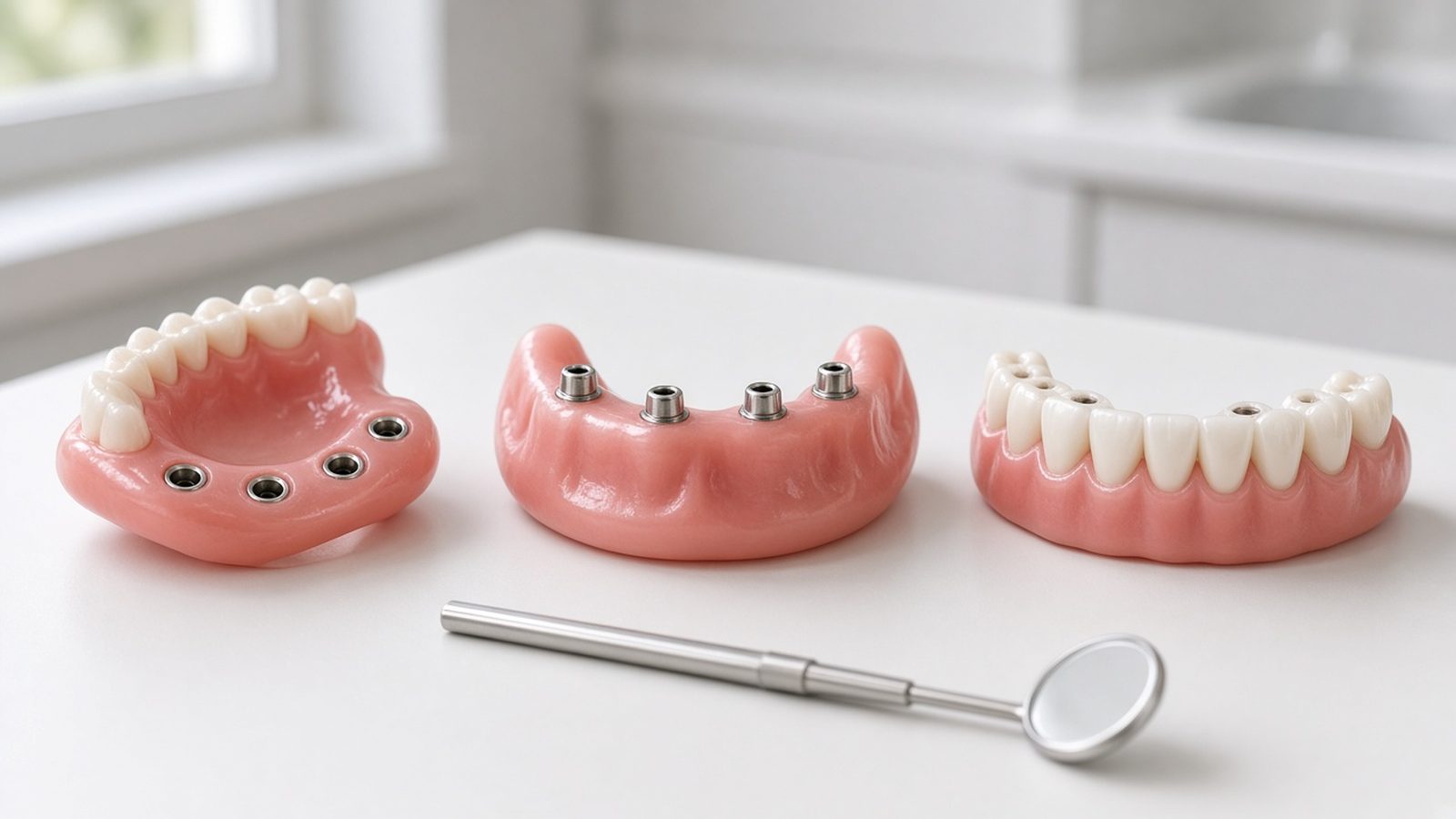
A snap-on denture, also called an implant overdenture, rests on your gums and clips onto implants for retention. A fixed full-arch bridge, often called All-on-4 or All-on-X, rests entirely on the implants and is screwed or locked in so that only your dental team can remove it. Those two designs ask very different things of the implants underneath, which is why an upgrade is not just a matter of making a new set of teeth.
Why two implants that hold a denture may not hold fixed teeth
An overdenture shares the chewing load with your gums and palate. A fixed bridge puts that load on the implants alone, so it usually needs more implants, spread farther apart along the jaw.
The classic lower snap-on denture uses two implants in the front of the jaw. That design has strong research behind it as a step up from a regular denture, because the denture still rests on the gums while the implants keep it from lifting. A fixed bridge has no gum support at all. Every bite, from a lettuce leaf to a steak, goes through the implants and the framework connecting them.
Research on full-arch fixed bridges reflects this. A systematic review by Heydecke and colleagues in Clinical Oral Implants Research looked at fixed full-arch bridges on four to six implants and found high estimated survival of the bridges at five and ten years, in both the upper and lower jaw. The same review said it was unclear whether three implants would do as well. In practice, that means a patient with two implants will usually need at least two more before fixed teeth are an option, and an upper jaw, which tends to have softer bone, may need more.
The upper snap-on denture is a different case again. Upper overdentures are often planned on more implants than lower ones, often with a bar connecting them, so some upper overdenture patients already have four or more implants. Whether those implants are in the right places for a fixed bridge is the next question. Our article on upper vs lower full-arch implants explains why the two jaws are planned differently.
The four things that decide whether your implants can be reused
Before anyone promises to reuse your implants, the team should check four things: how many implants you have, where they sit, how healthy they are, and how much vertical room there is for a fixed bridge.
- Number. As above, fixed full-arch bridges are well documented on four to six implants. Fewer than four usually means adding implants.
- Position and angle. For a fixed bridge, implants need to be spread from front to back so the bridge is supported along its length, and their screw channels need to come out where the teeth will be, not through the front of a tooth or the cheek side. Implants placed for a denture were positioned for a different job, so some line up well for a bridge and some do not.
- Health. Each implant is checked for bone level, gum health around it and any sign of infection around the implant, called peri-implantitis. An implant that has lost a lot of bone may hold a denture clip but be a poor anchor for a fixed bridge. Our article on peri-implantitis treatment explains what that infection is and how it is managed.
- Vertical space. This one surprises most people, so it gets its own section below.
There is also a practical question about parts. Implants come from many manufacturers, and the connecting pieces that a fixed bridge needs have to be available and compatible for your implant system. If your implants were placed somewhere else, bring any records you have, including the implant brand and size if you know them. That can save time and imaging.
The space problem most people have never heard of
A fixed bridge is thicker than the attachment parts of an overdenture. If there is not enough room between the top of your implants and where your teeth need to be, the bridge can be too bulky, too weak or both.
Dental researchers call this restorative space: the distance from the gum or implant up to where your biting surfaces sit. Prosthodontists Swati Ahuja and David Cagna, writing in the Journal of Prosthetic Dentistry, proposed a four-class system for overdenture patients, from 15 mm or more of space down to less than 9 mm. A 2019 review in the Journal of the American Dental Association by Carpentieri, Greenstein and Cavallaro summarized the minimum vertical space different designs need. Unsplinted overdenture attachments needed about 7 mm, a bar overdenture about 11 mm, and a fixed screw-retained hybrid bridge, the type many people picture when they say All-on-4, about 15 mm.
Why does this matter for an upgrade? Overdenture implants are sometimes placed without removing much bone, because the snap-on parts are short. If a fixed bridge needs several more millimeters, the options are to choose a thinner, stronger material where that is suitable, to adjust the bite, or to reshape bone and place new implants deeper. Each has trade-offs, and the right one depends on your face, your lips, your bite and how much bone you have. This is a big reason the upgrade conversation starts with the teeth you want and works backward to the implants, rather than the other way round.
Three realistic paths from snap-on to fixed
Most upgrades fall into one of three paths: reuse every existing implant, keep some and add more, or remove the old implants and start a new full-arch plan.
Path 1: Reuse what you have. If you already have four or more healthy, well-spread implants with enough space above them, a new fixed bridge may be made on the existing implants without more implant surgery. Some attachment manufacturers now sell a fixed version of a common snap-on attachment that is designed to work on the same abutments. Zest, for example, says its LOCATOR Fixed system needs a minimum of four implants and can turn an existing LOCATOR overdenture setup into a fixed bridge without changing the abutments. That is one option among several, and whether any particular system suits your mouth is a clinical decision.
Path 2: Keep and add. This is common for patients with two lower implants. The existing implants are kept if they are healthy and placed where they help, and two or more implants are added farther back. You may wear your current denture, adjusted, while the new implants heal, or you may receive temporary fixed teeth if the implants are stable enough. Same-day teeth are always temporary teeth, and not everyone qualifies for them. Our article on same-day temporary teeth vs final teeth explains the difference.
Path 3: Start again. Sometimes the existing implants are failing, sit too high for a fixed bridge, or are in positions that would force a poorly shaped bridge. Removing them, letting the area heal or grafting it, and placing new implants in better positions can be the more predictable choice, even though no one wants to hear it. Our article on whether a failing implant can be saved or should be replaced covers how that decision is made.
No path is right for everyone. A useful question to ask any office is which path they recommend for you and why the other two are not a better fit.
What actually changes day to day when you switch
Studies comparing the two designs generally find that patients rate fixed teeth higher for stability and ease of chewing, and rate overdentures higher for ease of cleaning. Both are large improvements over a regular denture.
A 2022 meta-analysis in the Journal of Prosthetic Dentistry by Borges and colleagues pooled ten clinical trials of people with no lower teeth. Fixed bridges scored better on several quality-of-life measures, including functional limitation and physical pain, and on satisfaction with comfort, chewing, retention and stability. Ease of cleaning was the one area where overdentures came out ahead. Clinical measures such as implant survival and bone loss did not differ significantly between the two.
A 2023 review in Clinical Oral Implants Research by Abou-Ayash and colleagues, covering 28 studies and 1,457 patients, found that both designs produced large improvements in how patients rated their mouths, with no significant overall difference between them. Stability was the one area rated clearly higher with fixed teeth. An earlier review by Yao and colleagues for the International Team for Implantology also found mixed results overall, with several studies agreeing that overdentures were easier to keep clean.
Put plainly, here is what patients who switch usually notice:
- No more taking teeth out. The fixed bridge stays in day and night. There is no clip to wear out, no denture in a cup and no plate to remove before bed.
- Less movement when chewing. Even a well-fitting snap-on denture can rock slightly on the gums with hard or sticky foods. A fixed bridge does not rest on the gums.
- Often less coverage of the mouth. Many fixed upper bridges leave the palate uncovered, which some people find changes how food tastes and feels.
- Cleaning becomes a different skill. You cannot rinse a fixed bridge at the sink. Food and plaque collect underneath it, and you clean there with a water flosser, special floss or small brushes. People with limited hand strength or dexterity should weigh this carefully. Our guide to cleaning and maintaining All-on-4 teeth shows what daily care involves.
- Professional removal visits. Because you cannot take the bridge out, the team removes it at maintenance visits to clean and inspect the implants and parts.
Some patients who are satisfied with their snap-on denture have no strong reason to switch. Others find the movement, sore spots or clip replacements frustrating enough that fixed teeth are worth the extra planning. Both are reasonable decisions.
Who may be better off staying with a snap-on denture
A snap-on denture may still be the better choice for people who need to clean easily, who have limited bone and do not want more surgery, or whose health makes another surgical phase a bigger risk.
Situations where staying with an overdenture, or improving the one you have, is often worth discussing include:
- Arthritis, tremor or other conditions that make cleaning under a fixed bridge difficult.
- Significant bone loss where reaching fixed teeth would mean grafting or advanced implant techniques that you would rather avoid. Our article on severe lower jaw bone loss explains those options.
- Medical conditions or medications that raise the risk of more surgery. These need a conversation with your physician and the surgical team.
- Lip and facial support that depends on the pink acrylic flange of a denture. A fixed bridge can be designed with gum-colored material too, but the team needs to show you how your face will be supported before you decide.
Sometimes the simpler fix is a new or relined overdenture, new clips, or an extra implant to steady a denture that rocks. Our article on options for loose dentures in Katy walks through those smaller steps.
How we plan an upgrade at our Katy office
At Regional Implant Centers, an upgrade starts with the prosthodontist deciding where your new teeth should be, then the team checks whether your current implants can support that plan.
Under our RISE Protocol, the prosthodontist maps out your bite, facial support, speech and the long-term plan for your new teeth before surgery begins. At our Katy office that includes Dr. Polyxeni Konti, our prosthodontist. The digital planning team then uses 3D CBCT imaging and scans to look at the bone around each implant, its angle and position, and the space above it. Our SegMark Workflow aligns CBCT imaging, intraoral scans, bite information, facial references and restorative goals into one digital plan, and denture conversion is one of the situations it was designed for.
If implants need to be added or replaced, our oral surgeons do that work, and both of our offices offer traditional dentures, snap-on implant overdentures and fixed full-arch teeth, so your choice is not limited to one type of treatment. For patients whose upper jaw bone is too thin for standard implants, RIC also offers zygomatic and pterygoid implants, performed by Dr. Dan Holtzclaw and Dr. Enrique Tabarini, when they are appropriate.
Our in-house dental lab is at the Katy office. Technicians there work beside the surgical and restorative team, and being able to see you in person helps them refine tooth shape, shade, lip support and smile line. After implants are in place, photogrammetry can be used to record their exact positions to help the final bridge fit passively. If your current implants were placed elsewhere, we evaluate them like any others: on their health, position and compatibility, not on where they came from.
Our Katy office is at 707 S Fry Rd Ste 150, Katy, TX 77450, and serves Katy, Cypress, Sugar Land, Fulshear and nearby communities. Hours are Monday through Thursday, 8 to 5, with Fridays reserved for surgeries. Patients coming from Sugar Land, Fulshear or Cypress can read our article on planning care at the Katy office.
Questions to ask before you switch
The right questions turn a vague upgrade quote into a plan you can compare. Ask these at any consultation, including ours.
- How many of my current implants can be used, and why not the others?
- Is there enough vertical space for a fixed bridge, and if not, how will you create it?
- Do my implants have compatible parts for the bridge you are proposing?
- Which path is this: reuse, keep and add, or start again? Why not the other two?
- What will I wear while new implants heal, and will I have temporary fixed teeth?
- What material will my final bridge be made from, and why that one for my bite? Our article on zirconia vs acrylic full-arch teeth explains the trade-offs.
- How will I clean under it, and how often will it be removed for maintenance?
- What does the written estimate include, and what is billed separately?
Insurance, financing and long-term care
Insurance may help with some surgical parts of an upgrade, such as extractions or bone grafting, but implants, the bridge and temporary teeth are billed to the patient. Coverage is never guaranteed.
When a medical plan helps with treatment at RIC, it is for surgical professional services. Non-surgical parts, including the implants, the prosthesis and temporaries, are billed to the patient separately. Only PPO plans work for our out-of-network oral surgery benefits, and RIC cannot bill Federal Employee Program (FEP) Blue Cross Blue Shield plans. If you have a PPO plan with oral surgery coverage, it is worth checking whether it may help with the surgical part of your upgrade, but please verify your benefits with us and your carrier before you decide. Our Insurance Advantage team reviews dental and medical benefits and explains estimated out-of-pocket costs, and our insurance disclaimer explains why no estimate is a guarantee.
We do not publish prices for upgrades, because the cost depends on how many implants are reused, added or replaced, whether grafting is needed and which bridge material is chosen. Our article on what affects the cost of full-mouth implants in Houston lists those factors. Before treatment, you receive a detailed plan outlining recommended care, estimated insurance benefits, financing options and your expected out-of-pocket investment. Financing is available through independent third-party companies, and approval and terms are set by each provider.
Fixed teeth also change your long-term care. RIC does not offer a traditional implant warranty. After your final bridge is delivered, ongoing protection comes through a required Maintenance Package, and enrollment must begin within 30 days of delivery. Our implant warranty page explains what that covers and what it does not, such as trauma, smoking, grinding without a night guard or missed maintenance visits.
Frequently asked questions
Can my snap-on denture be converted into fixed teeth?
Sometimes. It depends on how many implants you have, where they are, how healthy they are and how much vertical space there is for a fixed bridge. Many lower snap-on dentures sit on two implants, which is usually not enough for fixed teeth on its own, so more implants are often added.
How many implants do I need for fixed teeth instead of a snap-on denture?
Fixed full-arch bridges are well documented on four to six implants per jaw. The exact number depends on your bone, your bite and which jaw is being treated. Upper jaws often need more support than lower jaws because the bone tends to be softer.
Can I keep wearing my snap-on denture while new implants heal?
Often, yes. The denture can usually be adjusted so it does not press on new implants while they heal. Some patients receive temporary fixed teeth on the day of surgery instead, if their implants are stable enough. Same-day teeth are always temporary, and not everyone qualifies.
Are fixed teeth harder to clean than a snap-on denture?
Yes, for most people. A snap-on denture comes out and can be cleaned at the sink. A fixed bridge stays in, so you clean underneath it with a water flosser, floss or small brushes, and the team removes it at maintenance visits. Studies consistently rate overdentures as easier to clean.
Will insurance pay to switch from a snap-on denture to fixed teeth?
At RIC, the implants, bridge and temporaries are billed to the patient, not to insurance. A PPO medical plan with oral surgery coverage may help with surgical services such as extractions or bone grafting. It is worth checking, but please verify your benefits, because coverage is never guaranteed.
Talk with our Katy team about upgrading your snap-on denture
If you wear a snap-on denture in Katy, Cypress, Sugar Land, Fulshear, Richmond or anywhere in West Houston and you are curious whether fixed teeth are realistic for you, start with an evaluation of the implants you already have. Bring your current denture and any records from the office that placed your implants. If you come in, you will have a clinical exam, 3D imaging when indicated, and a written plan with estimated insurance benefits, financing options and your expected out-of-pocket investment before anything begins. Qualified patients receive a complimentary consultation, CBCT scan and insurance benefits evaluation. Schedule a consultation by phone or in person at our Katy office, or call (832) 632-7037. Austin-area patients can book with our Hutto office.
Sources & Resources
- Heydecke G, Zwahlen M, Nicol A, et al. What is the optimal number of implants for fixed reconstructions: a systematic review. Clinical Oral Implants Research. 2012.
- Ahuja S, Cagna DR. Classification and management of restorative space in edentulous implant overdenture patients. Journal of Prosthetic Dentistry. 2011.
- Carpentieri J, Greenstein G, Cavallaro J. Hierarchy of restorative space required for different types of dental implant prostheses. Journal of the American Dental Association. 2019.
- Borges GA, Barbin T, Dini C, et al. Patient-reported outcome measures and clinical assessment of implant-supported overdentures and fixed prostheses in mandibular edentulous patients: a systematic review and meta-analysis. Journal of Prosthetic Dentistry. 2022.
- Abou-Ayash S, Fonseca M, Pieralli S, Reissmann DR. Treatment effect of implant-supported fixed complete dentures and implant overdentures on patient-reported outcomes: a systematic review and meta-analysis. Clinical Oral Implants Research. 2023.
- Yao CJ, Cao C, Bornstein MM, Mattheos N. Patient-reported outcome measures of edentulous patients restored with implant-supported removable and fixed prostheses: a systematic review. Clinical Oral Implants Research. 2018.
- Zest Dental Solutions. LOCATOR Fixed (manufacturer product information).
This article is general patient education and is not a diagnosis or treatment plan. Whether existing implants can support fixed teeth depends on an individual clinical exam and imaging, and some patients need additional or replacement implants or are better served by a removable option. Insurance coverage is never guaranteed, and financing is provided by independent third-party companies. Regional Implant Centers has offices in Katy and Hutto, Texas. Outcomes vary, and implant treatment is not appropriate for every patient.
Ready to Learn What Is Possible?
Schedule a consultation with Regional Implant Centers.
Schedule ConsultationFrequently Asked Questions
Can my snap-on denture be converted into fixed teeth?
Sometimes. It depends on how many implants you have, where they are, how healthy they are and how much vertical space there is for a fixed bridge. Many lower snap-on dentures sit on two implants, which is usually not enough for fixed teeth on its own, so more implants are often added.
How many implants do I need for fixed teeth instead of a snap-on denture?
Fixed full-arch bridges are well documented on four to six implants per jaw. The exact number depends on your bone, your bite and which jaw is being treated. Upper jaws often need more support than lower jaws because the bone tends to be softer.
Can I keep wearing my snap-on denture while new implants heal?
Often, yes. The denture can usually be adjusted so it does not press on new implants while they heal. Some patients receive temporary fixed teeth on the day of surgery instead, if their implants are stable enough. Same-day teeth are always temporary, and not everyone qualifies.
Are fixed teeth harder to clean than a snap-on denture?
Yes, for most people. A snap-on denture comes out and can be cleaned at the sink. A fixed bridge stays in, so you clean underneath it with a water flosser, floss or small brushes, and the team removes it at maintenance visits. Studies consistently rate overdentures as easier to clean.
Will insurance pay to switch from a snap-on denture to fixed teeth?
At RIC, the implants, bridge and temporaries are billed to the patient, not to insurance. A PPO medical plan with oral surgery coverage may help with surgical services such as extractions or bone grafting. It is worth checking, but please verify your benefits, because coverage is never guaranteed.
This content is educational and not a substitute for a consultation.