Research & Evidence-Based Dentistry
Titanium Allergy and Full-Arch Dental Implants: What the Research Shows for Houston and Katy Patients
Titanium implant reactions are documented but rare. Here is what research says about allergy testing, ceramic implants and what to tell your team.
If cheap earrings or a belt buckle have given you a rash, it is fair to ask whether you could react to dental implants too. Titanium allergy and dental implants is a common worry among adults in Katy, Cypress, Sugar Land, Fulshear and West Houston weighing full-arch treatment. Online answers swing from "it is a myth" to "metal implants make people sick." The research sits in between.
This guide covers what full-arch implants are made of, how often titanium reactions show up in studies, why allergy tests help less than people expect, what the evidence says about ceramic implants, and what to tell your team. For the bigger picture on long-term results, see our companion article on what full-arch implant research actually shows.
The short answer
Reactions to titanium dental implants are documented but rare. In the largest clinical study, about 0.6% of implant patients tested positive, and reviews still call the link between titanium and allergic symptoms uncertain.
Most people who worry about a metal allergy can be evaluated for implants in the usual way, and a known nickel or other metal allergy is worth reporting so materials can be reviewed. Routine allergy testing before implants is not recommended unless you have a history of metal reactions, and even then the tests have real limits. Ceramic (zirconia) implants exist, but research on them for full-arch bridges is still thin. The most useful step is a detailed history: tell the team about every reaction you have had, and let the plan be built around that.
What a full-arch implant is actually made of
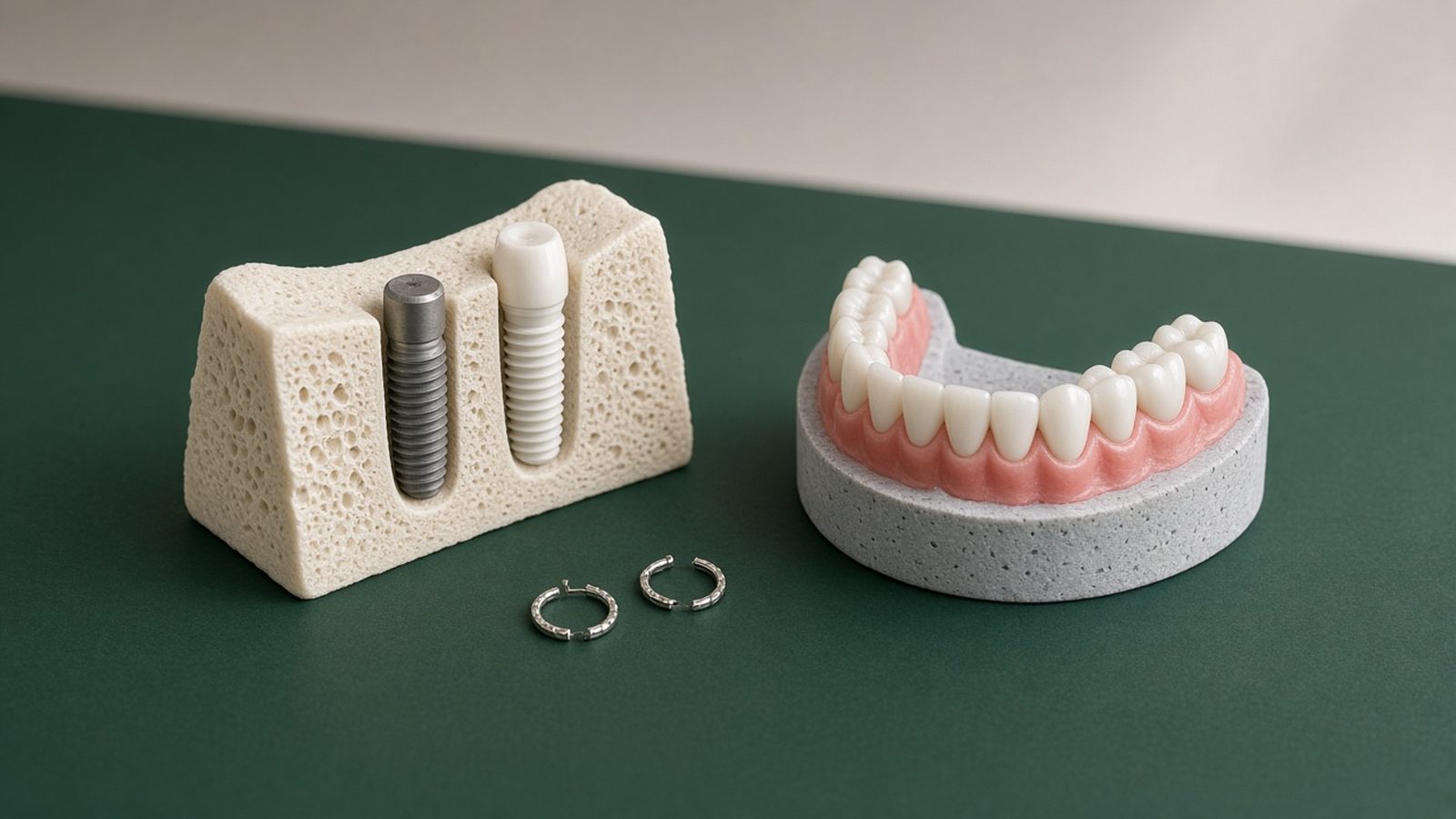
A full-arch implant plan has several layers: implants in the bone, connectors called abutments, small screws, and the bridge of teeth on top. Each layer can be a different material.
The U.S. Food and Drug Administration describes a dental implant system as an implant body in the jaw, an abutment that comes up through the gum, and often a screw joining the two. The FDA notes that most systems are made of titanium or zirconium oxide, sometimes titanium alloys or other materials, and that biocompatibility testing checks that body contact does not cause irritation or allergic reactions.
In full-arch treatment, the parts usually look like this:
| Layer | What it does | Common materials in full-arch care |
|---|---|---|
| Implant body | Anchors in the jawbone | Titanium or titanium alloy in most published full-arch protocols; ceramic (zirconia) implants exist |
| Abutment | Connects the implant to the bridge | Usually titanium or titanium alloy |
| Screws | Hold the bridge to the abutments | Usually titanium alloy |
| Temporary bridge | Same-day teeth while you heal | Usually a tooth-colored acrylic-type resin |
| Final bridge | Your long-term teeth | At our centers, full monolithic zirconia or titanium-reinforced |
So "metal allergy" questions are not only about the implant body. The 2022 German S3 guideline on titanium hypersensitivity, an expert consensus guideline, notes that other metals and impurities in alloys, abutments and bridges also need to be considered when someone reacts. A monolithic zirconia bridge has no metal framework, while a titanium-reinforced bridge has a titanium core for added strength. Neither changes what the implants themselves are made of.
How common is titanium allergy in implant patients?
Studies that went looking for it found it in a small fraction of patients, and most of the evidence comes from case reports and small groups.
The study most often quoted comes from a clinic in Spain that reviewed 1,500 consecutive implant patients from 2002 to 2004 and tested 35 of them: people with allergy-like symptoms or unexplained implant failures, and people with other risk factors such as past allergies. Nine of the 1,500 tested positive to titanium, about 0.6%. Eight of the nine already had symptoms, and five had unexplained implant failures. The authors called the estimated prevalence low.
A 2013 systematic review found only seven usable studies, with mixed findings, and concluded that titanium's role as a cause of allergic reactions in implant patients "remains unproven."
A 2026 systematic review in the Journal of Prosthodontic Research searched through July 2025 and found only nine qualifying studies out of 1,761 records, mostly case reports, covering 21 patients and 33 titanium implants. Of 20 diagnosed hypersensitivity cases, 17 had the implant removed and three were managed by replacing the abutment. The authors called titanium hypersensitivity rare but clinically relevant.
Put plainly: it is real enough that a good team asks about it, and uncommon enough that it should not, by itself, steer most people away from implants. With small studies and tests that disagree, no one can give you a precise risk.
Allergy, or something else? Why researchers now say "intolerance"
Much of the recent research suggests that problems around titanium implants are less often a classic allergy and more often inflammation triggered by tiny particles worn off the implant surface.
A classic metal allergy, like a nickel rash from jewelry, is a delayed immune reaction driven by T cells. A 2022 systematic review of titanium testing concluded that the evidence points elsewhere. Titanium forms a stable oxide layer within moments of meeting air, which makes a classic allergy to pure titanium unlikely. The authors reported strong evidence that titanium problems around implants come from nonspecific inflammation, with immune cells reacting to very small particles.
A 2025 review in the Journal of Dental Research describes titanium particles released into the gum pocket around implants and links them, together with the bacteria there, to peri-implantitis, the infection and bone loss that can develop years after treatment. The FDA's 2019 report on metal implants notes that oral biofilm and the weakly acidic mouth can contribute to corrosion of titanium alloys, and that while titanium in dental implants has generally been considered inert, literature reviews suggest possible adverse reactions.
Much of this is still lab research, but the takeaway is practical: clean gums and regular maintenance guard against the most common implant problem. Our article on peri-implantitis treatment explains what that infection looks like and how it is handled.
Symptoms people worry about, and what usually causes them
Reported titanium reactions include facial redness, eczema-like rashes, swollen or overgrown gum tissue and implants that fail to integrate. Each of these has more common explanations that need to be ruled out first.
A 2020 scoping review of 52 papers lists the signs described in the dental literature: facial redness and eczema, contact dermatitis, blistering rashes, and swollen or overgrown gum tissue around the implant. It also notes that people already diagnosed with allergies to other metals appear more likely to react to titanium. The difficulty is that almost every one of those signs has a more ordinary cause:
- Red, swollen or bleeding gums around an implant are most often caused by plaque and infection, such as peri-implant mucositis or peri-implantitis.
- An implant that loosens early can fail because of infection, smoking, uncontrolled diabetes or heavy bite forces, several of which the FDA lists among implant risks.
- A rash on the face or lips can come from cosmetics, toothpaste flavorings, medicines or other contact allergens.
- Soreness under a temporary bridge is common during healing and usually settles with adjustments.
That is why the German S3 guideline tells clinicians to let clinical signs, especially local inflammation with poor bone healing, lead the decision rather than an allergy test. If something feels wrong after implant treatment anywhere, get it examined. Our guide to failed All-on-4 implants and whether they can be saved covers how teams sort out the cause.
Should you get an allergy test before implants?
For most people, no. Allergy specialists say patch testing before dental implants is not indicated unless you have a history of metal reactions, and the tests available for titanium give inconsistent results.
In a 2024 Ask the Expert answer from the American Academy of Allergy, Asthma and Immunology (AAAAI), an allergist wrote that patch testing before dental implants is not indicated unless the patient has a history of metal-associated contact dermatitis, that a family history alone is not a significant risk factor, and that implants are typically titanium alloys that may contain trace amounts of other metals. The dental research points the same way:
- Skin patch tests check for a delayed allergy on the back or arm over several days. The 2022 testing review found titanium results inconsistent, partly because titanium dioxide does not pass easily through skin.
- Blood tests such as the lymphocyte transformation test (LTT) and MELISA measure how white blood cells react to metals in a lab. Their reliability was also inconsistent.
- The German S3 guideline recommends against testing "just in case" before implants. The testing review adds that patch testing may still help when a reaction to other metals in alloys or bridges is suspected.
Your history still matters. If a dermatologist or allergist has confirmed a metal allergy, bring the report; if it is unclear, your team may suggest seeing an allergist first. What the research discourages is tests unlikely to change the plan.
What about ceramic or "metal-free" implants?
Zirconia implants are an option with encouraging early results for single teeth and small bridges, but the evidence for them under full-arch bridges is limited and less predictable.
Ceramic implants are made from zirconia, the same family of material used in many final bridges. A 2023 systematic review in Clinical Oral Investigations found only two randomized trials comparing them with titanium, covering 100 zirconia and 99 titanium implants. One-year survival was similar; the authors called for longer trials.
For larger restorations, a 2025 review in The Journal of Prosthetic Dentistry pooled 13 studies with 737 zirconia implants. Those supporting bridges of three or more teeth had 93.2% survival at about 45 months on average, while those supporting overdentures had 69.5% survival at about 12 months, with wide variation. The authors supported zirconia implants for small bridges in lower-load areas and called overdenture results less predictable.
Professional views differ. The American College of Prosthodontists' patient FAQ says there is no such thing as truly "metal-free" teeth, that titanium allergy is extremely rare and that there are currently no proven alternatives to titanium implants. The German S3 guideline says ceramic implants can be considered when a titanium-particle reaction with poor bone healing is suspected.
For full-arch cases, most of the long-term research behind fixed bridges uses titanium implants, and data on ceramic implants under a full arch are thin. If ceramic implants come up in any consultation, ask how much evidence exists for that design in a case like yours.
A note on the final bridge
At our centers, final arches come in full monolithic zirconia or titanium-reinforced designs, chosen around your bite and the space available. Our zirconia vs. acrylic guide compares final materials. If metal is a concern, say so early.
What to tell your team before full-arch treatment
The most useful thing you can bring is a specific history: what you reacted to, what happened, who diagnosed it and when.
| If this applies to you | What the evidence suggests | What to bring or say |
|---|---|---|
| Rash from jewelry, watch backs, belt buckles or jeans snaps | Commonly linked to nickel; people with other metal allergies may be more prone to react to titanium, though true titanium reactions remain rare | Describe the reaction and any diagnosis; bring a patch-test report if you have one |
| A confirmed metal allergy from a dermatologist or allergist | Patch testing can be useful for metals in alloys and bridges, less so for titanium itself | The report listing the specific metals |
| A past dental implant that failed without a clear reason | Unexplained failures were overrepresented among positive tests in the largest study | Records, X-rays or the name of the office that placed it |
| No reactions, but a family member had one | A family history alone is not a significant risk factor, according to the AAAAI answer | Mention it; it is still part of your history |
| Allergies to medicines, latex or antibiotics | Separate from metal, but important for surgery and anesthesia | A full allergy list with the reaction for each |
Our guide to surgery day at the Katy office explains what else to have ready.
If you already have implants and suspect a reaction
Do not try to sort it out alone and do not stop maintenance. Get the area examined so infection, bite problems and loose parts can be checked first.
Most problems around existing implants turn out to be infection, a loose screw, bite overload or trapped food. In the few documented titanium reactions, treatment ranged from replacing an abutment to removing the implant. Removal is a surgical decision with real tradeoffs, so it should follow a careful workup, not a test result alone.
If your implants were placed elsewhere, try to get your records, including the implant brand and model, which the FDA recommends every implant patient keep. Our article on loose or broken All-on-4 bridges covers what to do before an appointment.
How our Katy team approaches material and allergy questions
Your history is reviewed alongside a 3D scan and a full planning workup, and the people who design your teeth are in the same building.
The RISE Protocol brings oral surgeons, prosthodontists, anesthesiologists and in-house lab specialists together under one roof. For someone with a metal or allergy history, that usually means:
- Your history of reactions to metals, medicines and dental materials is reviewed before anything is planned.
- A 3D CBCT scan checks bone, sinuses and hidden infection. Both our Katy and Hutto offices have a mobile CBCT, and the scan and an insurance benefits check are included in the $25 consultation.
- The prosthodontist and our in-house lab at Katy go over final bridge options with any material concerns on the table.
- The surgeon and anesthesiologist review allergies that affect surgery day. We offer local anesthesia, IV sedation and general anesthesia, and surgery happens in a very safe surgical facility with the highest standards of care.
Every patient leaves with same-day temporary teeth. Final arches are delivered in about 1 to 4 months, depending on healing, and a typical case takes 4 to 5 total visits. When bone is thin, RIC does sinus lifts and bone grafting, and for severe upper-jaw bone loss, zygomatic and pterygoid implants are performed by Dr. Enrique Tabarini. Not everyone is a candidate for implants, and for some people a well-made denture or snap-on overdenture is the better fit. Final teeth come with a 1-year warranty, and extended maintenance packages are available. Our cleaning and maintenance guide covers daily care.
Visiting our Katy office from Houston, Cypress, Sugar Land or Fulshear
Our Katy office is at 707 S Fry Rd, Suite 150, Katy, TX 77450, near I-10, and it is home to our in-house lab.
It is open Monday through Thursday, 8 AM to 5 PM, with Fridays reserved for surgery. Our guide for Sugar Land, Fulshear and Cypress patients covers the drive and visit planning, and the Katy location page has a map and booking link. Austin-area patients can be seen at our Hutto office. Bring any allergy or patch-test reports to your first visit.
Insurance notes, without promises
When medical insurance applies, it typically covers surgical professional services such as extractions, bone grafting and alveoloplasty. Implants, temporary teeth and the final prosthesis are billed to the patient. Please verify your own benefits.
Only PPO plans are relevant for RIC's out-of-network oral surgery benefits, and Federal Employee Program (FEP) Blue Cross Blue Shield plans cannot be billed. If you have a PPO plan with oral surgery coverage, the surgical portion may be worth checking with your plan; that is not a guarantee, so please verify. Our article on medical insurance for oral surgery in Houston explains how claims work, and financing options are available. This article does not list treatment prices beyond the $25 consultation.
Questions to bring to your consultation
- Given my allergy history, do you recommend I see an allergist before surgery, or is my history enough to plan?
- What materials are the implants, abutments and screws in my plan made of, and can I have the brand and model for my records?
- Which final bridge, monolithic zirconia or titanium-reinforced, fits my bite, and does my metal history change that?
- What signs after surgery should make me call right away, and what is normal healing?
- How will maintenance visits check the gums and bone around my implants over the years?
Frequently asked questions
Can you be allergic to titanium dental implants?
Yes, but it is rare. In the largest clinical study, about 0.6% of 1,500 implant patients tested positive, mostly people who already had symptoms or unexplained implant failures. Newer research points more toward particle-driven inflammation than a classic allergy.
Should I get tested for a titanium allergy before dental implants?
Usually not. Allergy specialists say patch testing before implants is not indicated unless you have a history of metal reactions, and the available titanium tests give inconsistent results. If you have a known metal allergy, bring the report and ask your team whether a visit with an allergist makes sense first.
I am allergic to nickel. Can I still get full-arch implants?
Often, yes. A nickel allergy is not a titanium allergy. People with other metal allergies may be somewhat more likely to react to titanium, and implant alloys, abutments or bridges can contain trace amounts of other metals, so tell the team and bring any test results so the materials can be reviewed.
Are zirconia (ceramic) implants better for people with metal allergies?
They are an option some clinicians use, especially when a titanium reaction is suspected, and short-term results for single teeth are similar to titanium. For full-arch bridges the evidence is limited, and a 2025 review found less predictable results under overdentures. Ask how much evidence exists for the exact design proposed for you.
What are the signs of a reaction to a dental implant?
Reported signs include facial redness or rash, swollen or overgrown gum tissue around an implant, and implants that do not bond to the bone. These are far more often caused by infection or healing problems, so get any of them examined promptly.
Talk with our Katy team about your history
If a metal allergy or past reaction has kept you from looking into implants, a careful history and a 3D scan are a good place to start. Bring your allergy records and questions, and we will go through the options with you.
Schedule your $25 consultation, which includes a CBCT 3D scan and an insurance benefits check, at /schedule-consultation or call (832) 632-7037. Learn more about how the centers are led on Jeffry Tobon's team page.
Sources & Resources
- U.S. Food and Drug Administration. Dental Implants: What You Should Know. https://www.fda.gov/medical-devices/dental-devices/dental-implants-what-you-should-know
- U.S. Food and Drug Administration, Center for Devices and Radiological Health. Biological Responses to Metal Implants, September 2019. https://www.fda.gov/media/131150/download
- Sicilia A, Cuesta S, Coma G, et al. Titanium allergy in dental implant patients: a clinical study on 1500 consecutive patients. Clinical Oral Implants Research, 2008. https://pubmed.ncbi.nlm.nih.gov/18705814/
- Javed F, Al-Hezaimi K, Almas K, Romanos GE. Is titanium sensitivity associated with allergic reactions in patients with dental implants? A systematic review. Clinical Implant Dentistry and Related Research, 2013. https://pubmed.ncbi.nlm.nih.gov/21414135/
- Restelli L, Uriarte X, Moreno X, et al. Titanium hypersensitivity in dental implants: a systematic review of updated clinical evidence and diagnostic strategies. Journal of Prosthodontic Research, 2026. https://pubmed.ncbi.nlm.nih.gov/41581901/
- Muller-Heupt LK, Schiegnitz E, Kaya S, et al. Diagnostic tests for titanium hypersensitivity in implant dentistry: a systematic review of the literature. International Journal of Implant Dentistry, 2022. https://pmc.ncbi.nlm.nih.gov/articles/PMC9276909/
- Muller-Heupt LK, Schiegnitz E, Kaya S, et al. The German S3 guideline on titanium hypersensitivity in implant dentistry: consensus statements and recommendations. International Journal of Implant Dentistry, 2022. https://pmc.ncbi.nlm.nih.gov/articles/PMC9633908/
- Comino-Garayoa R, Cortes-Breton Brinkmann J, Pelaez J, et al. Allergies to Titanium Dental Implants: What Do We Really Know about Them? A Scoping Review. Biology, 2020. https://pmc.ncbi.nlm.nih.gov/articles/PMC7698636/
- Kotsakis GA, Ganesan SM. Microbial Dysbiosis, Titanium Release, and Peri-implantitis. Journal of Dental Research, 2025. https://pmc.ncbi.nlm.nih.gov/articles/PMC12310141/
- Padhye NM, Calciolari E, Zuercher AN, et al. Survival and success of zirconia compared with titanium implants: a systematic review and meta-analysis. Clinical Oral Investigations, 2023. https://pmc.ncbi.nlm.nih.gov/articles/PMC10630218/
- Monteiro CGJ, de Oliveira Silva AM, de Almeida DCF, et al. Clinical outcomes of zirconia implants supporting multi-unit and complete arch prostheses: a systematic review and meta-analysis. The Journal of Prosthetic Dentistry, 2025. https://pubmed.ncbi.nlm.nih.gov/40781015/
- American Academy of Allergy, Asthma and Immunology. Ask the Expert: Patch testing prior to getting a dental implant, 2024. https://www.aaaai.org/allergist-resources/ask-the-expert/answers/2024/dental
- American College of Prosthodontists. Frequently Asked Questions about Dental Implants. https://www.gotoapro.org/dental-implants-faq/
Disclaimer
This article is for education only. It is not a diagnosis, a treatment plan or a promise that any treatment will work for every patient. Not every patient is a candidate for full-arch implants. Only a clinical examination, appropriate imaging and a review of your health and allergy history can determine what fits your situation. Allergy diagnosis and testing decisions belong with a qualified allergist or dermatologist. Insurance language here is general; please verify your own benefits.
Ready to Learn What Is Possible?
Schedule a consultation with Regional Implant Centers.
Schedule ConsultationFrequently Asked Questions
Can you be allergic to titanium dental implants?
Yes, but it is rare. In the largest clinical study, about 0.6% of 1,500 implant patients tested positive, mostly people who already had symptoms or unexplained implant failures. Newer research points more toward particle-driven inflammation than a classic allergy.
Should I get tested for a titanium allergy before dental implants?
Usually not. Allergy specialists say patch testing before implants is not indicated unless you have a history of metal reactions, and the available titanium tests give inconsistent results. If you have a known metal allergy, bring the report and ask your team whether a visit with an allergist makes sense first.
I am allergic to nickel. Can I still get full-arch implants?
Often, yes. A nickel allergy is not a titanium allergy. People with other metal allergies may be somewhat more likely to react to titanium, and implant alloys, abutments or bridges can contain trace amounts of other metals, so tell the team and bring any test results so the materials can be reviewed.
Are zirconia (ceramic) implants better for people with metal allergies?
They are an option some clinicians use, especially when a titanium reaction is suspected, and short-term results for single teeth are similar to titanium. For full-arch bridges the evidence is limited, and a 2025 review found less predictable results under overdentures. Ask how much evidence exists for the exact design proposed for you.
What are the signs of a reaction to a dental implant?
Reported signs include facial redness or rash, swollen or overgrown gum tissue around an implant, and implants that do not bond to the bone. These are far more often caused by infection or healing problems, so get any of them examined promptly.
This content is educational and not a substitute for a consultation.